The Research Behind Why Your Child’s Heart and Mind Grow Together
The Quiet Worry Every Singapore Parent Carries About Childcare
There is a silent tension beneath almost every childcare decision made by a thoughtful Singapore parent. It does not announce itself during school tours or show up on comparison checklists. But it is there, persistent and real.
It is the worry that wanting your child to thrive academically, to hit every milestone, to be prepared for the world, somehow means loving them less. The fear that in choosing quality care, you are choosing to be less present. That in trusting someone else with your child’s early years, you are choosing development over attachment, intellect over love.
If you have felt this, you are not alone. And you are not wrong to feel it. But you may be working from a framework that does not reflect what the science actually tells us about how children grow.
This article is about that misunderstanding. And about what happens when we correct it.
The Two Languages We Were Taught to Speak
We live in a culture that has learned to talk about children in two distinct vocabularies. These languages rarely intersect, and this separation is at the root of the anxiety many Singapore parents carry.
The language of love lives in attachment, bonding, emotional regulation, security, and connection. As parents, we have become fluent in this language. We understand that early bonds shape how a child will navigate relationships for life. We have absorbed the research on secure attachment. We know about attunement and responsiveness. We know that being present matters.
The language of learning speaks in milestones and measurements, neural architecture and cognitive development, school readiness and future potential. We have become fluent in this language too. We track growth charts. We celebrate first steps and first words. We understand that the first thousand days are neurobiologically critical.
Here is the problem: these two languages have been separated. We have been taught to treat them as competing priorities, as forces pulling in different directions. Developmental enrichment on one side. Emotional warmth on the other. Parents are left standing in the middle, told they must choose.
What the Science Actually Tells Us
The research does not support this separation. In fact, it points in one clear direction: these are not two different things. They are the same thing, wearing different clothes.
The brain does not separate feeling safe from learning to learn. When a caregiver responds to an infant’s distress with warmth and consistency, something profound is happening beneath the surface. The infant’s brain is not processing the response as emotional comfort alone. It is processing it as data. It is learning that the world is predictable, that needs can be met, that expressing oneself leads to connection rather than abandonment.
This is the beginning of executive function: the foundation of self-regulation, the capacity to focus attention, to manage impulses, to persist at difficult tasks. And it is built in the same moments that build emotional security. There is no separate architecture for feeling safe and another for learning how to learn. The architecture is one.
Security enables exploration, and exploration enables learning. The same attuned response that tells a child they are loved tells their brain that the environment is safe enough to explore. It is in exploration that language develops, problem-solving emerges, and social confidence takes root.
Consider a child who feels emotionally secure. They are free to be curious. They can venture away from their caregiver to investigate something interesting, knowing they can return. They can tolerate the frustration of not understanding something, knowing support is available. They can engage with other children, knowing they have a secure base to return to.
Curiosity is the engine of all learning. And curiosity requires security to run.
Emotional security and developmental milestones are the same outcome, measured from different vantage points. When a child is developing well, they are also feeling secure. When a child feels secure, they are also developing well. Quality caregiving does not ask us to choose between the heart and the mind because they are not separate systems.
The Question That Changes Everything
Now, let me speak directly to the guilt that many Singapore parents carry. The guilt of returning to work. The guilt of needing childcare. The guilt of not being the sole caregiver in those critical early years.
This guilt is real, and it deserves to be honored, not dismissed. But I also want to offer a reframe that may shift how you see your situation.
The question we have been conditioned to ask is: Can someone else provide what my child needs? Can another caregiver give my child the emotional warmth I give? Can they form the same kind of attachment?
The better question is: Can my child have a caregiver who is attuned, consistent, and responsive?
Because if the answer is yes, then your child is not losing something when they enter quality care. They are gaining something. They are gaining a second secure base. They are gaining the knowledge that the world contains people beyond their parents who can meet their needs, who can delight in their curiosity, who can support their growth.
The child who grows up knowing they are deeply loved by their parents and also deeply cared for by a consistent, attuned caregiver does not suffer from divided attention. They benefit from expanded security.
What Quality Childminding Actually Looks Like
If emotional security and developmental growth are truly integrated, then what should you look for when evaluating childcare options? These are the markers of quality that research consistently identifies:
- Responsive attention: Caregivers who notice and respond to your child’s signals promptly and warmly. Not just when something goes wrong, but when they reach, when they smile, when they discover something new.
- Consistency: The same faces, the same routines, the same expectations day after day. Children thrive when they can predict what happens next.
- Individual recognition: Your child is known not as one of many, but as a unique person with a unique temperament, a unique schedule, and a unique set of needs.
- Warm engagement: Caregivers who delight in your child’s discoveries, who celebrate their small victories, who are present not just physically but emotionally.
- Safe exploration support: An environment where your child can venture away knowing they can return, where curiosity is encouraged within safe boundaries.
- Communication with parents: A genuine partnership where you know what is happening, where your observations are valued, where you feel connected to your child’s daily experience.
These are not soft ideals. They are the specific conditions that enable both emotional security and developmental growth to flourish together.
The Concerns You May Still Have
Even with this understanding, questions remain. Let me address the ones that surface most often.
“Will my child form a secure attachment if someone else is caring for them?”
Attachment forms based on the quality of caregiving, not the identity of the caregiver. Children can and do form secure attachments with multiple consistent, attuned caregivers. What matters is that your child has at least one secure attachment. Additional secure attachments expand your child’s sense of the world as a trustworthy place.
“Will my child feel abandoned or rejected?”
Children interpret parental return to work through the lens of the overall care experience. If the care environment is warm, consistent, and responsive, your child learns that parents leave but return, that other caregivers are trustworthy, that the world contains reliable people. This is not abandonment. It is expanding security.
“How do I know quality care when I see it?”
Look for warmth that is genuine, not performed. Look for caregivers who describe your child as an individual, not a category. Look for environments where children are engaged but not rushed, where exploration is encouraged, where crying is met with comfort rather than correction. Ask to see how caregivers respond to distress. Ask how they communicate with parents. Trust your observations.
Where Integration Happens: The EduNanny Approach
EduNanny by BUTLER operates within the ECDA Childminding Pilot, and this designation matters not just as a regulatory category but as a reflection of philosophy. The pilot was designed to recognize something long understood in the research: that home-based and community-based care, when delivered with quality and intention, can offer something that larger centre-based settings often struggle to replicate. Individual attention. Emotional attunement. The consistency of a caregiver who knows your child as a unique person.
The ratio is the attunement. In the infant care model, ratios of up to one caregiver to three infants are maintained. This is not an administrative convenience. It is a deliberate structural choice designed to ensure that every child receives the responsive attention that the science tells us they need.
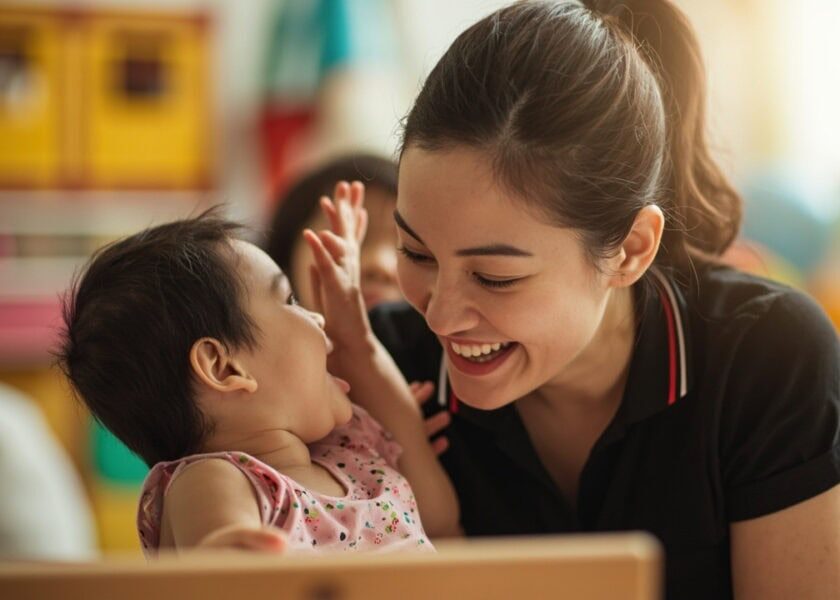
When a child signals, they are seen. When a child reaches, they are lifted. When a child explores, there is someone there to celebrate the discovery. This is integration embedded in structure. The ratio is the attunement. The training is the love. The consistency is the security.
Trust through transparency. Love without trust is incomplete. Parents need to know what is happening when they are not there. EduNanny has implemented communication and transparency measures, including documentation practices and regular updates, so that parents can have confidence in what they cannot see directly. The channel stays open because parental peace of mind is not separate from quality care. It is part of it.
Accessibility for working families. For families navigating the financial realities of quality care, services are structured to remain accessible within the pilot fee frameworks. CDA and Baby Bonus funds can be used, because quality care should not be a privilege reserved for those with unlimited resources. Monday to Friday care blocks provide the consistency that working parents need, with services available across Singapore.
Ongoing support for parents. EduNanny has introduced Thomas, an AI chatbot that serves as a thoughtful companion for parents navigating the complexity of infant care. Thomas does not replace human guidance but offers a new layer of accessibility. When questions arise at 11pm, when concerns surface between pickups, when parents need reassurance that is informed and immediate, Thomas is there.
What to Look For When Choosing Infant Care in Singapore
Here is a practical framework for evaluating childcare options, grounded in what the research tells us about what children actually need:
| What to Observe | Why It Matters |
|---|---|
| Caregiver responsiveness to distress | Shows whether emotional needs are prioritized |
| Individual attention ratios | Determines whether your child can be known as a person |
| Consistency of caregivers | Predictability builds security and trust |
| How children spend their time | Free play and exploration indicate developmental respect |
| Communication practices | Reflects partnership with parents, not separation |
| How caregivers talk about your child | Shows whether your child is seen as an individual |
These are not just boxes to check. They are the specific conditions under which emotional security and developmental growth flourish together. When you find care that meets these criteria, you are not choosing between your child’s heart and their mind. You are providing the conditions for both.
You Do Not Have to Choose
The most important thing I want to leave you with is not about features or frameworks or pilot programs. It is about you. It is about the decision you are making or have made or will someday make.
You are not choosing between loving your child and developing your child. You are not sacrificing their hearts to grow their minds. These are not two paths that diverge. They are one path, and you may already be on it.
Every time you respond to your child’s cry with tenderness, you are building their brain. Every time you marvel at their curiosity, you are nurturing their capacity to learn. Every time you choose care that sees your child as a whole person, you are giving them the gift of integration.
The child who grows up understanding that their emotional world and their intellectual world are not in conflict, that they do not have to choose between feeling deeply and thinking clearly, that they are valued not for what they produce but for who they are, that child begins their life with something rare. They begin it with wholeness.
If you have been carrying the weight of the false choice, I hope this article has given you permission to set it down. You do not have to wonder if love and learning are in conflict. They are not. They never were.
What your child needs, and what quality childminding is committed to providing, is care that holds them securely while they reach for the world. Care that celebrates their milestones not as achievements alone, but as expressions of a child who feels safe enough to grow. Care that sees you, the parent, as a partner in this work, not as someone who has delegated their most important responsibility to someone else.
You are still the parent. You will always be the parent. And what the right care arrangement offers is the recognition that your child can have more than one person who loves them well. That more love, more attention, more attuned care does not divide a child’s heart. It expands it.
That is the integrated child. That is what we are working toward. And that is what every Singapore parent has always deserved: the freedom to stop worrying about the false choice and to simply love their child deeply, develop their child fully, and trust that these two things are not just compatible. They are one.
To learn more about what developmental, emotionally attuned childcare looks like in practice, visit EduNanny Singapore. For questions about enrollment, pilot eligibility, or how childminding works for your family, reach out to the EduNanny team directly.