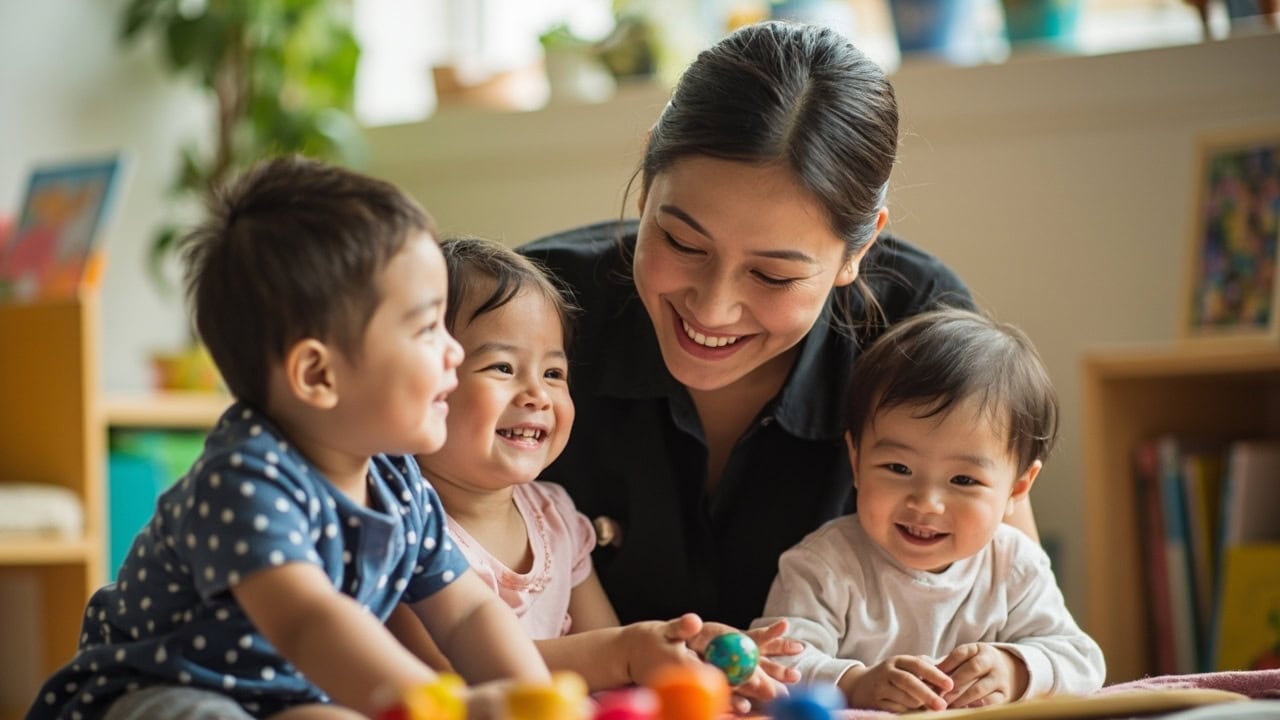
Beyond Supervision: How Singapore Parents Can Tell If Their Child Is Actually Growing
The Question Every Singapore Parent Carries (But Rarely Asks Out Loud)
There is a moment at the end of most Singapore workdays that millions of parents know well. You collect your toddler from childcare. She runs toward you with the particular joy of reunion. You sweep her up, breathe in that familiar smell, and in the brief pause before you ask “how was your day,” something surfaces beneath the relief of seeing her safe.
It is a quieter question. More important than logistics or safety reports. More fundamental than whether she ate well or slept well.
It is this: Is my child actually growing here?
Not just supervised. Not just comfortable. But developing. Building capabilities. Thriving in ways that will matter for the rest of her life.
This question lives beneath the practical considerations of location, cost, and commute. Most parents never voice it because it feels too hard to answer without expertise. So they rely on what they can measure: the clean environment, the qualified staff certificates on the wall, the cheerful photographs. These give peace of mind.
But peace of mind is not the same as informed confidence.
And Singapore parents deserve better tools to answer the question that matters most.
What Thriving Looks Like in Your Child Under Three
Here is where most parents find themselves without a map. You observe your child every day. You know her moods, her preferences, her particular ways of expressing joy or frustration. But observation without a developmental framework is like reading a book in a language you almost understand—you catch fragments, you sense the meaning, but you miss the full texture of what is being communicated.
So let us build that framework together.
1. Emotional Security: The Foundation of Everything
A child who feels safe in a care environment will show it in how she navigates the social world. She will not be without conflict or frustration—these are necessary experiences for learning. But she will have the emotional vocabulary and the underlying trust that allows her to express those feelings and recover from them.
What you might notice: She is beginning to name her emotions. She can move through a moment of upset toward resolution rather than remaining stuck in distress. When she is frustrated, she seeks comfort—and when she receives it, she visibly settles.
This is not a personality trait. It is a developmental achievement. And it happens partly because of the quality of caregiving she receives.
2. Engaged Curiosity: The Drive to Understand
A child who is developing well will show interest in the world around her. She will explore with her senses, manipulate objects with increasing precision, ask questions in the way that toddlers do—with pointing, with reaching, with the particular insistence of a child who has discovered that the world responds to her attention.
What you might notice: She reaches for interesting objects, explores how things work, watches other children with intent rather than fear. In a quality care setting, this curiosity is not left to chance. It is supported by an environment designed for discovery, by caregivers who respond to a child’s interests with materials and interactions that extend learning.
3. Social Competence: Learning to Be With Others
Social development in a child under three looks different from how it looks in an older child or adult. It is not sophisticated friendship yet. It looks like parallel play that is beginning to turn toward genuine interaction. It looks like the beginning of sharing, of turn-taking, of the early negotiations that will eventually become sophisticated social skills.
What you might notice: She watches other children with interest. She initiates small interactions—a touch, a vocalization, a gesture. She is beginning to understand herself as part of a social group, not just alongside others.
4. Language Engagement: The Joy of Being Understood
Language development in the first three years is staggeringly rapid. It happens through interaction. A caregiver who narrates the day, who sings, who responds to a child’s attempts at communication with warmth and expansion—this caregiver is doing essential developmental work, even when it looks like nothing more than conversation.
What you might notice: A growing vocabulary. Emerging sentences. Clear delight in being understood and in understanding others. You may not hear full sentences from a two-year-old, but you will hear the beginnings—the expanding sounds, the purposeful pointing, the clear attempt to communicate meaning.
5. Motor Confidence: The Body as a Tool for Discovery
A thriving toddler is a moving body, and that body is learning what it can do. The coordination, the balance, the sheer joy of physical capability that you see in a child running, climbing, manipulating small objects with her fingers—these are not just physical achievements. They are cognitive achievements. They are the foundations of confident engagement with the world.
What you might notice: She moves with growing confidence—crawling, walking, eventually running and climbing. She manipulates objects with increasing precision, discovering how things fit together, how they respond to her touch.
Why Surface Metrics Are Not Telling You the Full Story
Singapore has built a childcare infrastructure that many countries admire. The regulatory framework is robust. Safety standards are taken seriously. Options have multiplied across centres, home-based arrangements, and hybrid models.
This matters. Safety and access are foundational. No parent should have to choose between their career and the assurance that their child is physically secure.
And yet, with all this investment in options and access, a quiet gap remains. Most conversations about childcare centre on what we might call adult-centric concerns: Will my child be happy? Will I trust these people? Can I manage the logistics?
These are legitimate questions. But they have crowded out a more fundamental one: What is my child’s experience of this care? What is it building in her?
This matters because the first thousand days of life are not a waiting period before formal schooling. They are a period of extraordinary developmental activity. The architecture of language is being laid. The foundations of emotional regulation are forming. The capacity for curiosity, connection, and confident engagement with the world—these begin here, in the quality of attention and responsiveness a child receives in these earliest years.
Here is what many parents discover when they begin to look for these signs: they realize that most of the markers they have been given to evaluate childcare are insufficient.
The clean environment. The qualified staff. The regulated ratios. The cheerful photographs on the website. These things matter—but they do not tell you whether your child is actually developing in this environment. They tell you that the baseline has been met. They do not tell you about depth.
A comfortable child is safe, is fed, is not distressed. These are necessary conditions, but they are not sufficient for development. A growing child is challenged at the appropriate level, is supported through the productive struggle that leads to mastery, is receiving the kind of responsive interaction that builds neural pathways at a rate that will never again be matched in her lifetime.
Quality care is not about entertainment or even about warmth alone. It is about the deliberate cultivation of developmental opportunity in every interaction. This is the distinction that matters most. And this is where most childcare evaluation frameworks fall short.
What Developmental Quality Looks Like in Daily Care
Let us make this concrete. Imagine your end-of-day handover. Most parents experience this as a brief exchange of logistics: what your child ate, how long she slept, whether there were any incidents to report.
A developmentally responsive caregiver will not simply tell you that your child ate well and slept well. They will notice and share specific moments: the way your daughter initiated a game with another child today, the new sound she repeated with delight, the instance when she sought comfort and received it in a way that visibly settled her.
These are not anecdotes for their own sake. They are the evidence of development, made visible through attentive observation.
This is the quality of communication that distinguishes adequate care from developmental care. It is the difference between a report and a narrative. Between logistics and meaning.
How EduNanny Approaches Developmental Quality
EduNanny by BUTLER operates within the ECDA Childminding Pilot, and that pilot designation is not simply a regulatory classification. It represents a specific commitment to a model of care that allows for developmental depth.
When you have a caregiver ratio of up to one to three infants, when caregivers are not managing large groups but attending to a small number of children with focused intention, you create the conditions for the kind of responsiveness that drives development. This is not an accident. It is a design choice, rooted in the understanding that quality in infant care is not about the number of toys or the square footage of the space. It is about the quality of attention a child receives.
In the EduNanny model, whether care takes place in a home-based setting or within a community or centre-based pathway, the emphasis remains consistent: making developmental responsiveness visible and consistent.
This means caregivers are trained not only in safety and logistics but in the science of early development. It means they observe children with intention, tracking the small progressions that reveal a child is building capabilities, not just passing time comfortably. It means parents receive not just updates about meals and naps but meaningful information about their child’s engagement, curiosity, and growth.
EduNanny’s approach is built on the premise that parents deserve this kind of transparency. Where deployed, measures like CCTV provide an additional layer of assurance—not as surveillance but as transparency. A way of building the kind of trust that allows parents to relax into confidence rather than anxiety. The goal is not to watch over caregivers but to create the conditions for the open, honest relationship between parents and caregivers that serves children best.
Developmental quality and logistical accessibility are not in opposition—they must exist together for families. EduNanny operates Monday through Friday, with care blocks designed around the rhythms of working family life. Fees within the pilot structure are designed to be affordable, and for families navigating the financial realities of quality care, the usability of CDA funds and Baby Bonus contributions represents a meaningful acknowledgment that developmental quality should not be accessible only to the wealthy.
Singapore-wide relevance is built into the model because every child in this city deserves the same developmental opportunity, and because Singapore parents deserve access to care that meets this standard.
Questions to Ask in Every Handover Conversation
The good news is that you do not need a degree in child development to begin recognizing quality. There are practical things you can look for in your daily interactions that will give you real information.
- Ask not just what your child ate, but how she ate. What was her mood? Was she engaged with the food and the social experience of mealtime?
- Ask not just whether she napped, but how she went to sleep. Did she settle with comfort? Did she wake refreshed and alert?
- Ask about her language. What words was she using? What was she trying to communicate? How did her caregivers respond?
- Ask about her social world. Who did she play with? How did she handle the inevitable conflicts that arise between toddlers? How did the caregivers support her in those moments?
- Ask about her curiosity. What captured her attention today? What did she explore? How did her caregivers extend that exploration?
These questions will tell you whether you have chosen a care arrangement that is simply adequate or one that is genuinely developmental.
And the answers you receive—or the absence of meaningful answers—will tell you a great deal about the quality of the care you are receiving.
Common Concerns Singapore Parents Have
“Is developmental quality something I can actually evaluate?”
Yes. Instincts can be educated. The more you understand about development, the more clearly you will see it. You do not need to become an expert. You need to learn a few key markers and practice observing through that lens. It is like learning to notice the quality of light in photography—at first it seems abstract, but soon it becomes automatic.
“Isn’t all licensed childcare in Singapore held to high standards?”
Licensing standards establish necessary baselines. They ensure safety, adequate ratios, qualified staff. But baselines are not benchmarks. A care arrangement can meet every licensing requirement and still be developmentally mediocre. The difference between meeting standards and exceeding them through intentional developmental responsiveness—that is the difference this article is helping you see.
“What if I cannot afford premium childcare?”
Developmental quality should not be the exclusive province of the wealthy. This is why the ECDA Childminding Pilot structure, within which EduNanny operates, was designed to make quality care accessible. CDA funds, Baby Bonus contributions, and structured fee frameworks are all part of making this achievable for working families across Singapore.
“How do I know if EduNanny is right for my family?”
The answer lies in what you are actually looking for. If you want more than safety and comfort—if you want care that is deliberately cultivating your child’s developmental potential—then EduNanny’s model is built around that goal. If you are primarily looking for the lowest-cost option or the most convenient location, there may be other choices that serve those specific needs better. But if the question you carry is “is my child actually thriving here?”—then you are asking the right question, and EduNanny structures itself around answering it.
What to Look For: A Quick Reference
| Surface Marker | Developmental Indicator |
|---|---|
| Clean, safe environment | Environment designed for discovery and appropriate challenge |
| Qualified, certified staff | Caregivers trained in developmental observation and responsive interaction |
| Child appears happy | Child shows emotional vocabulary, recovery from distress, secure exploration |
| Regular updates on meals and sleep | Updates include engagement, curiosity, social interaction, language development |
| Age-appropriate toys and materials | Materials extended and rotated based on individual child interests |
| Licensed and regulated | Licensed with intentional design toward developmental depth |
The Question Worth Asking With Everything You Have
You are raising a person whose capacity for the rest of her life is being shaped in these earliest years. The relationships she forms now, the ways she learns to manage emotion, the curiosity that is either nurtured or discouraged, the language she absorbs, the confidence she builds in her own body—these are not trivial concerns. They are the foundations of everything that follows.
The choice you make about who cares for her while you are working, while you are building your own life and your own contribution to this city, is not a choice you make once and then set aside. It is an ongoing relationship. A partnership between your family and the caregivers you choose.
What EduNanny offers is not just a service. It is a commitment to making developmental quality observable, understandable, and consistently present. It is the recognition that Singapore parents are capable of understanding development, that they deserve information that helps them see what is actually happening with their children, and that the best care arrangements are those where parents and caregivers are true partners in a child’s growth.
As you consider your options, look deeper than the surface markers. Look at the children in the care setting—are they engaged, curious, emotionally present? Look at the caregivers—are they observing, responding, extending learning? Look at your own child after a day in care—is she tired in the way that comes from productive growth, or in the way that comes from mere stimulation without purpose?
Trust your instincts, but also trust that instincts can be educated.
The quiet question you carry—your child’s daily experience, her growth, her thriving—is the right question to carry. And it deserves a system that takes it seriously, that structures itself around the answer, that measures success not just in parental peace of mind but in the observable, meaningful development of the children in its care.
EduNanny by BUTLER was built for this. For parents who want more than safety, who want more than comfort, who understand that these early years are not a waiting period but a building period. For caregivers who are not merely watching children but cultivating their potential. For Singapore, a city that invests so much in its people, and that increasingly recognizes that investment must begin at the very start.
Your child is not just going somewhere while you work. Your child is growing. Make sure that growth is happening in a place that understands the difference, and that treats those first thousand days with the seriousness they deserve.
The question you are asking—quietly, hopefully, with all the love that drives you to want the best for your daughter—is the question that good childcare exists to answer.
And it is a question worth asking with everything you have.
If you are considering your childcare options in Singapore and want to learn more about an approach built around developmental responsiveness, we welcome the opportunity to speak with you. You can also read more about EduNanny’s approach or explore how the ECDA Childminding Pilot works.