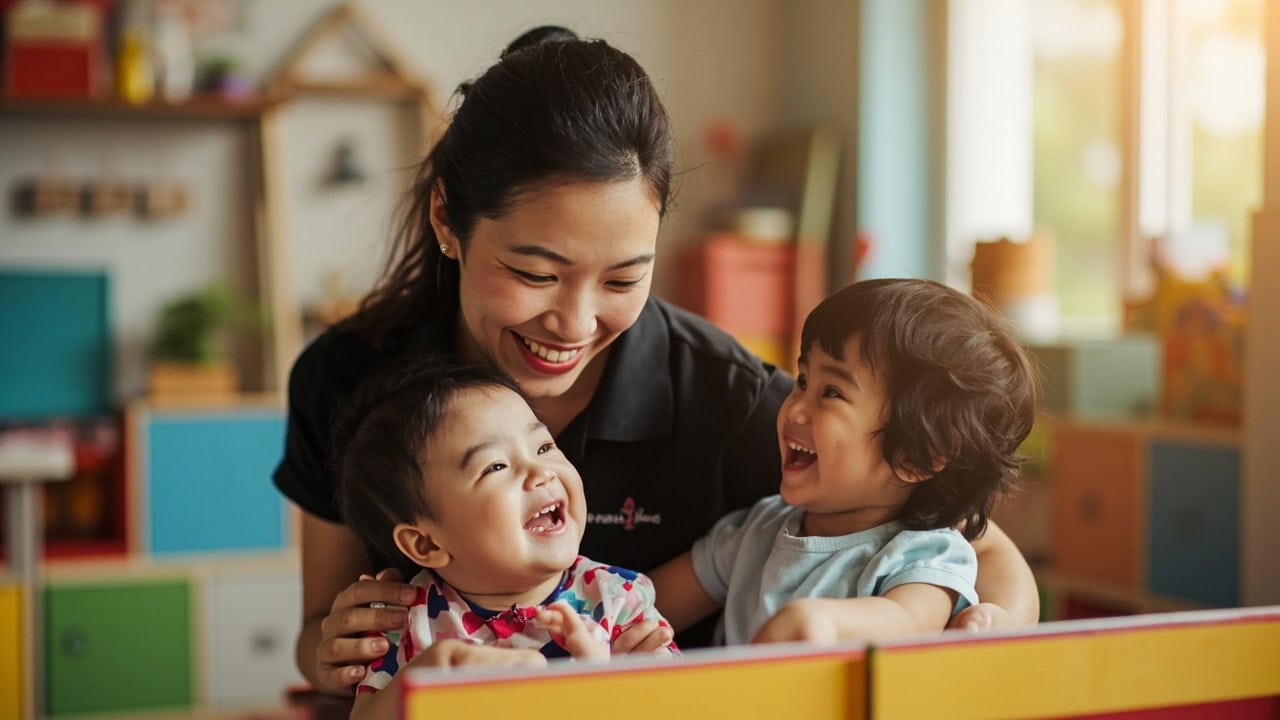
What Quality Infant Care Gives Your Child’s Developing Brain
The Invisible Truth Every Singapore Parent Carries
There is a moment, quiet and familiar, that happens in homes across Singapore more often than anyone admits.
You pick up your child at the end of the day. You scan their face as they emerge from the arms of someone else, searching for what has changed. And sometimes, if you are paying close enough attention, you notice it: a new word they did not have this morning. A way of holding a crayon. A strange confidence in greeting the security guard. A question about something they saw, something you did not show them.
Something happened while you were not there.
You feel it before you can name it. The child who left you eight hours ago is not quite the same child who has returned. Something has been added. Something has been built.
This is not a moment of anxiety or guilt, though you may feel those too. This is a moment of genuine wonder, because your child is revealing something important: they are learning how to be a person in the world, and not all of that learning is happening under your direct gaze.
This is the invisible truth at the heart of every childcare decision. It is the question sitting beneath every Singapore parent’s search for infant care, beneath every visit to a potential caregiver’s home, beneath every conversation with a spouse about whether they are making the right choice.
It is not really a question about logistics or convenience or even safety, though those things matter. It is a question that runs far deeper:
What is my child actually becoming in the hours I am not there?
And more specifically: Will this environment serve who they are becoming, or will it simply fill time until I return?
What Quality Infant Care Actually Builds
- The first 1,000 days of life are a unique window when your child’s brain is building the architecture that will shape how they think, feel, learn, and relate to others for the next 80 years
- Early environments are not passive containers—they actively construct or undermine neural pathways that determine emotional regulation, social confidence, and curiosity
- Quality care is not supervision (keeping children safe and fed); it is intentional development (building the internal capacities your child will carry for life)
- Choosing quality childcare is not a compromise—it is a deliberate developmental investment that extends rather than replaces your parenting
The Science of the First Thousand Days
There is a reason researchers keep returning to this period—why governments and health systems worldwide have begun investing seriously in early childhood development, why the World Health Organization speaks about it with a kind of reverence that surprises many people.
It is not because young children are cute or vulnerable or deserving of protection, though they are all of those things. It is because the first thousand days represent a window of opportunity that will not open again.
When a child is born, their brain contains roughly one hundred billion neurons, nearly the full complement they will carry through adulthood. What those neurons are not yet carrying is the architecture that will shape how that brain works for a lifetime.
The connections between neurons—the pathways that form the basis of how a child thinks, feels, learns, and relates to others—are not yet established. They are waiting to be built. And they are being built, continuously, from the moment of birth, by everything the child experiences: every face they see, every sound they hear, every interaction that teaches them whether the world is predictable or chaotic, responsive or indifferent.
The Architecture Is Real
This architecture is not metaphorical. Neuroscientists can observe it. Through imaging studies and longitudinal research, they can see how different early environments produce measurably different patterns of neural connection.
Children who experience responsive, language-rich, emotionally attuned care develop more robust neural pathways for emotional regulation, for curiosity, for the capacity to trust and to be trusted. Children who experience neglectful or chaotic environments develop pathways too—but these are pathways calibrated for survival in a world that is not safe, not reliable, not warm.
The brain is extraordinarily adaptive. It builds what it needs to build based on what it encounters. This is the invisible curriculum of the early years. It operates whether we are paying attention to it or not.
What Quality Infant Care Really Means
When we speak about quality in infant care, we are not speaking about whether the toys are new or the premises are clean, though those things have their place. We are speaking about whether the environment is actively building the architecture that will serve this particular child for the next eighty years of their life. We are speaking about whether the hours spent in a care setting are hours of profound, quiet learning or hours of mere accommodation.
The difference between these two outcomes is not subtle, and it is not trivial.
Supervision vs. Intentional Care
There is a distinction that separates the genuinely developmental from the superficially adequate: the difference between supervision and intentional care.
Supervision is what you might find in an environment where children are watched, where their basic needs are met, where they are kept safe and fed and changed and entertained. A supervised child is a child who is not in danger. This matters enormously. But supervision is a floor, not a ceiling. It is the minimum requirement, the foundation upon which anything more ambitious must be built—it is not itself the building.
Intentional care is something different. It is care organized around a specific understanding of what developing human beings need to become resilient, curious, emotionally competent people. It is care that pays attention not just to what a child is doing in the moment, but to what that child is becoming over weeks and months and years.
A Story of Two Responses
Consider what happens when a child falls and scrapes their knee.
A supervisor notices the fall and tends to the scrape. The child is comforted. The wound is cleaned. The moment passes.
An intentional caregiver notices the fall, tends to the scrape—and then observes carefully how the child responds to distress. Do they seek comfort or withdraw? Do they try again or hesitate? That observation becomes the basis for a quiet response, a bit of scaffolding, a moment of warmth calibrated to help this child learn something important about failure, resilience, and the reliability of human connection.
These two responses may look similar from the outside. But what they build inside the child over time is profoundly different.
What Intentional Environments Actually Do
- Environments where children are not merely accommodated but encountered
- Their signals are read and responded to with attunement
- Language is abundant, back-and-forth, and rich with genuine engagement
- Emotional experiences are navigated with the child, not managed through distraction—so the child learns what their feelings mean and how they can be lived with
- Social experiences are guided with skill, so children learn how to be with others, how to share, how to resolve small conflicts, how to notice another person’s feelings
These are not soft skills. These are the skills that determine, more than almost any others, how satisfied a person will be with their life at twenty-five, at forty-five, at seventy. Emotional regulation. Social confidence. The capacity for curiosity. The ability to form and maintain relationships. The resilience to recover from setback and disappointment.
These are the outcomes of early environments that understood what they were building and organized themselves accordingly.
Why Your Childcare Choice Matters More Than You Think
These capacities are not fixed at birth. They are not determined by temperament or genetics or socioeconomic circumstance in any simple way. They are built, day by day and hour by hour, in the environments where your child spends their time.
Which means they are not fixed by your choices either. They are shaped by them.
This is both a burden and a gift, and it is important to acknowledge both honestly.
The Weight and the Possibility
It is a burden because it means the early years matter in ways that can feel overwhelming. Parents in Singapore already carry extraordinary pressure: the costs of raising a child, the demands of dual-income households, the expectations of extended families, the hyperawareness of a society that compares and competes and plans relentlessly for the future. To add to this the weight of knowing that your childcare choice is shaping your child’s brain architecture can feel like too much. It can tip into anxiety, into paralysis, into second-guessing that helps no one.
But it is also a gift because it means what you choose matters. It is not predetermined. You are not trapped by circumstance or history or the limitations you perceive in yourself. You have the power to create, through the environments you choose for your child, outcomes that will compound across their entire life.
This is what premium quality infant care is, at its core. It is not a luxury or a status symbol or a reflection of parental inadequacy. It is a deliberate investment in the most important construction project that will ever be undertaken: the building of a human person.
The Fear of Being Replaced
There is a quiet anxiety that surfaces for parents, especially in those first months and years, when a caregiver is beginning to occupy a significant place in their child’s life. It is the fear of being replaced.
It is the fear that the child will come to love this other person more, or only, or instead. That the bond you have worked so hard to build will be undermined by the bond your child forms with someone else. That you will become, in some important sense, optional.
Developmental science has made very clear: your child is not a container with a fixed capacity for attachment. They are not dividing their love between you and a caregiver like someone splitting a limited resource.
Human beings are built for multiple attachments. Children who form healthy attachments with caregivers outside the home do not love their parents less. They love them more reliably, because the experience of being loved by one person teaches them that being loved is possible, and that makes them more available to receive love from another.
What Quality Care Actually Gives Your Child
A child who has experienced quality care from a confident, warm, developmentally skilled caregiver has not been stolen from their parent. They have been given a gift: an additional proof that the world contains people who will respond to them, who will see them, who will be there when they need something.
Your role as a parent is not to be the only person your child trusts. It is to be the anchor, the home base, the person whose return is always anticipated and celebrated. And you can be this anchor even when you are physically apart, because your child carries inside them the template you have given them for what love feels like.
If that template is secure and warm and reliable, then your child’s experience with a caregiver reinforces that template rather than replacing it. They are learning, through contrast and through connection, that you are their parent and this person is someone who cares for them while you are away—and both of these truths can coexist without conflict.
EduNanny: Where Developmental Science Meets Genuine Warmth
When you choose an environment that is intentionally organized around your child’s development, you are not outsourcing parenting. You are extending it. You are saying: I want my child to encounter, during the hours when I am working, the kind of responsiveness and language and warmth that will help them become who they are meant to be. I want the time they spend away from me to be time that is building them up, not just keeping them safe.
Part of the ECDA Childminding Pilot
EduNanny operates within the ECDA Childminding Pilot, a framework designed to bring professional, structured, quality-monitored home-based care to families across Singapore. This is not a casual arrangement. It is a pathway thoughtfully developed to address the specific needs of Singapore parents who want their children cared for in environments organized around development rather than mere supervision.
The pilot offers both home-based care, where a trained caregiver comes to your home, and community-based pathways where small groups of children are cared for in carefully selected settings. Both options maintain ratios that allow for genuine attention—with up to one infant per caregiver in many arrangements—so that the kind of attunement described above is actually possible rather than aspirational.
The Philosophy of Accompaniment
At the heart of the EduNanny approach is a simple but profound understanding: the caregiver is not just a service provider. The caregiver is, for many children, the first teacher they will ever have outside the family. The caregiver is a person who will, over months and sometimes years, become a significant figure in your child’s emotional life.
We select caregivers with the care that the role demands. We train them not just in safety protocols and compliance requirements, but in the developmental science that should inform every interaction with a young child. We support them in building the kind of responsive, warm, language-rich environments described earlier. And we maintain ongoing relationships with families so that care remains aligned with what each child needs as they grow and change.
Because children do change, and quality care must be prepared for that. The needs of a three-month-old are not the needs of a twelve-month-old, and neither are the needs of a twenty-four-month-old. A developmental approach to infant care means following the child, adapting to where they are, noticing what they are reaching toward and providing the scaffolding that will help them get there.
This is what EduNanny calls its philosophy of accompaniment. We are not just watching your child until you return. We are walking alongside them through their development, providing at each stage what they need to grow.
The Caregiver’s Dignity
The kind of care described throughout this article—intentional, developmentally informed, emotionally attuned—requires skill. It requires knowledge. It requires patience and observation and the ability to respond to a child’s cues with precision and warmth. It requires professional excellence.
At EduNanny, the caregivers who join the network are treated as the professionals they are. They receive training that prepares them for the complexity of the work. They receive ongoing support and development. They are recognized as essential contributors to the lives of the children and families they serve.
Because we know, and we believe you know too, that the person who cares for your child in those early years is not interchangeable or incidental. They matter in ways that will echo through your child’s entire life.
Technology That Serves Relationships
EduNanny has developed Thomas, an AI-powered assistant designed as a bridge between families and caregivers. Thomas is not designed to replace human connection. It is designed to strengthen it—helping parents stay informed in real time through meaningful communication that allows you to understand what your child’s day has been like, what they have been exploring, what has brought them joy or caused them frustration.
It helps caregivers document and reflect on the children’s development in ways that make their work more intentional. And it helps families and caregivers work together as partners, rather than as separate parties who occasionally exchange information.
Making Quality Care Accessible
The fee structures within the pilot have been designed with accessibility in mind. Families are able to utilize CDA funds and Baby Bonus payments in many cases, so that quality care is not only available to those with unlimited resources. The developmental advantages of quality early care should not be reserved for the privileged few. Every child in Singapore deserves an environment that is building them up.
Care is available across weekdays, Monday through Friday, in structured blocks that align with the realities of working parents’ lives. Communication practices are designed for transparency and trust, with regular updates that help you stay connected to your child’s day even when you are not physically present. Where CCTV measures are deployed, they are deployed not as surveillance but as transparency—so that you can feel confident about what is happening in the environment where your child spends their days.
How to Evaluate Infant Care: A Parent’s Guide
You are making a decision that deserves serious evaluation. Here are the questions that matter most:
Observe the Interactions
- Do caregivers respond to children’s cues promptly and warmly?
- Do they speak with children, not just at them? Is there back-and-forth conversation, even with pre-verbal children?
- How do caregivers handle moments of distress or conflict? Is the response calibrated to help the child learn, or simply to stop the behavior?
Consider the Ratios
- How many children per caregiver? Quality care requires attention that becomes impossible when ratios are too high.
- Are infants given individualized attention, or are they largely managed as a group?
Ask About the Approach
- Is there a documented philosophy that guides the care, or is it ad hoc?
- How does the caregiver or service handle developmental milestones and transitions?
- What does a typical day look like? Is there time for free exploration, structured activities, and rest?
Trust Your Observations
- Visit unannounced if possible. See what the environment looks like when it is not prepared for observation.
- Notice how children in the setting look and behave. Do they seem settled? Curious? Engaged?
- Ask yourself: would I feel comfortable if I could not see what was happening here?
The Decision You Are Actually Making
Let me pull together everything into the clarity I hope you are carrying with you.
You are not making a logistics decision. You are making a developmental one. The environment you choose for your child in the first thousand days of their life will shape the neural architecture that they carry for the next eighty years. It will influence how they regulate their emotions, how they relate to other people, how curious they remain about the world, how resilient they are when things go wrong.
These are not small outcomes. These are the outcomes that determine whether a person flourishes.
Quality infant care—care that is intentional and responsive and developmentally informed—is not about replacing you. It is about extending the developmental support that your child receives, so that the hours you are apart are hours of building rather than hours of mere accommodation.
The caregivers who do this work are not incidental figures in your child’s life. They are essential contributors, and they deserve to be treated with the professionalism and respect that their role demands.
The Reframing to Carry With You
You are not choosing between being a good parent and using professional childcare. You are being a good parent by choosing professional childcare that understands what it is doing. You are investing, with intention and care and seriousness, in the most important construction project of your life: your child.
In Singapore, we are fortunate to be part of a society that is increasingly recognizing the importance of the early years. The ECDA Childminding Pilot represents a commitment to making quality care accessible to more families, and EduNanny is proud to be part of that commitment.
We believe that every child deserves the kind of start that will serve them for a lifetime. And we believe that parents deserve the support and peace of mind that come from knowing their child is in an environment that is genuinely serving their development.
The next time you pick up your child at the end of the day, and you see that subtle change in their face—that new word or that strange confidence or that question about something you did not show them—I want you to know what you are seeing.
You are seeing evidence of learning. You are seeing the invisible curriculum at work. You are seeing the quiet, profound, essential building of a human person.
And you are seeing proof that the choice you made was the right one.
That child is becoming. And because of the thoughtfulness you have brought to this decision, they are becoming in a direction that will serve them well.
If you are ready to explore what quality, intentional infant care looks like for your family, we invite you to begin a conversation with EduNanny. Every child’s development is unique, and we would be honored to learn about yours.
Begin your journey with EduNanny today.
To learn more about EduNanny’s approach to childcare, visit our about us page or explore the ECDA Childminding Pilot details. You can also get in touch to discuss your family’s needs.