From Uncertainty to Clarity: A Singapore Parent’s Framework for Evaluating Childcare
The Problem Is Not Information. It Is Framework.
Singapore parents are some of the most research-savvy people I know. You read articles. You ask questions. You tour facilities. You compare curricula. You check ECDA licensing statuses. You are not lacking information.
The problem is something subtler. You lack a framework. You lack the vocabulary and the observational toolkit to translate what you are seeing into something you can evaluate. You know that childcare matters enormously. But you do not know how to tell the difference between childcare that genuinely nurtures your child’s development and childcare that simply keeps your child safe and occupied.
That gap between what you feel and what you can actually assess creates a kind of low-grade, persistent uncertainty that follows you long after you have made your decision. You second-guess yourself. You wonder if you made the right choice. You find yourself scrutinising every update photo for signs of happiness or distress.
This does not have to be your experience. The ability to evaluate quality is not a talent reserved for early childhood educators. It is a skill that develops with practice and with intention. And it is a skill that Singapore parents deserve to have.
What Quality Childcare Actually Looks Like
The Caregiver’s Positioning and Attention
When you know what to look for, a childcare environment stops being a blur of colour and activity. It becomes legible.
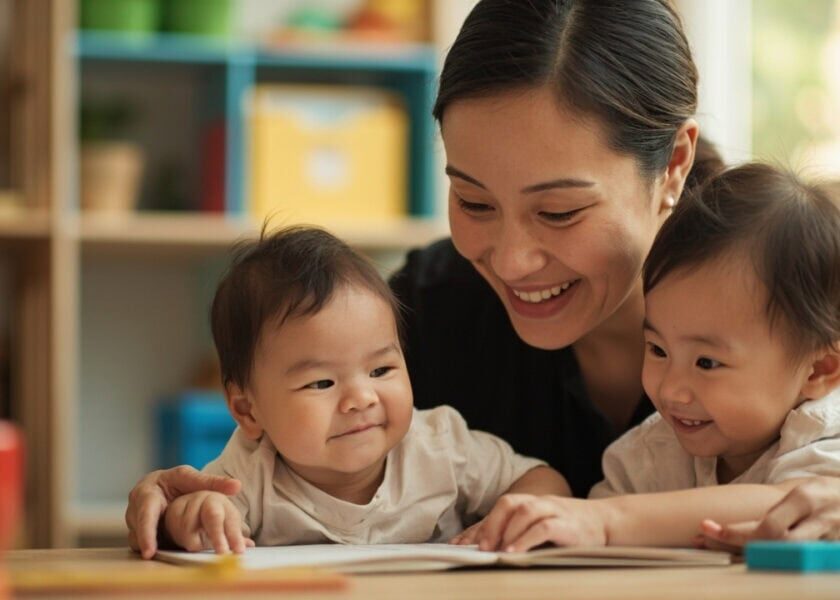
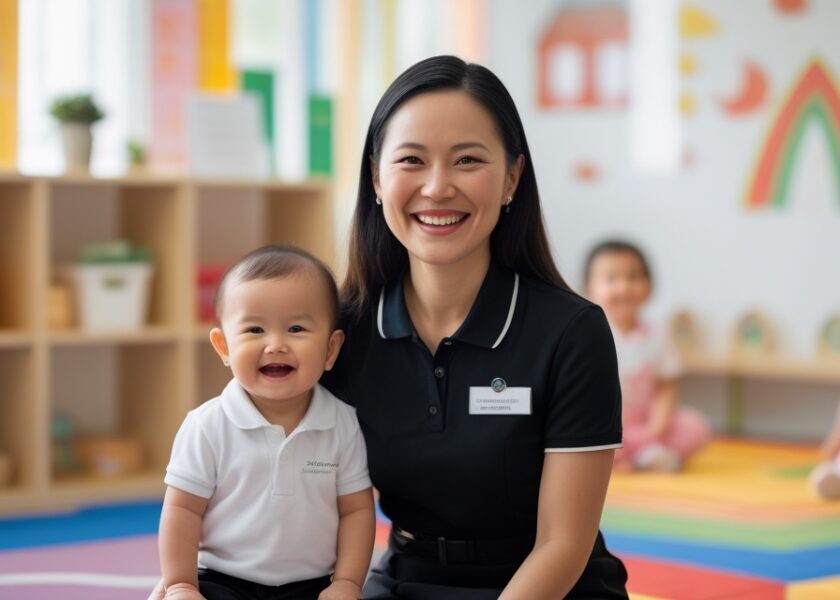
Start with the caregiver. Notice how she positions herself in the room. Is she seated at the children’s level, kneeling to speak with a toddler, or standing above them issuing instructions from a distance? These are not trivial distinctions. Physical positioning communicates philosophy. A caregiver who consistently works at a child’s eye level is demonstrating a respect for children that goes beyond training.
More important than where she stands is the quality of her attention when a child approaches her. Watch closely: is she looking at the child? Or is she looking at the child while also glancing at her phone, at the next task, or at the clock? A caregiver who can truly attend to a child in front of her, while maintaining a broader awareness of the room, is demonstrating something that cannot be faked and cannot be learned overnight.
The Micro-Moments That Reveal Everything
Here is what many parents miss: the interactions you want to observe are not the big, dramatic moments. They are the small ones. The quiet ones.
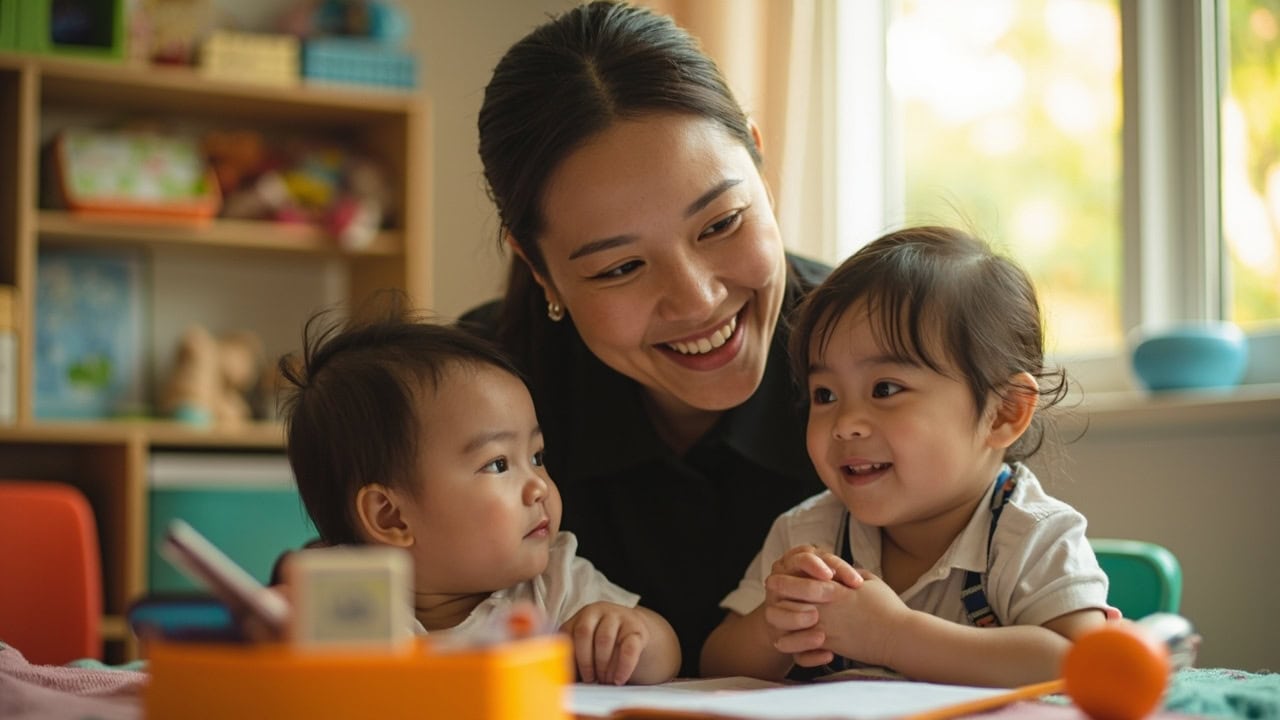
Watch a caregiver kneel down to speak with a toddler who has just dropped a toy. Watch the patience in that moment. Watch whether she redirects the child immediately or takes a breath and lets the child experience the small disappointment before moving on. That micro-moment, repeated dozens of times across a day, is where quality either lives or does not.
You are not looking for perfection. No caregiver is perfect. What you are looking for is pattern. Warmth and attentiveness, consistently observed, tells you something real. Impatience or distance or distraction, consistently observed, tells you something real as well. One good interaction does not make a programme. One bad interaction does not condemn one. What you are looking for is the texture of daily life.
Reading the Environment for Intentionality
When you walk into a space, resist the temptation to evaluate it the way you would a hotel lobby. The question is not whether it is beautiful or impressive. The question is whether it is designed for children to be active participants in their own learning.
Look for evidence of intentionality. Are materials accessible to small hands at small heights? Can children reach what they need without asking an adult every time? Are the toys open-ended rather than loud and single-purpose?
Open-ended materials—wooden blocks, art supplies, sand and water, dress-up clothes—are tools for learning, not just objects for occupation. They invite children to think, to create, to experiment. Their quiet presence signals that a programme values imagination and problem-solving over mere entertainment.
Look at how children move through the space. Are they allowed to choose, within reasonable limits, what they engage with? Or is every activity directed, every transition abrupt, every moment of free movement managed?
Transitions: Where Philosophy Becomes Visible
Transitions are the moments between activities. The move from free play to circle time. The shift from indoor to outdoor. The end of nap time. These moments are where programmes either show their respect for children or their impatience with them.
A programme that rushes children through transitions, that snaps at them to line up, that treats the schedule as sacred at the expense of the child’s emotional experience, is a programme that is running for the convenience of adults.
A programme that gives gentle warnings before transitions, that allows children a moment to finish what they are doing, that handles the emotional difficulty of moving from one activity to another with patience, is a programme that has placed the child at the centre of its practice.
Ask yourself, when you visit: how do the children move through the room? How do caregivers speak to them during these moments? You will learn more in ten minutes of watching transitions than in an hour of listening to a scripted tour.
The Questions That Reveal More Than Surface Answers
Questions are tools. And the best questions go beneath the surface.
The question, “Do you love children?” is not a useful question. Of course the answer is yes. What you want to understand is how a caregiver thinks about children, not just how they feel about them.
Ask about how they handle conflicts between children. Ask about how they support a child who is struggling with separation anxiety. Ask what a typical day actually looks like, not in glossy brochure language but in real, specific detail. Ask what they do when a child’s behaviour challenges them. Ask about their training and what they have learned from it. Ask them to describe a moment when they felt proud of their work.
Listen to the answers. Not just for content, but for tone. Does the caregiver speak about children with curiosity and respect? Does she seem to reflect on her practice, or does she rely on scripts? Does she seem comfortable with uncertainty, or does she claim certainty that feels unrealistic?
These qualities—easy to overlook when you are focused on logistics, fees, and operating hours—are actually among the most important indicators of quality you will encounter.
Documentation and Professional Practice
Have you ever asked a caregiver how they document your child’s development? If you have not, I would encourage you to ask.
Documentation is not administrative paperwork. It is evidence of professional practice. When a caregiver or programme systematically observes and records what children are learning and how they are developing, it means two things: they are paying close enough attention to notice development as it unfolds, and they are taking responsibility for making sure that development is not left to chance.
Documentation allows caregivers to plan. It allows them to identify children who may need additional support. It allows them to share your child’s progress with you in concrete, meaningful ways rather than vague reassurances that everything is fine.
Ask to see examples of documentation. Ask how they share it with parents. A programme that takes documentation seriously will have clear, professional systems for doing so. They will welcome your interest in it. A programme that treats documentation as a box-checking exercise, or that becomes defensive when you ask about it, is telling you something about its priorities.
Watch the Children Themselves
I cannot overstate this. When you visit a programme, watch the children. Not just the ones who are performing for visitors, but all of them.
Are they comfortable? Are they engaged? Are they moving with ease through the space, or are they listless, or overstimulated, or waiting for something to happen?
The behaviour of the children is the most honest reflection of a programme you will ever see. It cannot be faked for a tour. It is the product of months and years of accumulated daily experience. If you walk into a room and the children seem genuinely happy, genuinely curious, genuinely at ease, that is not a coincidence. That is the result of thousands of small decisions made by the adults in that room, and it tells you something profound about the quality of care your child would receive there.
Conversely, if the children seem disconnected, or if the energy in the room feels flat or chaotic in a way that serves adults rather than children, take that observation seriously. You are not a trained observer, but you are a parent, and your perception of atmosphere is a legitimate data point. Trust it.
EduNanny by BUTLER: Where Evaluation Meets Partnership
This is where EduNanny by BUTLER stands apart. We were built on a conviction that Singapore parents deserve real choice and real support in navigating this decision.
We are part of the ECDA Childminding Pilot, a government initiative that recognises the value of structured, quality childminding for Singapore families. We offer home-based care across Singapore, in both community and centre settings, with small ratios that allow caregivers to truly know each child in their care. Up to one infant to three caregivers, because we believe that attention is not a luxury. It is the foundation.
Our care runs Monday to Friday, in structured blocks that serve the rhythms of working families. We know that affordability matters, and within the pilot fee structures, we have worked to make quality care accessible. CDA and Baby Bonus funds are usable, because we believe that financial considerations should not force families into lower-quality options.
But beyond the logistics, what we are most committed to is the partnership we build with parents. We believe in transparency. In communication. In documentation and reporting that keeps you connected to your child’s daily experience, even when you are not in the room. Where deployed, we implement measures like CCTV to provide additional assurance—not because we have anything to hide, but because we understand that trust is built through openness. Parents need more than reassurances. They need evidence. They need to see what their child is experiencing, to understand the rhythm of the day, to feel like genuine partners in their child’s care rather than passive consumers of a service.
What we offer is not simply a matching service. It is a philosophy of care, embedded in every caregiver we work with, every environment we create, every system we put in place. We are not the right choice for every family. But for families who share our belief that quality early care is one of the most important investments they will ever make, we offer something more than a service. We offer a standard. A framework. A commitment to the kind of care that deserves the scrutiny you are already prepared to bring to it.
Addressing Your Real Concerns
“How do I know if I am being too picky?”
You are not being too picky. The search for quality childcare is not about perfection. It is about attention. You are looking for a standard of care that honours the significance of this stage in your child’s life. That is not pickiness. That is parenting.
“What if the tour looks good but the daily reality is different?”
This is exactly why observation skills matter. A scripted tour can be polished. The texture of daily life cannot be faked. When you learn to watch for responsiveness patterns, genuine engagement, and the way children move through transitions, you develop an understanding that goes beyond what any tour can show you. And once enrolled, your continued observation as an engaged parent is your greatest protection.
“I do not want to be that difficult parent who questions everything.”
Asking thoughtful questions is not being difficult. It is being engaged. The programmes that are confident in their quality welcome that kind of partnership. Parents who stay observant, who ask questions, who notice if something changes, who build real relationships with caregivers and educators—those are the parents who make the best use of childcare. That kind of engaged attention is not intrusive or distrustful. It is simply what good parenting looks like in this context.
“How do I balance quality with what I can actually afford?”
This is a real tension for Singapore families, and we do not pretend otherwise. Quality care is an investment. Within the ECDA Childminding Pilot fee structures, we have worked to make quality care accessible. CDA and Baby Bonus funds are usable. We believe that financial considerations should not force families into lower-quality options. We are happy to discuss your situation openly and work toward solutions.
Before you choose an infant care provider in Singapore, consider these practical steps:
- Visit during different times of day, not just scheduled tour times
- Observe at least one transition between activities
- Ask specifically about caregiver training and ECDA registration
- Request to see examples of how they document and share your child’s development
- Notice how the programme responds to your questions and concerns
- Ask about their approach to handling separation anxiety, feeding, and sleep routines
- Check ECDA licensing and regulatory compliance
Here is what I want to leave you with. The measure of good childcare is not the perfection of the tour or the impressiveness of the credentials or the absence of guilt in your heart. It is something simpler and more honest.
When you visit, do you see warmth? Do you see attentiveness? Do you see children who are engaged, caregivers who are present, and a programme that feels alive with the right kind of purpose?
When you pick up your child at the end of the day, do they seem happy? Not just quiet, but genuinely happy. Are they developing in ways you can see and celebrate?
When you ask questions, do you get real answers? When you share concerns, are they received with respect and addressed with care?
If the answer to these questions is yes, you are not guessing. You are evaluating. And the trust you build on that foundation is not naive. It is earned. It is informed. It is the kind of trust that holds.
If you are reading this article feeling overwhelmed by the search for childcare in Singapore, I want you to know something. You are not as unprepared as you feel. Everything you need to make this choice well is already within you. You have the attention. You have the love. You have the willingness to learn.
The skills described in this article are not beyond you. They develop with practice. The more you observe, the more patterns you will notice. The more patterns you notice, the more confident you will become. Not false confidence, but grounded confidence—the kind that comes from truly understanding what you are evaluating.
You are already paying attention. You are already asking questions. You are already invested in your child’s wellbeing in a way that goes beyond what words can express. That investment is not a weakness. It is your greatest strength. It is what qualifies you to make this choice.
Singapore parents deserve more than reassurance. They deserve clarity. They deserve to understand what quality looks like, and they deserve to be able to trust that when they find it, they will know. They will know because they have developed the eyes to see it.
EduNanny was built to honour that seriousness—not to make the choice for you, but to be the kind of partner that your informed attention deserves. To be worthy of the scrutiny you bring to this decision, today and every day that follows.
The stakes are high. You know this. But you do not have to face those stakes with anxiety alone. You can face them with informed attention. With a framework. With the confidence that comes from truly understanding what you are evaluating.
You have everything you need to make this choice well. And we are here to walk it with you.
Find out how EduNanny by BUTLER can support your family. Reach out to learn about availability, pilot fee structures, and how we can partner with you in your child’s early years.
#singaporechildcare #eduNannySG #infantcare #childmindingSG #qualitychildcare