Beyond the Meltdown Countdown Singapore Parents Finally Have a Choice
The Cultural Collision Every Singapore Parent Knows
We have built a culture in Singapore that romanticizes family togetherness. The reunion dinner table. The multigenerational household. The idea that children belong in the thick of celebration.
And simultaneously, we have built a society where young parents are expected to manage the impossible: keep a toddler’s nervous system regulated while performing filial piety, navigate unsolicited commentary on parenting choices while spooning soup, and somehow enjoy yourself while watching the clock for the nap that absolutely cannot be missed.
This is the silent tension that no one names at parties. The distance between what we believe families owe each other — presence, participation, continuity — and what our children actually need to thrive. Not because their needs are unreasonable. Because the architecture around us was not built with their nervous systems in mind.
Every Singapore parent knows this feeling. You arrive at a wedding banquet and immediately start calculating. How long can we stay? Two hours maximum before the overtired collapse. Where is the quiet room if we need it? Who will watch the baby so I can eat something that is not eaten one-handed while bouncing on my heel?
You love your family. You want to be there. And yet, somewhere between the third comment about why the baby is not walking yet and the fifth person picking up the chopsticks to feed your eighteen-month-old, you feel something curdle inside you. Not anger, exactly. Something closer to grief. The grief of being pulled in two directions you cannot reconcile.
What These Gatherings Actually Ask of Young Families
Consider the Lunar New Year reunion dinner. It is not simply a meal. It is a ritual of identity, of belonging, of continuity across generations. To be absent is to register as missing from your own family’s story.
And yet the reunion dinner is held at eight o’clock at night in a hall with blasting air conditioning and cousin-loud karaoke and food that is aggressively non-child-friendly. Your two-year-old has been awake since six in the morning. They have already had their dinner at home at six. By seven-thirty, they are running on fumes and goodwill that does not exist.
Or the wedding banquet. The mooncake festival gathering at your parents’ place. The Ching Ming visit where your child must sit still and quiet for an hour in clothes that itch. The birthday celebration at a restaurant where every adult is three drinks deep by the time the fried rice arrives.
These are not fringe scenarios. This is the texture of family life in Singapore. These are the moments that define whether your child grows up feeling like they belong to something larger than their immediate household, or whether they grow up feeling like they were the reason you always had to leave early.
What Children Actually Learn at Family Gatherings
Here is what we rarely say out loud: your child’s presence at these events is not just a logistical challenge. It is a statement about who they are in this family, who your family is to them, and whether cultural identity is something that is transmitted through lived experience or something that happens to other people’s children.
Children learn what celebration feels like. They learn what it means to be part of a clan, a lineage, a story that stretches backward and forward in time. They learn this not through explanations but through presence — through the smell of certain dishes at certain times of year, through the sound of elders laughing in a language they are only beginning to understand, through the particular chaos of cousins running in packs and aunties pinching cheeks and uncles making bad jokes that no one laughs at but everyone pretends to enjoy.
This is how cultural identity takes root. Not in textbooks. In lived, embodied, sometimes overwhelming participation in family life.
The Catch We Do Not Discuss Honestly
Your child cannot absorb any of this if they are dysregulated. A toddler who is overstimulated, overtired, and fighting their own biology is not learning about family tradition. They are learning that family events are places where bad things happen to them.
The sensory overload, the disrupted sleep, the well-meaning but terrifying strangers — this is not neutral. It is actively encoding a relationship with family life that may not serve anyone well.
So what do Singapore parents do? Most have developed an internal algorithm:
- Option one: Attend the event. Leave early. Accept the commentary. Apologize for the child’s tiredness. Swallow the guilt of disrupting routine. Spend the next three days re-regulating a child who has been thrown off by travel, unfamiliar environments, and late nights. Return to baseline. Start again.
- Option two: Leave the child at home with a caregiver. Attend the event fully present, engaged, available. Return to a child who has maintained their routine and is not paying the price for adult obligations. Feel guilty about being away. Enjoy the banquet anyway. Feel vaguely like a bad parent for enjoying the banquet. Repeat.
- Option three: Stop attending altogether. The relief is enormous. The cost — to family relationships, to cultural continuity, to the child’s sense of belonging — is slower and harder to measure.
None of these options feel good. And that is because the problem is not a willpower problem. It is not a parenting philosophy problem. It is a structural problem.
Why This Is a Structural Issue, Not a Personal One
The structure of Singapore family life and the structure of early childhood development are operating on incompatible assumptions.
Family life assumes flexibility, adaptation, the child who falls asleep anywhere. Early childhood development assumes consistency, rhythm, the child whose nervous system needs predictable patterns to feel safe.
These two structures are not in dialogue with each other. They are colliding, and parents are absorbing the collision.
The question is not how to be a better parent or a more devoted child. The question is whether there is a way to build the scaffolding differently. Whether the two things — your child’s stability and your family’s participation — can be held simultaneously. Whether the reunion dinner can be something your child grows up remembering with warmth instead of dread.
The answer is yes. But it requires something most parents do not have: the invisible infrastructure that makes presence possible without the price.
What Near-Home Care Actually Does
Near-home care, when it is done well, is not a convenience. It is a release valve. It is the thing that sits between your child’s routine and your family’s demands and absorbs the tension so that you do not have to.
A Different Architecture
Imagine this. It is two days before the reunion dinner. You know you need to be at your parents’ place by six for the preparations. Your child has their afternoon nap at one, their dinner at six-thirty, their bedtime at eight.
In a normal week, this is manageable. In reunion week, this is a puzzle that requires five contingency plans.
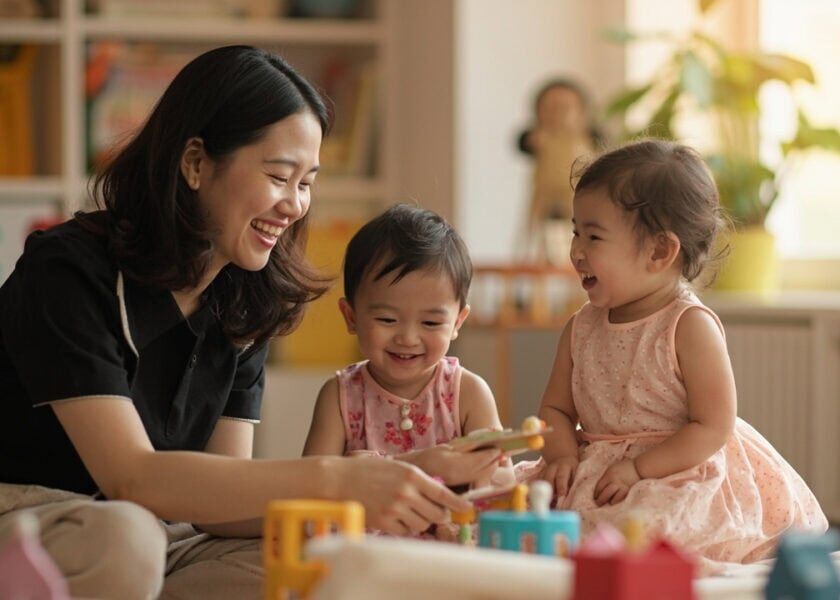
But now imagine a different architecture. Your child is at home, in familiar surroundings, with a caregiver they know and trust. The caregiver maintains the routine. The nap happens. The dinner happens. The bedtime happens.
And you — you are at the reunion dinner, present, engaged, not watching the clock, not calculating the meltdown countdown. Your child is home, stable, safe. And you are at the table, where you belong, doing the thing that connects you to everyone who came before you.
This is not a fantasy. This is what the right childcare arrangement actually does. It does not free you from your child. It frees you to be present without your child being destabilized. It creates the conditions for genuine participation instead of anxious attendance.
The Caregiver as Part of Your Extended Support System
The caregiver in this scenario is not just a childcare provider. They are part of your family’s extended support system. They are the person who holds the routine steady so that you can go out into the world and do the things that matter.
They are the invisible infrastructure that makes your participation possible. And the relationship matters enormously — because your child needs to feel secure with this person, needs to trust them enough that the routine holds even when you are not in the room.
This is not a transaction. It is a partnership.
What Quality Childminding Looks Like
Not all childcare arrangements are created equal. Here is what to look for when you are evaluating your options:
- Small ratios — Attention at this age is not divisible. A caregiver who is responsible for too many children cannot provide the consistency your child needs.
- Routine preservation — The best care arrangements do not adapt your child to the world. They maintain the world your child needs while you are away.
- Communication systems — You should know what is happening with your child during the hours you are apart. Updates, transparency, open channels for questions.
- Trust infrastructure — This is someone you are handing your child to. Trust is not assumed. It is built through consistent evidence over time.
- Flexibility within structure — Life with young children is unpredictable. The right care arrangement has enough structure to provide security and enough flexibility to accommodate reality.
How EduNanny Fits Into This Picture
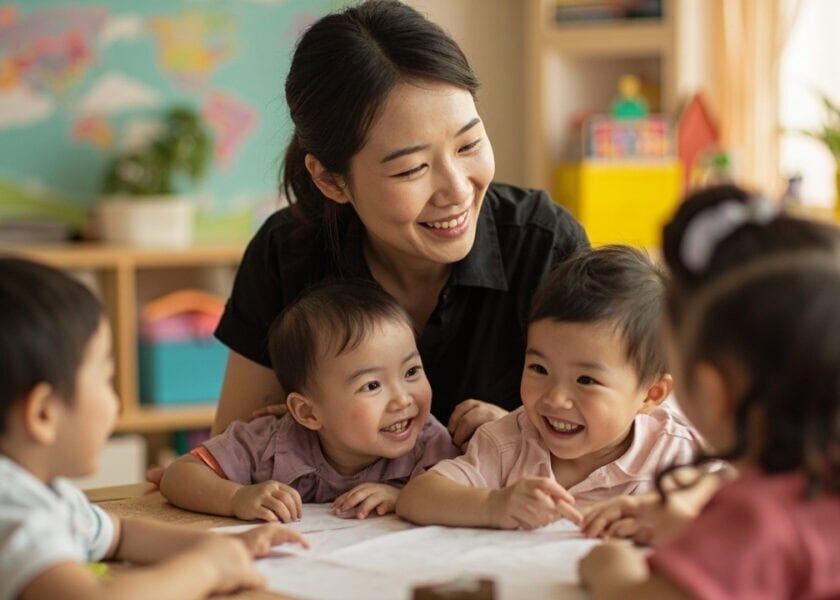
EduNanny operates within the ECDA Childminding Pilot, a framework designed to make quality childminding accessible to Singapore families. Our caregivers maintain small ratios — up to one to three infants — because attention at this age is not divisible.
We offer both home-based and centre-based pathways, recognizing that every family’s geography and needs are different. Our care operates Monday to Friday in structured blocks, because routine is not a preference but a necessity for children under three.
For families within the pilot, CDA and Baby Bonus schemes can help make childcare a supported investment rather than an impossible expense. We work with these systems to reduce the financial burden where possible.
On communication and trust — we have measures in place that reflect the reality that you are handing your child to someone else. Regular updates, open channels for the questions that arise at two in the afternoon when something minor feels enormous. We know that trust is not assumed. It is built, over time, through consistent evidence.
Common Questions Parents Ask
Before you explore options, you may have questions. Here are the ones we hear most often:
“Will my child feel abandoned?”
Not if the relationship with the caregiver is secure. Children under three need consistency, not constant presence. What damages a child’s sense of security is unpredictability and chaos — not a parent who steps out for the evening and returns calm and present.
A child who knows their routine is intact, who trusts the person caring for them, can handle temporary absence. It is the maintenance of rhythm that creates safety, not the number of hours spent in the same room.
“Will my family judge me for not bringing my child?”
Possibly. Extended family dynamics in Singapore are complex, and cultural expectations run deep. But here is the reframe: bringing a dysregulated, overtired child to an event is not a gift to your family. It is a gift to no one — not your child, not you, and not the relatives who have to witness the meltdown.
Your child’s presence at family gatherings should be a choice made from stability, not an obligation fulfilled through suffering. The right care arrangement lets you choose presence over obligation.
“Isn’t this just for working parents?”
No. This is for any parent who wants their child to be part of family life without paying for it in dysregulation. Evening events, weekend gatherings, holiday celebrations — these are not luxuries. They are how cultural identity is transmitted. Quality childminding is not just about enabling work. It is about enabling a family life that works for everyone.
“What about grandparents? Aren’t they the support system?”
Grandparents are irreplaceable. They are not, however, a childcare infrastructure. There is a difference between the grandparent who visits and spoils and plays, and the grandparent who maintains a toddler’s nap schedule on demand.
For many families, grandparents are either not nearby, not available on the schedule required, or not the right fit for the particular needs of a young child. Quality childminding is not competing with grandparents. It adds a professional layer of care that addresses the specific pressures of modern Singaporean family life.
The Version of Family Life That Is Possible
There is a version of family life in Singapore where parents feel torn apart. Where every gathering is a test of endurance. Where the choice is between disappointing your elders and disrupting your child. Where the guilt is constant and the joy is intermittent.
This is the version most parents are living in right now. It is exhausting and lonely and it does not have to be the only option.
There is another version. In that version, your child is known and held and cared for by someone who takes their role seriously. In that version, you can attend the reunion dinner without running the meltdown calculations. In that version, your child grows up with a relationship to family life that is warm, not traumatic.
What Cultural Identity Transmission Actually Looks Like
It is not a choice between presence and protection. It is creating the conditions where both are possible simultaneously.
Your child will grow up knowing they belong to this family — not because they were dragged to every event exhausted and dysregulated, but because they were present for the ones that mattered, in the ways that worked for them.
And the rituals, the traditions, the sense of being part of something larger — this does not require your child to be at every single gathering. It requires your child to be included, over time, in the story your family tells itself about who it is.
In that version, you are not choosing between being a good parent and being a good daughter. You are simply present, and that presence is possible because the infrastructure around you is working.
That version is not a luxury. It is not only for families with enormous resources or particularly easy children or grandparents who live next door. That version is available, through the right kind of support, to every family willing to build it.
How to Choose the Right Care Arrangement
If you are considering your options, here is a practical framework for evaluation:
- Start with routine — Any arrangement that cannot preserve your child’s routine is starting from a deficit. Ask specifically how meals, naps, and bedtime are handled.
- Ask about ratios — How many children per caregiver? For infants and toddlers, smaller is almost always better.
- Evaluate communication — How will you know what is happening during the day? What is the policy on updates and check-ins?
- Consider geography — Home-based or centre-based? Think about what makes sense for your family’s rhythm and your child’s temperament.
- Check for fit — This is someone who will be part of your family’s daily life. Do you trust them? Do they listen? Do they explain their approach?
- Understand the costs — Look into CDA and Baby Bonus mechanisms. Childcare is more affordable than many parents assume when the right support systems are in place.
What we are offering is not just childcare. It is the capacity to stay in the story. The capacity to be present without your child paying the price. The capacity to honor both your child’s needs and your family’s traditions, not by sacrificing one for the other, but by building something that holds both.
So if you have been dreading the next family gathering, wondering how you will manage, feeling the familiar weight of impossible choices — know this.
You are not failing. You are under-resourced.
And resources exist.
The reunion dinner is waiting for you. Your child is ready to be part of this story, in the way that works for them. And the scaffolding that holds both — routine and tradition, protection and presence, the needs of a small child and the obligations of family life — that scaffolding can be built.
We would like to help build it with you.
If you are ready to explore how the right childminding arrangement can change the way your family experiences celebrations, rituals, and daily life — we would love to talk. Connect with EduNanny to learn more about our approach to infant care in Singapore.
#SingaporeChildcare #InfantCareSingapore #ChildmindingSG #FamilyLifeInSingapore #EduNanny