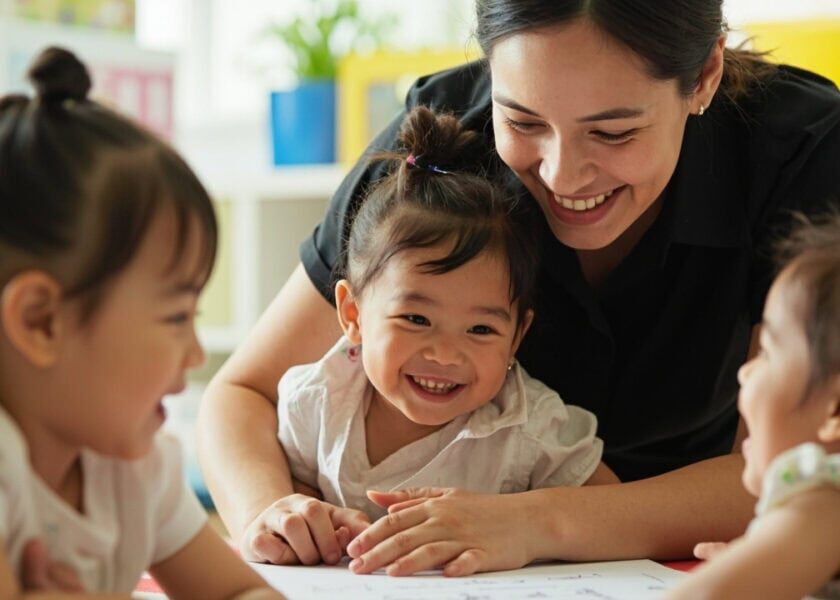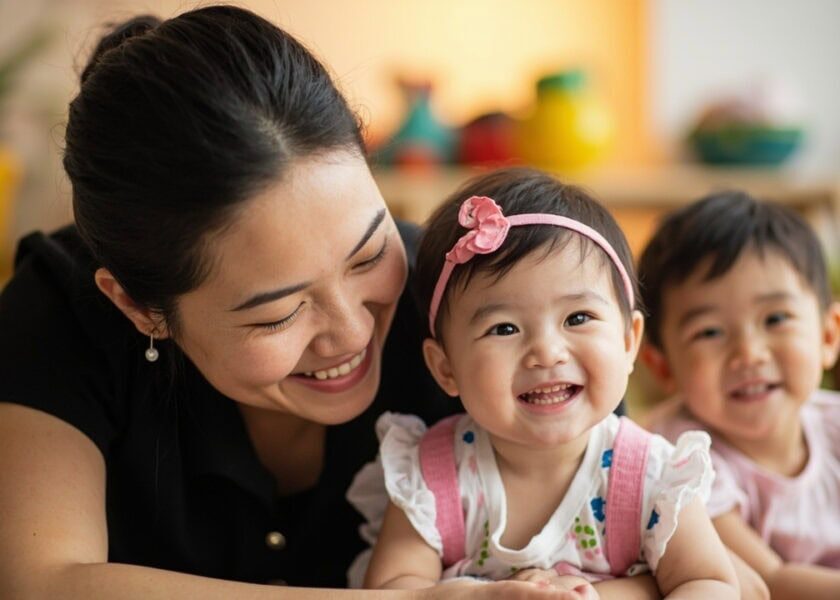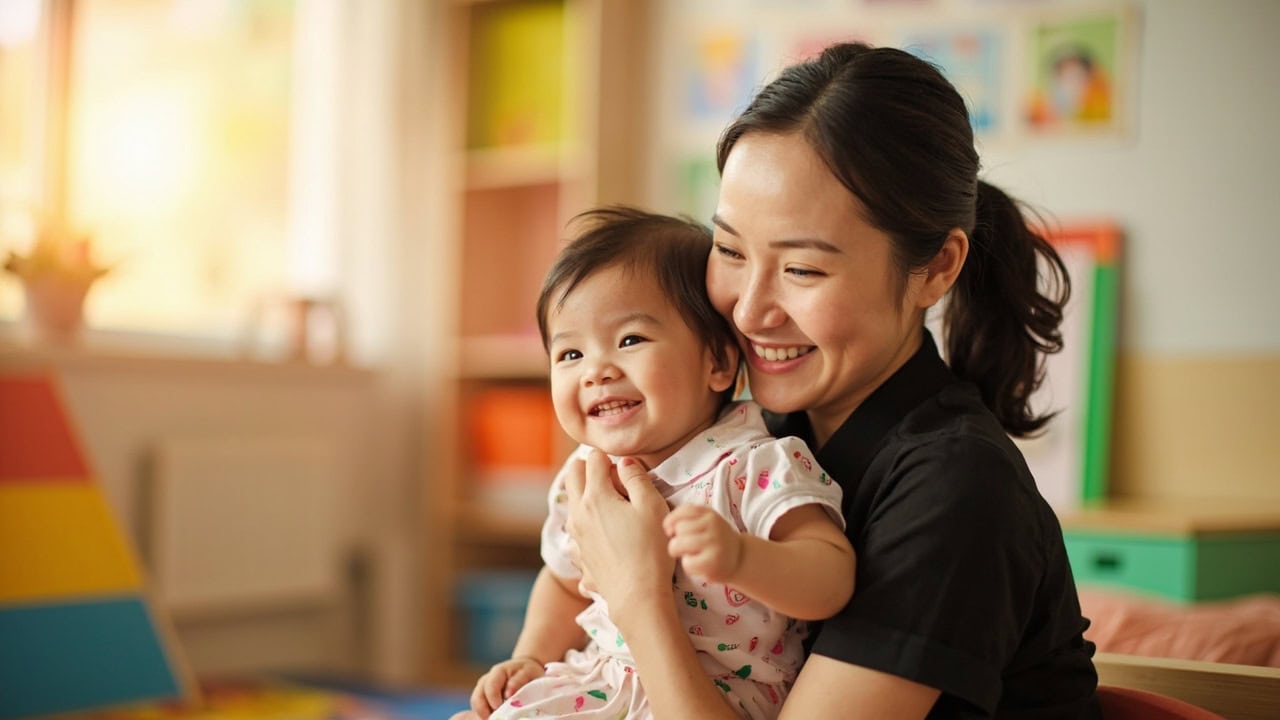
Beyond the Sole Attachment: Why Multiple Caregivers Strengthen Your Child
What You Are Actually Feeling Is Normal
Here is what we rarely acknowledge: the modern Singapore parent has inherited a care landscape our grandparents could not have imagined. Three generations living together or nearby has always been part of how we live. Our parents raised us with help; their parents raised them with help—this is not new.
What is new is the professional caregiver—the trained, employed, compensated person who comes into your home or joins your child’s day and brings with them a different kind of relationship. Not the warmth of blood, but the warmth of attuned attention. Not the long memory of family, but the present moment of professional care.
Your mother has known your child since before they drew breath. She carried them in a different sense, held the weight of your hopes and fears across nine months, dreamed them into being before they arrived. The caregiver arrived later. She came with a resume, with training, with the ECDA Childminding Pilot framework that EduNanny operates within. She is a professional.
And yet your child runs to her. Falls asleep in her arms. Develops preferences—her voice, her songs, her particular way of stacking the blocks. Your child will be handed to your mother after school and within minutes will be asking about the other one. Not replacing. Not forgetting. Just holding another person in that capacious, astonishing heart that you made but did not design.
This is where the quiet grief begins. It is not dramatic. It is not the grief of loss. It is the grief of discovering that love is not a finite resource. That your child can hold more than one secure base. That the morning you watched your mother feed your child, and the afternoon your caregiver sang your child to sleep, are both real, both formative, both loved.
What Attachment Science Actually Tells Us
For many parents, this feels like erosion. As if each attachment your child forms with someone else is a small tide pulling away at the beach of your importance. But attachment science—the very science we lean on when we choose quality care, when we read about developmental windows, when we ask ourselves whether returning to work will harm our children—tells us something different. Something that might, if we let it, reframe everything.
Secure attachment is not exclusivity
Developmental research consistently shows that children can form multiple secure attachments. They can have a primary attachment figure—often the parent—and secondary secure attachments with grandparents, caregivers, and teachers. What matters is not the number of attachments, but their quality.
A secure attachment is characterised by responsiveness (the caregiver notices and responds to the child’s signals), consistency (the relationship follows predictable patterns over time), and emotional attunement (the caregiver reads and responds to the child’s emotional state).
When your mother meets your child with consistent warmth, your child learns: This person is safe. This relationship is reliable. I can explore the world from this base. When your EduNanny caregiver arrives each morning with trained attentiveness and consistent routines, your child learns the same lesson again, in a different voice.
The child does not think: My mother is the real mother; the caregiver is the imposter. The child thinks: I have two places in this world where I am held. And that is not poverty. That is wealth.
The Singapore Reality: Why This Tension Feels So Acute
The anxiety Singapore parents experience around grandparent and caregiver dynamics is real, and it is layered.
Part of it is biological. Oxytocin, bonding hormones, the ancient wiring that kept our ancestors’ offspring alive by making us vigilant about who held them.
Part of it is cultural. The weight of filial expectation, the knowledge that your parents sacrificed for you, the unspoken contract that 三代同堂 is both privilege and pressure. Your mother-in-law’s input on your child’s feeding schedule is not just about childcare—it is about legacy, about lineage, about the unspoken question of whether her way is still good enough.
And part of it is deeply personal. The quiet need to matter. To be irreplaceable. To be known as the one your child runs to when the world is too much.
That need is not wrong. It is deeply human. But when we let it calcify into fear—when we begin to see grandparent and caregiver as competitors rather than collaborators—we lose something. We lose the ability to see what your child actually has. And we lose the ability to see ourselves clearly.
There is a question that lives at the centre of this tension: Who am I in my child’s constellation of loves? Not Who does my child love more? but What is my place in this web of secure attachments?
From Sole Attachment Figure to Attachment Orchestrator
Here is the shift that I find most quietly transformative: from sole attachment figure to attachment orchestrator.
You are not, and never were, the only person responsible for your child’s emotional security. This is not a diminishment of your role. It is a clarification of it. You are the person who curates the environment in which your child forms their multiple attachments. You are the one who sets the tone, who establishes the philosophy, who makes the decisions about who enters your child’s world and on what terms.
This is not a smaller role. It is a different one. And for many parents, it is a more honest one.
The orchestrator does not play every instrument. The orchestrator ensures the music works. When your mother rocks your child to sleep, that is one note in a larger composition. When your EduNanny caregiver sings the afternoon song, that is another note. When you arrive home and your child reaches for you with the particular intensity of reunion, that is the resolution—the moment when all the notes come together and the piece makes sense.
You are not diminished by the other musicians. You are the conductor.
The research confirms this
When parents are secure in their role, when they do not experience other caregivers as threats, the entire system works better. Children are exquisitely tuned to adult anxiety. When you are relaxed about your mother-in-law’s afternoon spoiling, your child absorbs that relaxation. When you trust your caregiver’s methods, your child benefits from that trust. When you model healthy relationships with all your child’s caregivers, your child learns that love is not a competitive sport.
The emotional climate you create as orchestrator ripples outward in ways you may not even notice until you stop and observe: your child, at the end of the day, reaching for you with absolute certainty. Not because you are the only one, but because you are the one who makes the whole system work.
What Quality Childminding Actually Looks Like
Understanding the theory is one thing. Understanding what quality care looks like in practice is another. Here is what to look for when researching infant care options in Singapore—and why these elements matter for your child’s development.
The five markers of quality home-based care
- Attentive ratios: One caregiver to no more than three infants. This allows genuine attunement, not just supervision.
- Consistent routines: Predictable rhythms for feeding, nap time, and play. This builds security and trust over time.
- Aligned philosophy: The caregiver respects and extends your family’s approach, creating continuity rather than disruption.
- Transparent communication: Daily updates, honest sharing, open dialogue. This keeps you informed and trusting.
- Trained responsiveness: The caregiver reads cues and responds appropriately, building secure attachment in every interaction.
The integration principle
Quality childminding is not about finding someone who will do what you do. It is about finding someone who will do alongside what you do. The best caregiver does not replace your mother’s dialect songs. She learns them. The best caregiver does not ignore the routines your family has established. She absorbs them and builds on them.
Home-based care that complements rather than competes. Care that sees your child’s multiple attachments as a feature, not a bug. Care that positions itself as part of your village, not above it.
How EduNanny Approaches Family Integration
EduNanny’s model offers something specific: not a replacement for family care, but an integration of it. Not a programme that asks you to choose between grandparents and professionals, but one that positions professional care as part of the architecture your family is already building.
Aligned rhythms, not imposed routines
Your EduNanny caregiver is trained to align with your household’s rhythms—not to impose a foreign routine but to absorb and extend the patterns you and your family have established. When your mother has spent the morning with your child, the caregiver receives that child with awareness of what came before. She does not start from zero; she builds on the foundation.
Working within established frameworks
The ECDA Childminding Pilot framework that governs this approach is not simply a regulatory structure. It is a recognition that quality care happens in context—that a child is not a unit to be processed but a person embedded in relationships.
When EduNanny operates within this framework, it means your caregiver is skilled in infant development with training and ratios of up to one to three infants ensuring attentive care. She is also skilled in reading the emotional texture of your household. She knows that Grandpa likes to take the morning walk. She knows that Grandma’s dialect songs are part of the soundtrack your child is learning. She does not replace these things. She creates continuity within diversity.
Transparent partnership
Practically, this means open communication about your child’s day, honest dialogue about any concerns, and a genuine willingness to align with your family’s values rather than impose a one-size-fits-all approach. The caregiver who arrives at your door each morning is not your replacement. She is another architect of your child’s secure world.
Questions Singapore Parents Actually Ask
“Will my child love me less if someone else cares for them?”
No. Developmental research consistently shows that children can hold multiple secure attachments without any reduction in the quality of their bond with their parents. In fact, children with multiple secure attachments tend to show greater emotional resilience. Your child reaching for your caregiver does not mean your child loves you less. It means your child is learning that the world can hold them—and that is a gift you are giving them by creating this environment.
“How do I navigate different caregiving styles between my parents and our professional caregiver?”
The key is not to eliminate these differences but to manage them with clarity. You are the orchestrator. You set the overall philosophy. You communicate it clearly to all caregivers. And you accept that your mother will do things her way, just as your caregiver will do things hers—as long as both are safe, loving, and within the boundaries you have set.
“What if my child seems to prefer someone else?”
Children do not experience preference the way adults do. Your child may run more enthusiastically to your caregiver at the end of the day because that is the reunion they have been building toward. When you arrive, there is a different quality of reunion—the primary attachment figure, the emotional home base. Your child may be more regulated with your mother because your mother is less anxious. These differences are not rankings. They are different notes in the same piece of music.
“Is it selfish to want to be the most important person in my child’s life?”
No. The desire to matter deeply to your child is not selfish. It is one of the most fundamental expressions of parental love. The question is not whether you want to matter—you do matter, profoundly—but whether you can allow your child to also matter to others without experiencing that as a threat to your own importance. That is the work. And it is work worth doing.
Practical Guidance for Choosing Infant Care in Singapore
If you are researching options right now, here is what matters most:
- Prioritise integration over replacement. Look for care arrangements that see your family as the foundation, not the obstacle. The best caregiver will learn your family’s rhythms, respect your parents’ roles, and position herself as part of your village rather than its leader.
- Ask about training and ratios. Quality care requires proper investment. Ask about caregiver training, the number of children per caregiver, and how the programme ensures attentive, responsive care.
- Look for transparent communication. You should know what happened in your child’s day. You should feel comfortable raising concerns. You should receive honest answers, not reassurances.
- Trust your read of the caregiver. Your child will form an attachment. You should feel good about the person that attachment is forming with. Do you sense warmth? Attentiveness? A genuine love for their work?
- Consider the whole family, not just the child. Quality care should make your life easier, not more complicated. If the arrangement creates friction with your parents, if it adds to your mental load rather than reducing it, something is misaligned.
What You Are Actually Giving Your Child
Your child is watching you. Not just for safety, not just for food, not just for the basic provisioning that keeps them alive. They are watching to learn how love works.
When you model a relationship with your own mother that includes warmth and boundaries, respect and honesty, your child learns that love can be complex. When you model a relationship with your caregiver that includes trust and clear communication, your child learns that professional care is not a lesser form of love but a different form of it. When you model your own relationship with your child—not as possessive, not as threatened, but as secure in your own place—you are teaching your child something invaluable: that the people who love them can also love each other. That the village can collaborate. That the architecture of care is not a competition but a collaboration.
The grief you feel—the quiet, nameless ache of watching your child love someone else—is not a problem to be solved. It is a doorway. It is the doorway to a different understanding of what parenting is, what love is, what a family is in this particular moment in Singapore’s history.
Your child will not remember every morning. But they will remember the feeling of being held by many hands. They will remember that their grandmother’s arms and their caregiver’s arms and your arms were all part of the same safety. They will carry forward the knowledge that love is not diminished by sharing—that in fact, the opposite is true. That a child who knows many secure bases is a child who can go anywhere. Who can trust widely. Who can build a life of depth and connection because they learned, in those early years, that the world could hold them.
And you—through all the anxiety, through the parking lot questions and the MRT thoughts and the quiet evenings when you wonder if you are doing this right—you will have given them that. Not alone. Never alone. But as the curator of a village that works. As the orchestrator of a love so secure it can be shared.
The village your child needs is already around you. We are here to help it work.
If you are considering home-based childminding for your family and would like to explore how EduNanny can become part of your village, we invite you to begin a conversation with us.
#SingaporeChildcare #InfantCareSG #WorkingParentSG #EduNannySG #ChildmindingSingapore