The Interior Architecture of Your Baby’s First Year
The Sensory Architecture of Infancy
The first year of life is, in ways we are only beginning to fully appreciate, a year of extraordinary sensory immersion. Your baby is not simply waiting in a room. She is absorbing the world through her body with an intensity she will never again experience.
Consider what is happening neurologically when you hand your infant to a caregiver in the morning. The smell of that person’s skin — distinct, familiar, irreplaceable — becomes a signal of safety encoded at a neurological level. The particular tone of voice that means comfort rather than alarm. The rhythm of daily routines that allows her to predict what comes next. The quality of touch that communicates presence rather than haste.
These are not peripheral details. They are, quite literally, the building blocks of her emotional architecture.
Your infant is reading the room in ways you may not consciously notice. She notices whether the caregiver’s movements are calm or hurried. She notices the emotional temperature of interactions — not through language, but through the body. She is building, moment by moment, an understanding of what to expect from the people around her.
The First Thousand Days: Building the Operating System
Research in infant psychology and developmental neuroscience has been telling us something remarkable with increasing clarity: the first thousand days are not simply a period of rapid physical growth. They are a period during which your child’s brain is constructing its fundamental operating system — the patterns of expectation, response, and relational trust that will shape how she interprets the world for decades to come.
The most powerful architects of this system are not toys, screens, or curricula. They are human relationships, experienced through the body, felt before they are ever thought.
There is a concept in developmental psychology called the internal working model — the mental template that a child develops in the first year of life based on the quality of care they receive. This template answers questions the child cannot yet ask: Is the world a place that responds to me or ignores me? Are other humans sources of comfort or merely sources of food and warmth? Can I trust that my signals matter?
If the template is one of consistency, responsiveness, and warmth, the child enters the world expecting that people are trustworthy, that their own signals matter, that it is safe to explore. If the template is one of unpredictability, inattention, or emotional absence, the child carries forward different expectations — ones that are harder to revise than to install correctly from the beginning.
This is what neuroplasticity means in practical terms. The brain is not merely growing in the first year. It is being shaped, moment by moment, by experience. The neural pathways that process safety, interpret social cues, and regulate emotional states are being laid down with extraordinary speed.
The Difference Between Supervision and Attunement
In the language of childcare, we often speak about supervision. Someone is watching. Something is being kept track of. This is important. But for the developing infant, it is not enough — and it is not the right question.
What your infant needs is attunement.
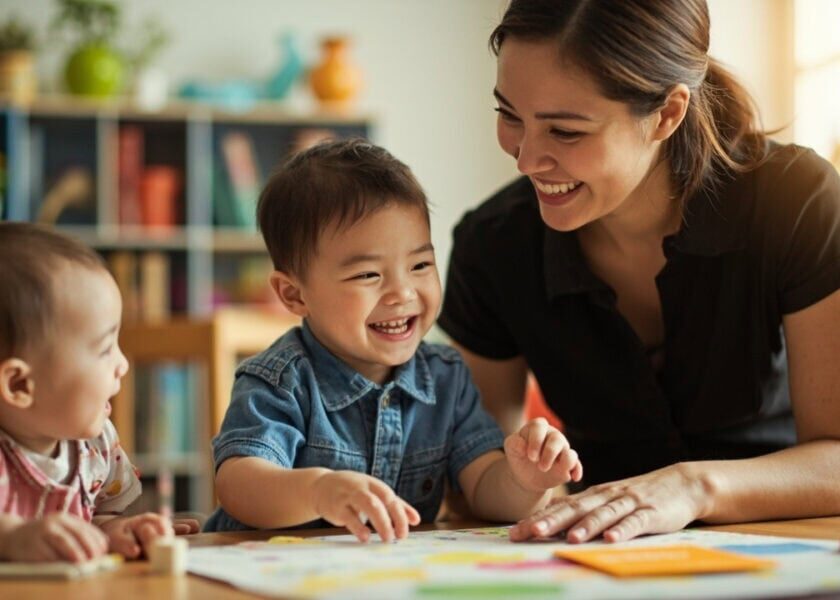
Attunement is a felt experience: the world is warm, the world is attentive, the world makes sense. It is the caregiver who speaks softly before approaching, who gives the infant time to register her presence before lifting her, who mirrors the child’s facial expressions and pauses to let the child lead the exchange.
Consider what this looks like in practice. A child in attuned care is noticed before she cries — the caregiver sees the flicker of frustration building and offers comfort proactively. A routine is maintained not rigidly, but responsively, so the child can predict the shape of her day without feeling controlled by it. When the caregiver notices something that interests the child, she pauses — she lets the child lead.
This caregiver is not just providing care. She is teaching your child something fundamental about human connection: that it is reciprocal, that it is responsive, that it is worth trusting.
Why Near-Home Care Creates the Conditions for Attunement
A child in near-home care — whether in a dedicated home-based setting, a community pod, or a small-group environment — is in a position that carries distinct advantages for exactly this kind of development.
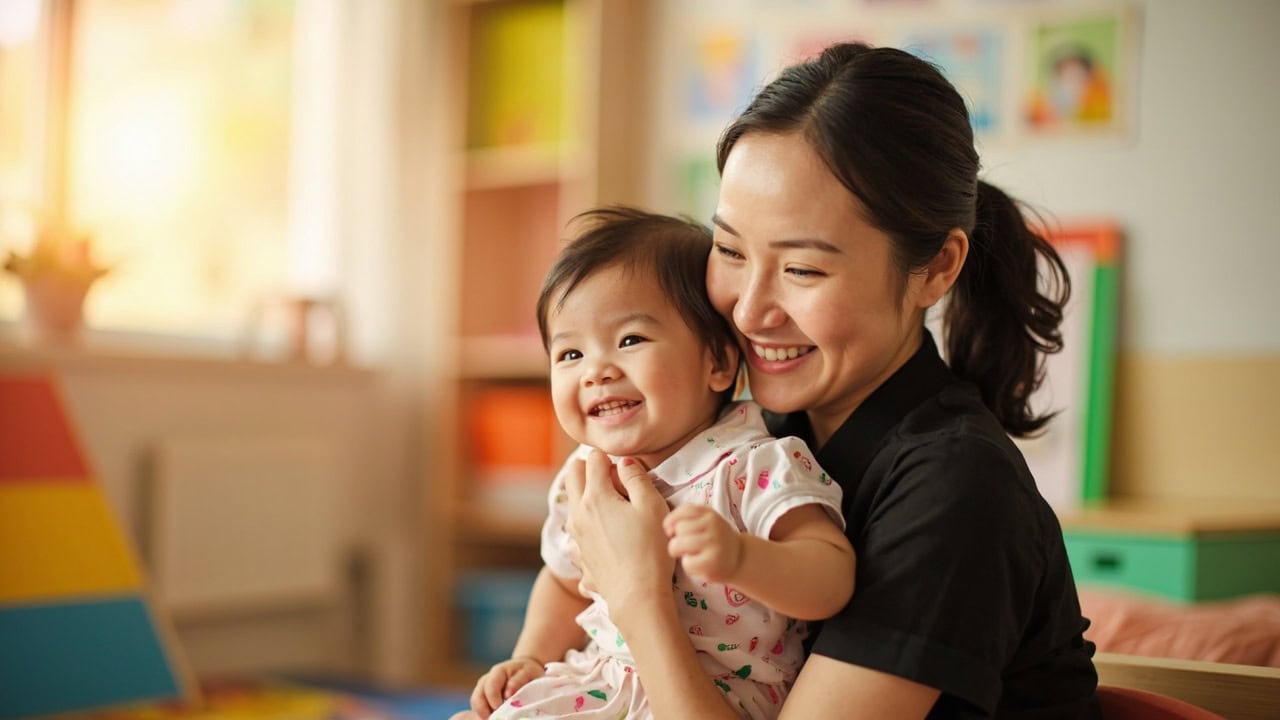
She is exposed to a consistent caregiver, or a very small team of caregivers, who come to know her rhythms as intimately as her own family does. She learns the texture of this person’s presence, the way they hold her when she is tired versus when she is curious, the sound of their voice in different moments.
When a child is in near-home care with a ratio of one caregiver to up to three infants, something becomes possible that is simply not achievable in a larger group setting. Each child can be seen as an individual — their rhythms observed, their cues read, their emotional states tracked and responded to in real time.
For an infant in the first year of life, this is not a luxury. This is the medium through which her emotional intelligence is being built.
What this looks like day to day:
- Consistent caregiver presence: Your infant builds a neurological expectation of who will be there — and this expectation of safety is itself protective.
- Responsive routines: The day has a predictable rhythm — feeding, sleep, play — that your child can internalize and rely upon.
- Real-time cue reading: Caregivers notice subtle signals of hunger, fatigue, or overstimulation before they escalate.
- Emotional attunement: Your child learns that her feelings matter, that she is seen, that her presence affects others positively.
- Warm, unhurried interactions: There is time for eye contact, for mirroring, for the slow exchanges that build trust.
EduNanny Singapore: Where Science Meets Care
Understanding what infants need is the starting point. Creating the conditions for it is where the work happens.
EduNanny Singapore is part of the ECDA Childminding Pilot, operating across both home-based and community-based pathways. Our care blocks are available Monday through Friday, designed to support working families across Singapore.
Our infant ratios are structured to make attunement achievable — not as an aspiration, but as a daily practice. Our caregivers are trained not only in the technical requirements of infant care, but in the attunement principles that research shows matter most: reading cues, responding with consistency, creating the sensory and emotional environment in which a child’s internal working model of trust can take root.
We believe trust is built in small moments. It is built in the way a caregiver notices your child’s frustration before it becomes a cry. It is built in the way routines are maintained — not rigidly, but responsively. It is built in the communication we maintain with families: the transparency, the updates, the photographs that show not just that your child is present, but how she is present — engaged, curious, content, held in a relationship that takes her seriously as a person.
Where deployed, our CCTV measures offer additional reassurance — not as surveillance, but as an extension of the transparency we believe families deserve.
Making Quality Care Accessible
Quality care should not be available only to those with substantial means. Through the pilot fee structures, supported by the usability of CDA and Baby Bonus schemes, we work to ensure that attunement-based infant care is accessible to families across Singapore.
Every infant deserves the kind of environment that builds a secure foundation. Every family deserves the ability to provide it.
What Singapore Parents Actually Worry About
These concerns come up again and again. They deserve honest answers.
“Will my child feel abandoned?”
Your child is not processing your absence the way you would. Infants do not experience separation with the same adult understanding of loss. What they experience — and what matters most — is the quality of presence they encounter in your absence. A consistent, attuned caregiver does not replace you. It extends the felt sense of safety into the hours you are apart.
“Is home-based care as good as a centre?”
The research does not support a simple answer to this question. What it consistently shows is that consistency and attunement matter more than setting. A small, consistent environment with a caregiver who is attuned to your child will almost always serve an infant better than a large setting where individual attention is diluted. Near-home care is not a compromise — for infants in the first year, it may be optimally suited to their developmental needs.
“How do I know the caregiver is really attuned?”
Look for signs of responsiveness: Does the caregiver speak about your child as an individual? Do they share observations about your child’s moods, preferences, and patterns? Do they communicate proactively — not just when something goes wrong, but about the ordinary moments of your child’s day? Attunement shows up in details: the way a caregiver pauses when entering a room, the way they give a child time to process before lifting them, the way they mirror facial expressions and wait for the child to lead.
“What if my child cries during drop-off?”
Crying at drop-off is developmentally normal and does not indicate that your child is being harmed or is unhappy overall. What matters is what happens after you leave. A child in attuned care typically settles within minutes of a parent’s departure — because she has learned that parting is temporary, and because the caregiver’s presence is genuinely soothing. If your child does not settle, or if crying persists and is not addressed, that is worth discussing with your caregiver.
Practical Guidance: Choosing Infant Care in Singapore
If you are researching infant care options, here are the questions worth asking — not just of providers, but of yourself.
- What is the caregiver-to-infant ratio? For infants in the first year, smaller is better. One caregiver to no more than three infants allows for genuine attunement.
- How consistent is the caregiver relationship? Will your child have one primary caregiver, or will she encounter multiple rotating faces? Consistency in the first year is foundational.
- How does the environment feel? Visit at an unscheduled time if possible. Notice the emotional temperature. Is it calm? Warm? Does it feel like a place where a child could thrive?
- How does the caregiver interact with the children present? Watch for attunement: do they kneel to a child’s level? Do they mirror expressions? Do they pause and wait for a child’s lead?
- What is the communication like? You should feel informed — not just about your child’s basic needs being met, but about her emotional state, her discoveries, her moments of contentment.
- What is the philosophy of care? Ask explicitly how the programme understands its role in your child’s emotional development. If the answer is only about safety and schedules, ask more questions.
The Interior Architecture of a Person
When you choose near-home care for your infant, you are not simply arranging supervision so that you can return to work. You are making a statement about what you believe your child needs — not just to be kept safe, but to be built well.
You are investing in the interior architecture of a person who will one day be a child in a classroom, a teenager navigating friendships, a young adult entering relationships and careers — all of them drawing, whether they know it or not, on the felt sense of safety and trust that was installed in those first thousand days.
The events themselves may not be remembered as stories or images. Your child may not grow up recalling the particular smell of her caregiver’s skin or the rhythm of those afternoons. But their residue is stored in the body, in the nervous system, in the implicit knowledge of whether the world is a place that responds to you or ignores you.
This is the work that caregivers do every day, often without recognition, always with profound consequence.
Think of your child at the end of a care day, being handed back to you with that particular look of recognition — not just that you are her parent, but that you are her person, the one she has been oriented toward all day, the one who makes sense of the world by confirming that it is a place worth returning to.
Think of the caregiver in that moment, watching the reunion with something quiet and satisfied, knowing that she has held up her end of a fragile and essential bond.
Think of the child, too young to speak of it, already carrying forward the knowledge that there are good people in the world, that care is reliable, that she is attended to — not because she cried loud enough, but because she was noticed.
The first home inside your child’s memory is not made of walls. It is made of presence, of rhythm, of the thousand small moments when someone paid attention and got it right.
That is the architecture we are committed to building, one child, one family, one day at a time.
If you are ready to learn more about how EduNanny Singapore approaches infant care — or if you simply want to have a conversation about what your family needs — we invite you to reach out. The right care for your child is closer than you think.
#infantcareSingapore #nearhomecare #childmindingSG #firstthousanddays #EduNannySingapore