Beyond the Sunday Lunch: How Singapore Parents Are Redefining Family Care
The Grandparent Gap: How Singapore Parents Are Redefining Family Care
There is a moment that happens in almost every Singapore household, usually over a Sunday lunch, when a grandmother reaches across the table and says the words that have launched a thousand parental debates.
“Let me help. I raised four children. I can handle one baby.”
And in that moment, something beautiful and something complicated arrive at the same time.
The beautiful part is obvious. She means it. She loves this child already, fiercely and completely, in the way that only grandparents can. She is offering not just childcare but continuity—she is offering to weave your child into the fabric of your own childhood, to be the thread that connects who you were to who your child is becoming.
But the complicated part—the part that keeps modern parents lying awake at 2 a.m., replaying that Sunday lunch conversation—that complicated part is almost entirely unspoken.
We have built entire industries around childcare advice, yet we have barely begun to talk about the most intimate, charged, culturally loaded childcare decision in Singapore: the role of grandparents in our children’s early years.
Today, we want to sit with that complexity together. Not to tell you what to decide, but to name what you are actually navigating—and to show you why near-home care, done thoughtfully, can complete the village without breaking it.
The Two Stories of Singapore Grandparenting
The story of modern grandparenting in Singapore is not one story but two, told simultaneously.
There is the story our parents tell—a story of resilience, of raising children in a Singapore that was younger and louder and somehow, in memory, full of afternoon light. They raised us with what they had, and what they had was often not enough, and they made it enough anyway. That story is true and it deserves honoring.
And then there is the story our parents are living now—a story that looks quite different.
In the 2020s, full-time grandparent childcare means something different than it did a generation ago. It means bodies that are not as young as they once were, carrying a toddler from morning to evening, five or six days a week. It means lifting a toddler repeatedly, bending to buckle car seats, chasing a newly walking child up and down corridor stairs—demanding work for bodies that may be managing arthritis, recovering from surgery, or simply the accumulated gentle resistance of age.
It means grandparents who moved to Singapore from Johor or Guangdong province, living far from their own siblings and friends and sources of rest—and finding themselves in a flat in Ang Mo Kio or Clementi, alone with a baby all day, speaking a dialect that the child’s parents have already begun to quietly replace with English.
We do not say these things aloud very often, because gratitude should not come with conditions. But we want to acknowledge something that most parenting literature ignores: loving grandparents are not always available grandparents, and available grandparents are not always rested grandparents, and rested grandparents are not always grandparents who signed up for full-time infant care in their sixties and seventies.
The grandmother who raised four children in the 1980s raised them in a world where babies were kept quiet, where schedules were rigid, where the goal was compliance and safety and not too much crying. The world your child is growing up in has different expectations—play-based learning, responsive attachment, rich language exposure, sensory environments that a forty-year-old nursery could not have imagined. Grandparents often do not know this world. They love the child desperately, but they are being asked to perform a role that has quietly transformed into something they were never trained for and never expected.
This is not a criticism of grandparents. It is a recognition of what we have asked of them—and what we have rarely examined.
Why Proximity Is Not the Same as Attunement
Here is what attachment science tells us, not in the language of journals, but in the language of every parent who has ever watched their child reach for someone and felt their heart expand and contract at the same time.
The first thousand days of a child’s life matter enormously. The quality of early attachments shapes not just emotional development but cognitive architecture, stress response systems, and the capacity for relationship throughout life. This is not a soft claim; it is one of the most replicated findings in developmental psychology.
But here is what we often misunderstand about attachment: it is not produced by love alone. It is produced by attuned, responsive, consistent interaction over time. A loving grandparent who is distracted, exhausted, or overwhelmed—even by love—cannot offer the same quality of attunement as a caregiver who is rested, trained, and able to give their full presence.
Think of it this way: your child does not need one perfect attachment figure. Your child needs a network of relationships that are warm, consistent, and responsive—and that includes you, and can include grandparents, and might also include a childminder who brings professional training and rested attention to every interaction. The village is not a zero-sum equation. It is an ecology.
A child who knows their grandparents deeply—who spends weekends in their grandfather’s workshop, who hears her grandmother’s voice saying the prayers she learned as a girl, who is carried and fed and loved by people who have known her parents since before her parents were her parents—that child is richer than a child who knows only the professionals who care for her.
But a child who also receives expert, attuned, responsive early care—a child who is in a setting designed for her development, with a caregiver who is rested and trained and giving her full attention—that child is richer still. Not instead of. In addition to.
What Quality Childminding Actually Looks Like
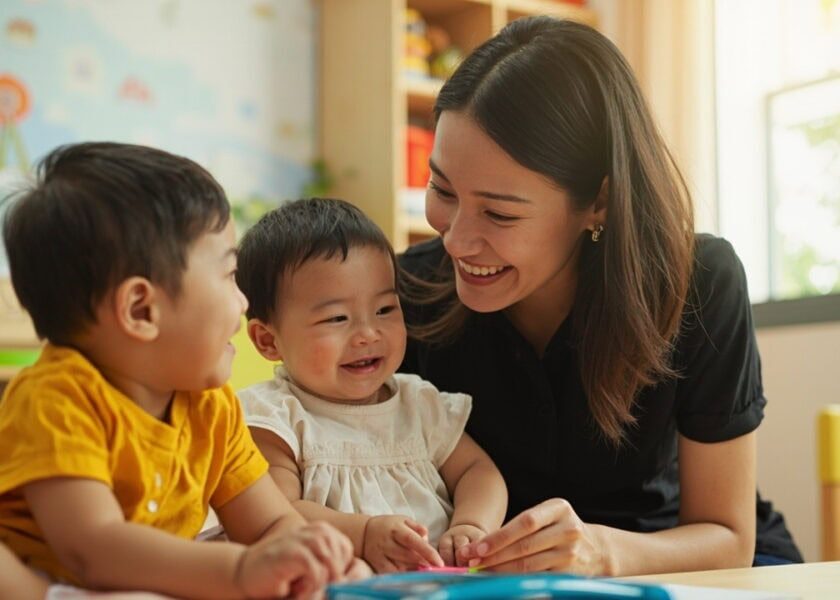
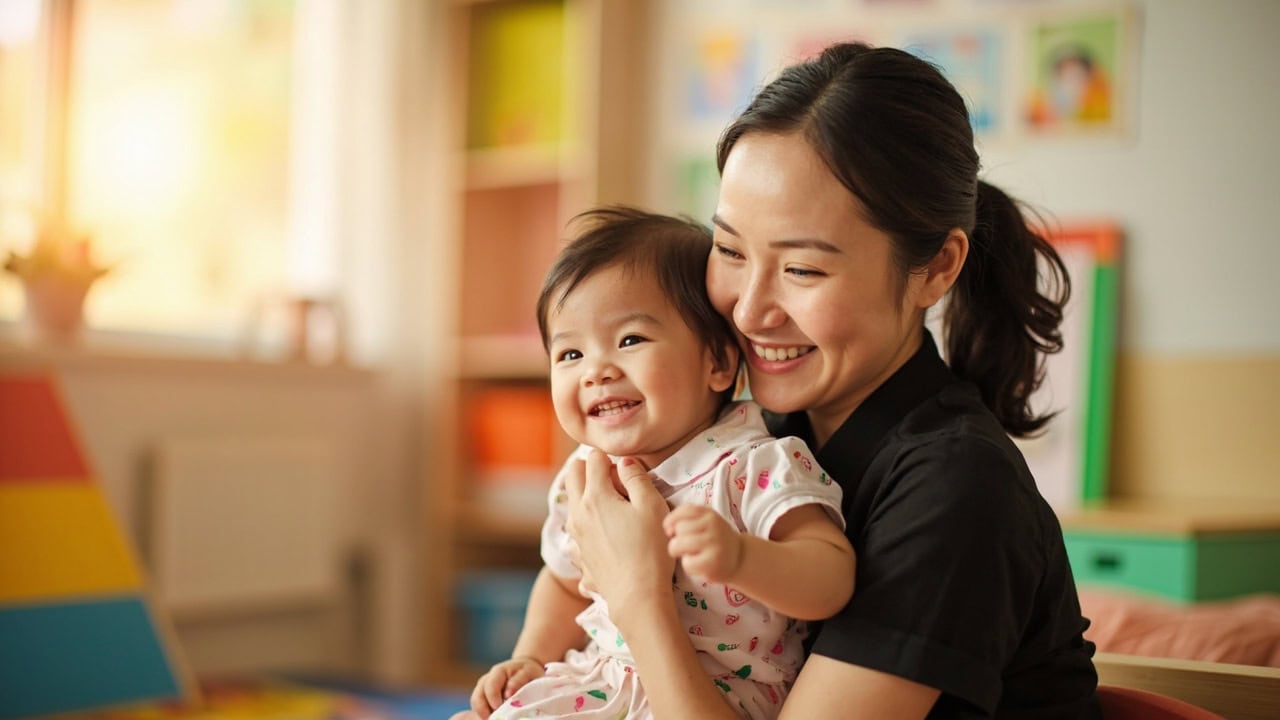
For Singapore families navigating this tension, near-home childminding offers something that neither full-time grandparent care nor large center-based care can provide: a middle path that honors both generational wisdom and modern early childhood best practices.
Quality childminding is characterized by several key elements:
- Small ratios: A caregiver tending to no more than three infants at a time, allowing for genuine attunement to each child’s cues, moods, and developmental shifts.
- Home-based setting: An environment that feels familial rather than institutional, closer to home, and accessible for grandparent visits.
- Professional training: Caregivers who understand early attachment, developmental milestones, and play-based learning approaches.
- Rested attention: The fundamental difference—a caregiver who can give genuinely available presence because they are not emotionally or physically depleted.
- Communication and transparency: Systems that allow parents to trust what they cannot see.
The key insight is this: children need multiple warm, consistent, responsive relationships. They do not need one person to do everything. In fact, research suggests that a diverse care network—one that includes family members in their appropriate roles and professional caregivers in theirs—may actually support healthier attachment development than any single caregiver arrangement.
EduNanny: Completing the Village
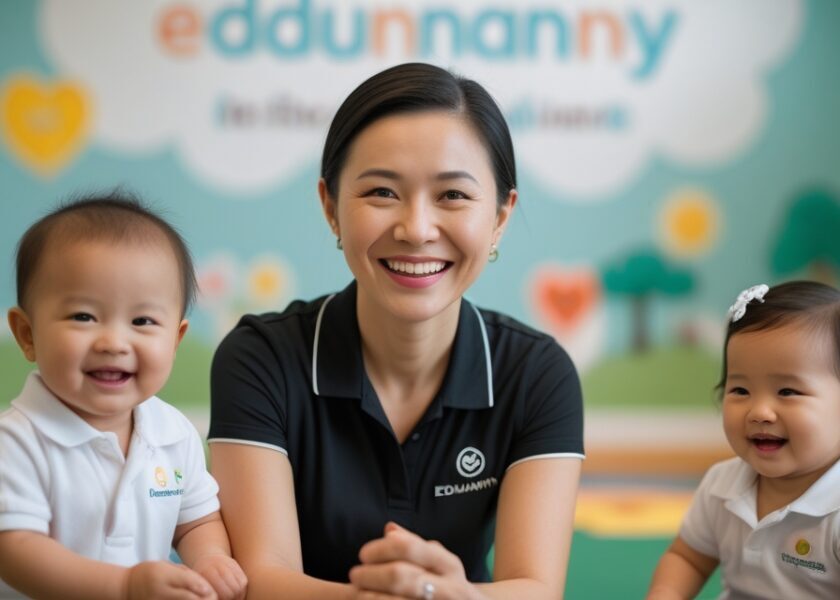
EduNanny by BUTLER operates within the ECDA Childminding Pilot, part of Singapore’s deliberate effort to expand what early childhood care can look like. The pilot was designed because policymakers recognized that center-based care alone does not serve every family—that there are children for whom home-based care, with its smaller ratios and familial warmth, is simply a better fit.
Our childminders care for up to three infants at a time. This ratio is not an accident. It is the ratio that allows a caregiver to truly know each child, to notice the small shifts in mood and development that larger settings miss, to respond with genuine attunement rather than generalized care.
The care is near-home, which means your child is not traveling across the island to an unfamiliar environment. They are in a setting close to where you live, close to the rhythms of your neighborhood, and—importantly—close enough for grandparents to visit, to participate, to remain woven into the child’s life rather than sidelined by distance.
What Parents Have Told Us They Need
We know that parents need to trust what they cannot see. That is why we have implemented communication and transparency measures, including CCTV where deployed, so that you know what is happening in real time.
We know that affordability matters. That is why we operate within pilot fee structures designed to be accessible, and why CDA and Baby Bonus funds can be used to offset costs.
We know that flexibility matters. That is why care is available in structured Monday-to-Friday blocks that align with how most Singapore families actually work.
None of this is designed to compete with grandparents. All of it is designed to support a family system in which everyone can contribute what they genuinely have to give.
What This Looks Like in Practice—and How to Talk About It
A grandmother who has been doing full-time childcare for two years is exhausted. Her daughter-in-law knows this but has not known how to say: “Mama, we need a different arrangement—not because you are not enough, but because you have already given so much.” With near-home childminding, that grandmother can now come two mornings a week. She can pick up her granddaughter from the childminder’s home at 4 p.m., just as she used to pick up her own daughter from school. She can be the grandparent again—present, joyful, rested—rather than the primary caregiver who has quietly been drowning.
A grandfather who misses his grandson because they live in different parts of Singapore can now visit the near-home setting on Wednesday afternoons. He is not replacing anyone. He is simply present in his grandson’s life in a way that distance and full-time caregiving had made impossible.
A mother who has felt guilty for years about wanting professional care—who has whispered to her husband in the dark that she does not know how to tell her own mother that she does not want her to watch the baby anymore—can now frame this differently. “Mama, we found something that lets you be grandma, fully and beautifully. You are not being replaced. You are being freed.”
We know that the distance between what you want to say and what you can actually say to your parents is sometimes very far. Here are some ways to begin.
When you want to honor what they’ve given while asking for something different:
“Mama, I want our child to know you the way I know you. I want you to be the grandmother who bakes with her, who tells her stories, who picks her up and makes everything okay—not the grandmother who is too tired to play, who has to say no to one more round of chasing because her knees hurt.”
When you want to reframe professional care as an act of love:
“Ah Ma, you gave me everything. I want to give our child everything too. And that means finding care that has the energy and training for the hours when you deserve to rest.”
When you want to expand rather than divide the village:
“This is not about choosing between you and professional care. It is about building a village that has room for all of us, doing what we do best.”
Grandparents in Singapore have earned the right to be honored—not because they raised children decades ago, but because they are raising them still, in different ways, with different gifts. A grandparent who is freed from the burden of full-time infant care can be a grandparent in the truest sense: the person who spoils a little, who teaches a language, who passes down recipes and songs and the feeling of being utterly adored. This is not a lesser role. It is the role that grandparents are meant to play.
Addressing Your Real Concerns
If you are feeling the weight of this decision right now, you are not alone. Here are the concerns we hear most often—and why they deserve honest answers rather than dismissal.
“Am I betraying my parents by wanting professional care?”
No. You are not failing at filial duty by recognizing that what they once did beautifully has become difficult. You are not choosing your child over your parents. You are choosing, as every generation of parents must, to do what you believe is best for the child who is in your sole keeping—and you are doing it with your eyes open, with your heart full of gratitude, and with your hands extended toward everyone who loves this child.
“Will my child still have a bond with their grandparents?”
Near-home care actually preserves and often strengthens grandparent relationships. When grandparents are no longer the primary caregiver, they are freed from the stress and exhaustion that can erode the joy of interaction. Visits become something to look forward to rather than obligations to dread. The bond deepens because it is no longer weighed down by the demands of full-time care.
“Is this about saying grandparents aren’t good enough?”
Not remotely. This is about understanding that loving grandparents are not always the same as rested, trained, available caregivers for forty-plus hours a week. The issue is not capability—it is sustainability. The question is not whether grandparents love children. The question is whether one person—regardless of how much they love—should carry the full weight of infant care alone.
“Will I lose the multigenerational benefits for my child?”
The opposite is often true. Children raised in a thoughtfully designed care network gain more from each relationship than children who have one overwhelmed primary caregiver. Your child still knows their grandparents deeply. They still learn the language, the stories, the family recipes. They simply also have access to professional, attuned care during the hours when their grandparents deserve to rest.
The Village Expands
The guilt you feel is not a sign that you are doing something wrong. It is a sign that you care enormously about getting this right.
But some of that guilt is based on a false premise: the idea that the village can only hold so many people, that welcoming professional care means closing the door on grandparents.
The village holds everyone who loves this child. It holds you. It holds your parents. It holds the childminder who chose this work because she believes that every infant deserves attentive presence in their first thousand days.
The village is not a fixed plot of land with a gate. It is an expanding circle of care, and it grows larger every time we refuse to pretend that love is enough on its own, and every time we do the harder, wiser thing of building systems that allow love to be expressed in the ways it is actually needed.
There is a photograph we want you to hold. It is a Saturday morning in a flat in Singapore, any flat, and a grandfather is on the floor with his granddaughter. She is eighteen months old, and she is showing him how to stack blocks, and he is watching her with a concentration that is indistinguishable from love, because for him, it is love—watching this small person discover how the world fits together, being present for the wonder.
He is rested. He is unhurried. He is not exhausted from five days of full-time infant care. He is simply, fully, the grandfather he has always wanted to be.
Across the room, her mother is making breakfast, and the child’s childminder has the morning off, and everything is as it should be: a family in which each person is giving what they genuinely have, and receiving what they genuinely need.
This is the village we are building together. Not a village that replaces the old ways, but one that makes them possible again. Not a village without grandparents, but one in which grandparents can finally be grandparents.
Taking the Next Step
EduNanny was founded on a simple conviction: that Singapore’s children deserve more than one model of care, and that families deserve more than a binary choice between center-based schedules and informal arrangements that strain everyone involved.
We keep our ratios small because we believe that attunement requires space, and space requires numbers that allow a caregiver to truly know each child. We maintain transparency through our communication measures because we believe that trust must be built and visible, not assumed. We price within pilot structures and accept CDA and Baby Bonus funds because we believe that quality care should not be available only to those who can afford premium pricing.
If you are navigating this decision—if you are caught between the love you feel for your parents and the instinct you feel toward professional, attuned care—we want to walk alongside you.
Your child is lucky to have grandparents who love them. Your child is lucky to have parents who care this much about getting it right. And your child is lucky, if you choose us, to have near-home, attentive, professional care as part of the village—close enough for family to remain woven in, small enough for genuine attunement, structured enough to support both your child’s development and your family’s wellbeing.
The village expands. The love remains. And together, we give our children not just what we inherited, but what we have chosen.
Explore how EduNanny’s near-home childminding services can complement your family’s care arrangements. Learn more about our approach or speak with our team about what a care arrangement that honors everyone in your household might look like for your family.
#SingaporeChildcare #GrandparentCare #NearHomeCare #EduNannySG #AttachmentScience