
EduNanny Redefined Safe Joyful Infancy Across Singapore Through Near Home Care and Attunement

EduNanny by BUTLER: Redefining Infant Care and Early Learning in Singapore
Thank you for joining this conversation about the first rooms where our children are held, heard, and helped to grow. EduNanny by BUTLER is not merely another care option; it is a living standard for infant care and childminding that treats everyday moments as the building blocks of a life. Grounded in Singapore’s needs and values, EduNanny blends evidence-based practice with practical, scalable delivery—centre-based and home-based—across the island, Monday to Friday, 7am to 7pm. At a 1:3 infant-to-caregiver ratio, with transparent design, secure opt-in CCTV for peace of mind, and affordability starting from $33/day, EduNanny makes high-quality care accessible, safe, and meaningful for families and society alike.

Foundations: The Philosophy that Guides EduNanny
EduNanny is shaped by a lineage of early childhood pedagogy and safety science. We draw on Montessori’s prepared environment, Pikler’s respectful caregiving, and Vygotsky’s guided discovery, while anchoring practice in Bowlby’s secure attachment, Erikson’s psychosocial development, and contemporary safety standards. This synthesis translates into quiet, repeatable routines that protect the infant nervous system while inviting curiosity and competence. The result is a care model that respects both the child’s inner pace and the family’s realities.
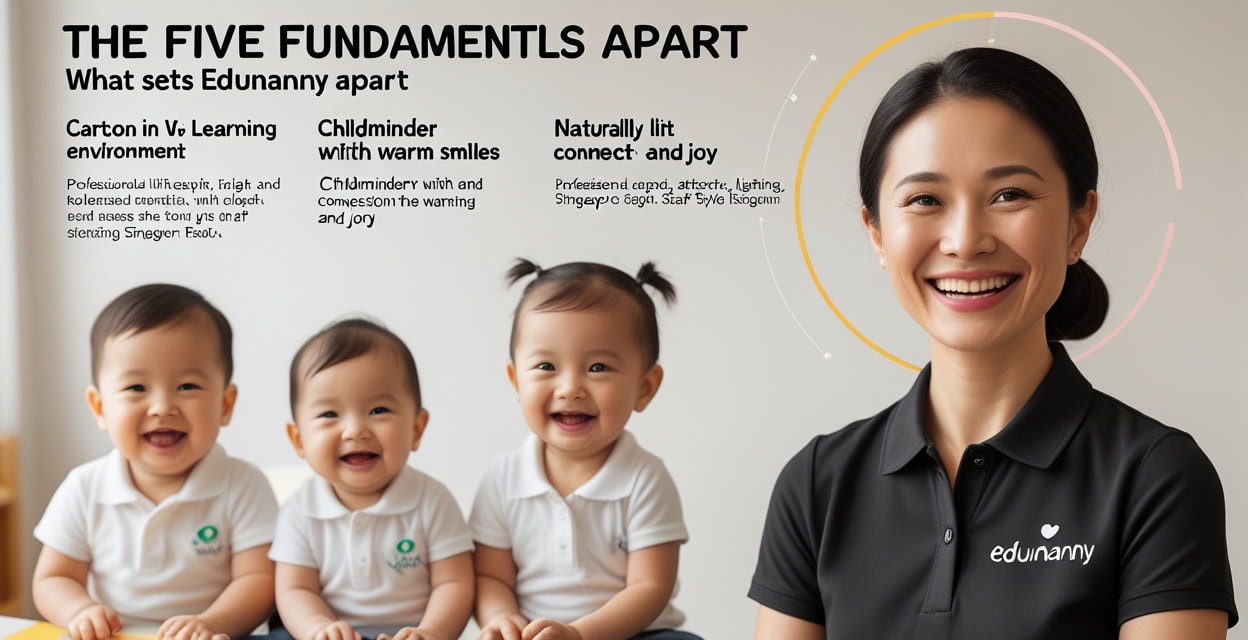
The Five Fundamentals: What Sets EduNanny Apart
We organise practice around five core fundamentals that matter most to families. Each is designed to work in tandem with the others, creating continuity from home to centre and back again.
- Closeness—Reduce commuting strain and maximize continuity by placing infant care close to where families live and work, with consistent caregivers who know the child’s patterns and preferences.
- Transparency—Design both physical space and digital communication to build trust; secure CCTV is opt-in and paired with respectful privacy practices, clear daily notes, and parent-friendly dashboards.
- 1:3 Rhythm—A caregiver who truly sees an infant, not just supervises, enabling deeper responsiveness, faster cue recognition, and personalised pacing.
- Teaching Mindset—Recognise that feeding, diapering, and sleeping are learning moments; each routine is an opportunity to expand language, motor skills, and self-regulation.
- Reliability—Centre- and home-based options with consistent hours (7am–7pm, Monday to Friday) to create stable adults and stable days for babies.
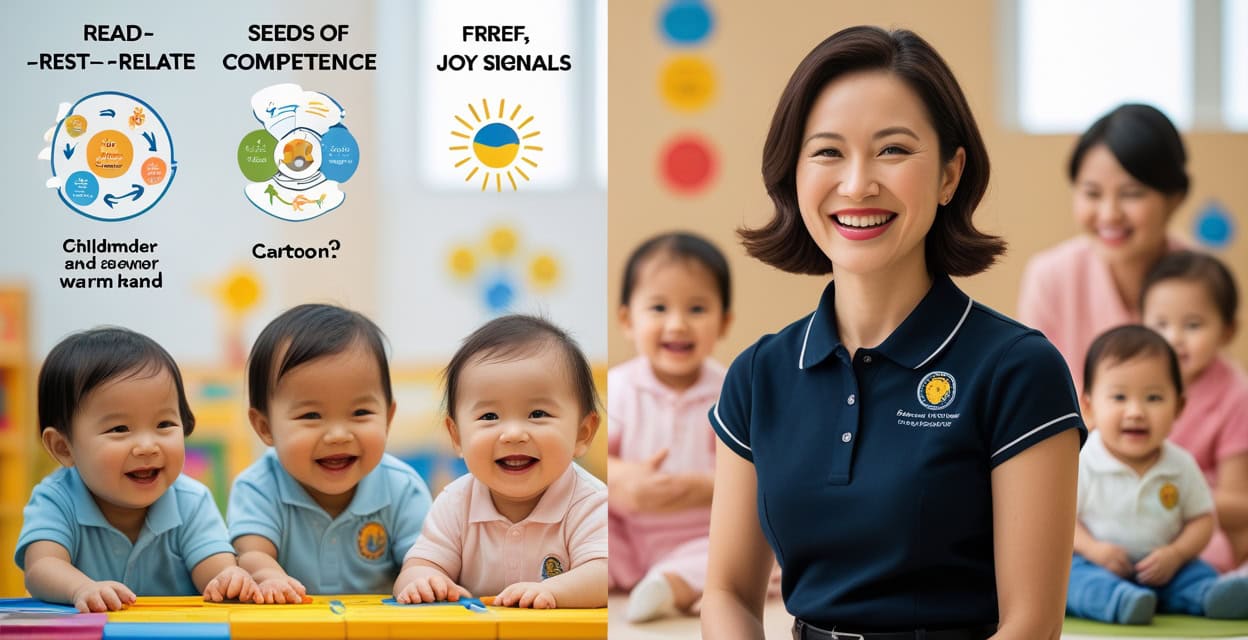
Four Practice Areas: Read–Rest–Relate; Safe-Path Mapping; Seeds of Competence; Joy Signals
Topic 1: Read–Rest–Relate—Our Daily Cadence for Infant Pedagogy
Infant learning is a tide, not a timetable. Our Read–Rest–Relate cadence aligns with the child’s voice, body, and bond, turning everyday moments into rich learning opportunities. Here’s how to translate this cadence into practical routines:
- Read—Read cues continuously: breathing rate, eye gaze, hand movements, vocalisations. Train caregivers to respond to a yawning as a cue for rest or a gaze for joint attention. Actionable tip: maintain a 3–5 minute “cue check” every 15–20 minutes during awake periods to stay attuned.
- Rest—Unhurried routines cultivate self-regulation. Separate “settling” from “sleep onset” with predictable steps: warmth, gentle rocking, soothing voice, and a comfortable sleep position. Practical example: create a consistent pre-sleep ritual with a familiar object or blanket to signal sleep readiness.
- Relate—Co-narration links sensation to language. Use precise phrases during care routines: “I’m lifting your left arm to put on your sleeve,” reinforcing vocabulary and social understanding.
Implementation in EduNanny centers ensures staff are trained to apply this cadence across feeding, diapering, and transitions. Home-based caregivers can mirror the cadence, using caregiver-led narration to reinforce language and emotional security. A practical home exercise: during diapering, narrate every action and invite the child to participate with simple movement (e.g., “lift your leg” or “arms up”), turning routine care into a cooperative learning moment.
Topic 2: Safe-Path Mapping—Safety by Design, Habit, and Relationship
Safety is a culture, not a checklist. Our Safe-Path Map spans four layers to create calm, predictable environments where infants can explore with confidence.
- Physical—Floor plans with sightlines, low shelves, soft flooring, rounded edges, and age-appropriate equipment. Daily checks ensure furniture is stable and surfaces are clean. Actionable tip: implement a “safety walk” each morning where staff rotate zones to review for hazards and record findings.
- Procedural—Three daily safety sweeps (bottles, sleep, hygiene), safe sleep protocols, precise handovers, and drills tailored to the local context. Practical example: standardized handover cards that capture the baby’s feeding cues, sleep state, and any concerns, shared at shift change.
- Relational—With a 1:3 ratio, each infant is known by name, pattern, and preference. Secure attachment supports exploration and reduces injury risk. Implementation idea: maintain a simple “infant profile” per child that includes triggers, soothing strategies, and comfort objects, updated weekly by caregivers in collaboration with parents.
- Digital—Opt-in, secure CCTV and data stewardship; transparent parent communication that informs without intruding on dignity. Practical guidance: establish privacy-friendly camera zones and a clear policy for when video access is granted, with parental consent documented and revisited annually.
Beyond compliance, Safe-Path Mapping nurtures a predictable rhythm that infants feel as safety. Parents can support this at home by aligning sleep routines, feeding windows, and quiet-time rituals with what EduNanny provides, enabling smoother transitions and stronger trust bonds.
Topic 3: Seeds of Competence—Deliberate Growth Across Five Domains
We cultivate development across five interwoven domains. Each domain is supported by purposeful daily experiences rather than isolated milestones.
- Attachment and Emotional Security—Consistent responders, warm tones, responsive touch, and reliable routines foster secure base behavior. Practical activity: establish “caregiver stay-prompt” moments where a caregiver remains with the infant during a transition to demonstrate steady support.
- Sensorimotor Confidence—Open floor space, reachable materials, and time to retry builds balance, strength, and initiative. Home-tip: provide age-appropriate objects that invite reaching, grasping, and exploration in short, regular play windows.
- Early Communication—Co-narration, turn-taking sounds, songs, gesture games, and shared book experiences lay foundations for speech and literacy. Practical exercise: two short language-rich sessions per day—one during feeding and one during play—focusing on naming objects and actions.
- Executive Function Beginnings—Simple, two-step routines and wait-for-it games nurture impulse control and focus. Activity idea: offer a choice between two safe options and require waiting for a cue before acting, gradually increasing wait times as the child grows.
- Social Awareness and Belonging—Tiny group rituals teach infants to notice others, share space, and enjoy community. Home practice: model and reward sharing during snack or toy time, narrating social rules in simple terms (“We pass the block,” “Your turn is coming.”).
EduNanny does not chase milestones; it collects small competencies. Over time, these formative moments accumulate into confident, curious, capable children who feel at home wherever they are.
Topic 4: Joy Signals—Recognising and Nurturing True Happiness
Happiness in infancy is visible when we see the child’s cues. Our Joy Signals Protocol trains childminders to monitor three robust indicators:
- Relaxed Body—Soft shoulders, open hands, restful sleep, and unhurried breathing signal comfort and safety.
- Rhythmic Play—Repetitive, self-chosen actions (rolling a ball, stacking blocks) demonstrate mastery through repetition, not boredom.
- Reciprocal Gaze and Sound—Sustained eye contact and back-and-forth vocalizations reflect trust and curiosity.
Parents stay connected through daily notes, secure video moments, and end-of-day conversations that highlight personality and growth, not only schedules. A truly joyful environment honours quiet moments of delight as much as visible milestones.

Operational Excellence: The EduNanny Model in Practice
EduNanny blends quality with practicality, offering consistent, meaningful experiences for families and robust support for staff. Here are the practical elements that translate philosophy into daily life.
- 1:3 Infant Ratio—A non-negotiable core that enables genuine observation, rapid response, and individualized support.
- Centre-Based and Home-Based Options—Islandwide access with distance support to guide home routines when required, ensuring continuity across settings.
- Hours—Monday to Friday, 7am–7pm, to align with real working-day patterns and reduce fatigue for caregivers and families.
- Environment—Modern, open-plan layouts designed for supervision and safe exploration, with materials that invite independent investigation under guided oversight.
- Security and Transparency—Opt-in secure CCTV paired with clear privacy protocols and regular parent communication that informs, not alarms.
- Affordability—Care starting from $33/day with CDA/Baby Bonus accepted, making high-quality care accessible to more families.
- National Alignment—A proud partner in the ECDA Childminding Pilot, contributing to a national initiative that elevates standards and creates meaningful employment.

Affordability and Access: Making High-Quality Care Feasible
Excellence must meet families where they are. EduNanny combines competitive pricing with social impact. By participating in the ECDA Childminding Pilot and offering payment options like the CDA/Baby Bonus, we remove key barriers to access. We also design long hours, stable routines, and localized premises to reduce travel time, enable continuity of care, and support working families. For parents, the practical takeaway is simple: inquire about centre distance, caregiver continuity, and how daily notes translate to your child’s growth, then compare against a transparent pricing structure.

Parent and Caregiver Partnership: What Families Can Do to Maximise Benefits
High-quality care emerges from a strong partnership between families and EduNanny. Here are practical steps for families to participate actively in their child’s learning journey.
- Share Home Languages and Routines—If your child’s home language is different from the centre’s language, request bilingual notes and language-rich activities to promote language development and cultural continuity.
- Consistency Across Settings—Coordinate feeding windows, nap times, and soothing strategies with your EduNanny team to create smooth transitions and stable routines.
- Engage in Co-Narration at Home—Practice live narration during daily activities (meals, dressing, play) to reinforce vocabulary and social concepts at home.
- Review Daily Notes Together—Ask for specific observations like “today I noticed” entries, which can reveal interests, fears, or emerging preferences, guiding more personalised care.
- Participate in Safety Conversations—Discuss Safe-Path practices, privacy concerns for CCTV, and how to balance transparency with dignity to build trust on both sides.

Who, What, When, Where, and How: A Practical Roadmap to EduNanny
We present a clear, family-centric roadmap that mirrors the structure of EduNanny’s core offering.
- Who—Infants and toddlers aged 0–3; parents seeking safety, warmth, and learning; caregivers seeking dignified, meaningful work; employers relying on reliable care for teams.
- What—High-quality childminding combining attachment-informed care, evidence-based pedagogy, and safety-by-design at a 1:3 ratio.
- When—Monday to Friday, 7am–7pm; predictable routines that fit modern work patterns and support family stability.
- Where—Centre-based rooms and home-based settings islandwide, with optional distance guidance for at-home routines.
- How—Prepared environments, respectful care routines, co-narration, Safe-Path Mapping, transparent documentation, secure CCTV, training, and a consistent focus on safety, belonging, and development.

Why EduNanny Matters: The Public Good of Early Care
Infancy and early years have impact beyond memory. They shape temperament, trust, and lifelong curiosity. By making high-quality care safe, accessible, and deeply human, EduNanny strengthens families and, by extension, Singapore’s social fabric and future workforce. When childminders are respected, trained, and well-supported, communities thrive.

Closing: Ordinary Moments, Extraordinary Futures
The future arrives not with fanfare but in the steady breaths of a sleeping child, a caregiver’s quiet voice naming an emotion, and the repeated success of a small block tower in balance. EduNanny exists to dignify those moments—to make them safe, purposeful, and within reach of every family. If you believe, as we do, that early care is both an intimate act and a public good, we invite you to visit us, walk our rooms, meet our childminders, and see how small, careful practices become a lifetime’s foundation.
Because when infants are held well, a nation stands taller.
Visit EduNanny.com or Childminding.EduNanny.com to learn more and to join the movement.

Conclusion
In Singapore’s evolving landscape of early childhood care, EduNanny by BUTLER stands as a benchmark for quality, accessibility, and human-centred practice. By centring families in design and delivery—through Read–Rest–Relate cadence, Safe-Path Mapping, Seeds of Competence, and Joy Signals—EduNanny demonstrates how daily routines, when done with care and intention, become the foundation for lifelong learning and well-being. Join us in reimagining the first rooms of childhood as spaces where safety, trust, and learning are inseparable, and where every ordinary moment becomes a building block for a resilient future.
[#keyword1, #keyword2, #keyword3, #keyword4, #keyword5]Ready to Experience Excellence?
Transform Your Family’s Journey
Discover Singapore’s leading infant care and childminding services. Expert guidance for your little one’s first thousand days.