
Attuned Minute and Near Home Pods A Civic Vision for Safe Joyful Infancy in Singapore

Introduction: What EduNanny Is—and Why It Matters
Thank you for joining EduNanny as we chart a course for Singapore’s shared future in childminding. In a city that moves with remarkable speed, EduNanny exists for the one part of life that must never be rushed: the beginning. We are EduNanny by BUTLER—Singapore’s centre-based and home-based childminding movement—built to make the first thousand days safe, joyful, and deeply human.
EduNanny unites the best of infant pedagogy and practical life for modern families. We draw from Montessori’s prepared environments, Pikler’s respectful care, Bowlby’s secure attachment, Vygotsky’s guided participation, Piaget’s discovery, Froebel’s play, and Erikson’s early trust. Then we translate that wisdom into everyday practice—from floor-level attunement and safe sleep to language-rich routines and transparent family partnerships.
We are part of Singapore’s social compact: Monday to Friday, 7 a.m. to 7 p.m., islandwide. We operate in community settings and home premises; we deliver an ultra-low 1:3 infant ratio; we provide secure innovation CCTV and modern layouts; we make access affordable from $33 per day with fees payable by CDA/Baby Bonus; and we do it under a national spirit—through the ECDA Childminding Pilot, as a public-minded initiative with a Maximum Employment Mandate that uplifts the caregiving workforce and serves families where they live.
Our promise is simple: beginnings worthy of potential. Our work is detailed, measurable, and personal.
In the pages that follow, we offer practical guidance drawn from EduNanny’s Attuned Minute approach, with actionable steps for parents, caregivers, and communities to apply in daily life.

The Attuned Minute: A Unique Explainer
Infants learn in tiny windows—sixty-second cycles of “serve and return.” EduNanny trains childminders to master the Attuned Minute: pause, notice, respond, and name. When a baby reaches, we meet the reach. When a baby babbles, we answer in kind. When a baby is unsettled, we slow the room. This is not soft sentiment—it’s rigorous pedagogy. Attention at eye level stabilizes the nervous system, organizes experience, and lays pathways for language, motor planning, self-regulation, and trust. Minute by minute becomes month by month—becomes a life that expects the world to be safe and navigable.
To translate this into home practice, families can adopt staged play: short, predictable exchanges that honor the child’s lead. Below are practical ways to weave the Attuned Minute into daily routines.
- Pause deliberately before responding to a cue (a pause of 1–2 seconds can reset momentum and invite a meaningful reaction).
- Notice nonverbal signals—eye gaze shifts, breathing patterns, and body posture—to tailor an appropriate response.
- Respond with warmth and specificity—“I see you found the red block. Do you want to put it on the shelf together?”
- Name what the child expresses, even before a full word is available—this anchors language development.
- Repeat the interaction in slightly varied forms across the day to build neural pathways for trust and communication.
Implementing the Attuned Minute is a collaborative practice: it requires training, consistency, and a shared language between families and carers. When done well, minute by minute becomes a life of confidence, curiosity, and resilience.

Four Topics Shaping Infant Care in Singapore Today
1) Pedagogy: The Calm Triangle—Observe, Name, Invite
EduNanny’s Pedagogy rests on three rhythmic actions that become a universal language across centres and home-based settings:
- Observe: We begin on the floor, at the baby’s horizon. Watch the gaze, the breath, the hand. Note readiness, not just age. For parents, this means slowing down to notice subtle cues like a widening smile after a gentle bounce or a shift in posture that signals curiosity.
- Name: We give language to experience. Examples: “You found the red ball.” “You hear the bus.” Naming anchors memory and maps the world. Parents can practice daily by narrating simple, concrete actions and sensations during routine care—bath time, diaper changes, or stroller rides.
- Invite: We extend the moment by one gentle step—roll to reach, point to choose, hum to coo, tap-tap-pause to encourage imitation. Micro-invitations respect the child’s pace while gradually widening their repertoire of actions and words.
Why it works: These micro-invitations mirror Vygotsky’s scaffold and Montessori’s self-chosen work. Short, repeatable, and predictable routines become the curriculum without eclipsing the child’s lead. Practical takeaway for families: create a daily “Observe-Name-Invite” loop during 15-minute play windows and during transitions between activities.
2) Safety: Quiet Engineering That You Can See and Feel
Safety should be designed, not declared. EduNanny’s model rests on calm procedures that disappear into the background but never into complacency. Focus areas include:
- Ultra-low ratio 1:3: Ensures eyes, hands, and hearts can keep pace with tiny signals. Plan activities that accommodate every infant’s pace and signal for rest when necessary.
- Safe sleep by default: Back to sleep, firm surface, no pillows or loose bedding; room-sharing without bed-sharing; visual checks without overstimulation. Parents should establish a consistent sleep routine that mirrors the Attuned Minute’s calm approach.
- Allergy controls that are boring by design: Single-source snack prep, colored allergen tags, double verification, incident drills. Create simple kitchen protocols that minimize risk and maximize confidence for caregivers and families alike.
- Secure innovation CCTV with privacy safeguards: Transparency that improves practice and reassures families while respecting boundaries. Regular reviews of footage use, consent, and access are essential.
- Daily sanitation choreography: High-touch rhythms, toy rotation, and hand hygiene taught as ritual, not reprimand. Turn cleaning into a predictable, reassuring part of the day.
- Choke-safe environments: Objects vetted against safe-diameter standards; food cut to age-safe sizes. Prepare a simple home safety checklist to keep play spaces age-appropriate.
- Handovers that are never rushed: Two-way briefings, mood-and-sleep notes, clear next-step plans. Establish routines for daily communication to ensure continuity of care.
In every location—centre-based or home-based—safety is the quiet hum beneath the music of the day. Parents are encouraged to inquire about staffing ratios, sleep practices, allergen controls, and how handovers are structured during tours or onboarding.
3) Development: The Six Capacities Ladder (0–3)
We focus on growth you can feel at home. The Six Capacities Ladder anchors development in everyday experiences, from infancy through the first years.
- Regulation: From being soothed to self-soothing. Predictable rhythms, soft transitions, and breath-led settling help children learn to regulate their emotions.
- Attachment: From comfort to confidence. One primary carer anchors consistency; trust becomes the launchpad for exploration and risk-taking in safe spaces.
- Motor Mastery: From reach to roam. Emphasize floor time, safe climbing, grasp-release activities, bilateral movement, and daily outdoor light when possible.
- Language: From babble to meaning. Narrate care, sing in patterns, favor real words, and respond to every sound with respect—turning conversation into a shared exploration.
- Curiosity and Early Executive Skills: From cause-and-effect to simple choices. Offer gentle choices (two options) to foster decision-making and problem-solving.
- Belonging: From parallel play to first friendships. Teach turn-taking through games and celebrate tiny triumphs on visible boards that families can see and replicate at home.
Implementation tips for families: align home routines with the Six Capacities Ladder—mirrorActivity time with short, structured play; use consistent caregiving routines; capture simple observations in a family notebook; and share progress during weekly or biweekly family updates. Education and consistency at home reinforce what happens in care settings.
4) Happiness: Joy Literacy as Daily Practice
Happiness is not a mood; it’s a literacy we teach through repeatable rituals. Joy literacy supports emotional well-being, social connection, and a curious mind.
- Warm greeting at eye level: Name the child, greet with a gentle touch, and set the day’s tone before any activity.
- Predictable cadence: Care, play, rest, repeat. The security of “what comes next” helps children feel safe and ready to learn.
- Music as social glue: Fingerplays, echo songs, and soft drumming for turn-taking. Music is a bridge for language and rhythm development.
- Nature touchpoints: Daylight, breeze, textures that calm and awaken. Short outdoor sessions support sensory integration and mood regulation.
- Soft endings: Unhurried goodbyes, quick parent recap, and one tiny win named aloud to celebrate progress and strengthen trust.
Joyful rooms are quieter, safer, and more curious. They are also kinder places to work, which grows the profession we all rely on. Parents can co-create joy rituals with caregivers—weekly song lists, daily mood notes, and shared photo journals that document “tiny triumphs.”
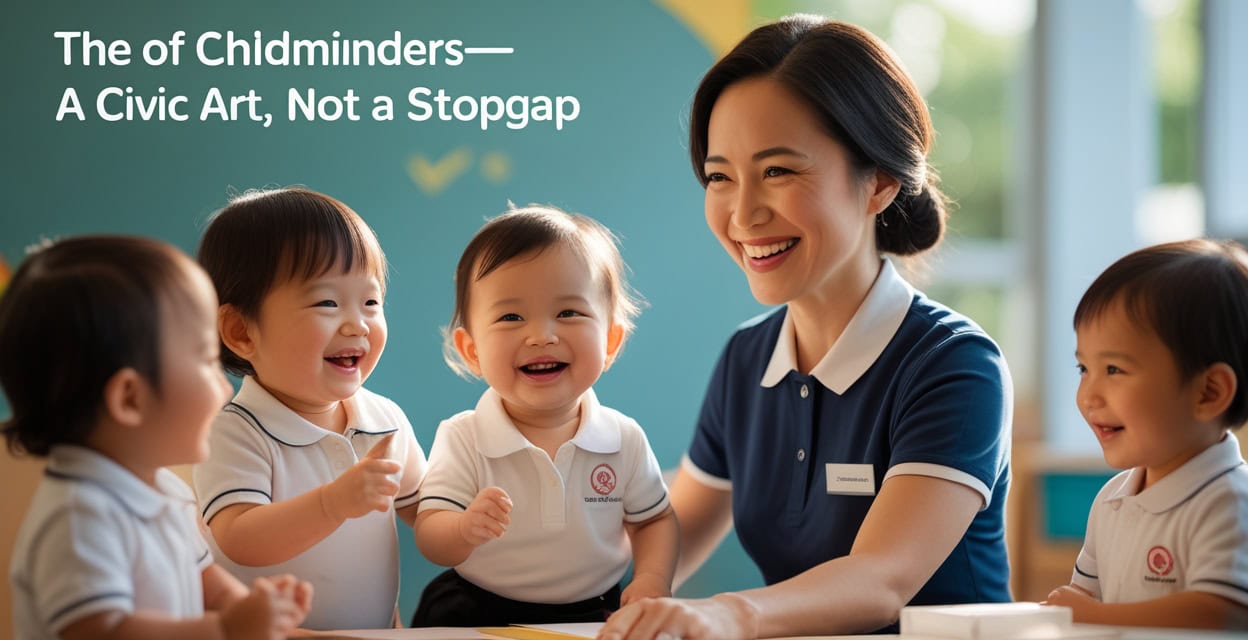
The Purpose of Childminders—A Civic Art, Not a Stopgap
Great childminding is a public good. It stabilizes families, enables employment, and dignifies the labor of care. EduNanny invests in the people who hold our youngest citizens:
- Reflective practice: Training for thoughtful analysis: what did I see, what did the child see, and how will I improve the next minute?
- Meaningful jobs through a Maximum Employment Mandate: Professional pathways that elevate both centre-based and home-based carers.
- Transparent family partnerships: Clear notes, calm handovers, and honest problem-solving that build trust over time.
- Alignment with ECDA Pilot: Access near where families live, with accountability that strengthens public trust.
Childminders are not placeholders. They are first teachers, first responders, and first mirrors for children. When we honor them, children feel it—and families experience stability and growth in daily life. Families can support this civic art by engaging in regular feedback, asking about training, observing the Attuned Minute in action, and participating in mandatory safety briefings where available.

How EduNanny Makes Infant Care and Childminding Work for Singaporean Families
EduNanny delivers a holistic approach to infant care and childminding with clear advantages for families, caregivers, and communities:
- Excellence and Quality: A unified standard across centre-based and home-based settings, designed with modern layouts and an infant-first flow that reduces friction between care and learning.
- Access and Convenience: Monday to Friday, 7 a.m. to 7 p.m., islandwide—designed to fit family work schedules and urban living realities.
- Affordability: From $33/day. Fees payable by CDA/Baby Bonus to reduce out-of-pocket expenses for families.
- Transparency: Secure CCTV with privacy safeguards, simple daily reports, and open-door communication to keep families informed.
- Safety by Design: 1:3 infant ratio; safe sleep practices; hygiene choreography; allergy and medication protocols—built into everyday routines.
- Choice of Setting: EduNanny Centre Based Childminding for social learning and resources; EduNanny Home Base Childminding for near-home intimacy and continuity.
- Inclusive Pilot with Public Purpose: Part of the ECDA Childminding Pilot; a national initiative that supports families and creates dignified employment for carers.
Practical steps for families considering EduNanny:
- Visit EduNanny.com or Childminding.EduNanny.com to learn about locations, curricula, and safety policies.
- Schedule a tour to observe the Attuned Minute in action and ask about teacher qualifications and training programs.
- Prepare a short, shared family plan that includes daily routines, sleep needs, feeding schedules, and allergy information.
- Request sample daily notes and a copy of the centre/home-based care agreement to review at your pace.
- Discuss how handovers work and establish a preferred communication channel (app, notes, or in-person check-ins).

A Closing Reflection: Who, What, When, Where, and How Childminding Matters
- Who: Infants, parents, and childminders—the first circle of trust that shapes how a child will meet the world.
- What: Daily, dignified care that blends safety, pedagogy, and play into the Attuned Minute—served calmly, repeated faithfully.
- When: The first thousand days—when the brain is most plastic, and the heart learns what to expect from others.
- Where: In thoughtfully designed centres and home premises across Singapore—near workplaces, near HDB estates, near grandparents, near life.
- How: Through an ultra-low 1:3 ratio; respectful routines; evidence-aligned practice; transparent technology; and true partnership with families.
- Why: Because beginnings become beliefs. A child who is seen at eye level learns to seek, to ask, to give, and to lead.
EduNanny’s philosophy is that care is curriculum, safety is design, and joy is teachable. Our purpose is to ensure every infant in Singapore starts life in rooms where hands are steady, voices are warm, and time is kept at the child’s pace. Our promise to parents is practical and personal: a reliable place, a trusted person, and a day that makes sense for your baby.
This is childminding that honors science and heart. This is work worthy of a great city. And this is how we cradle tomorrow—together.
Thank you. We invite you to visit EduNanny.com or Childminding.EduNanny.com, meet our team, tour a centre or a home setting, and see the difference an Attuned Minute makes.

Conclusion
EduNanny offers a concrete, research-informed path to early childhood care that respects both the child’s pace and the family’s needs. By embracing the Attuned Minute, focusing on safety by design, and training caregivers as reflective professionals, EduNanny helps Singapore build a public trust in childminding that is as steadfast as it is compassionate. Families, caregivers, and communities can partner to ensure the first thousand days are safe, joyful, and deeply human—creating strong foundations for lifelong learning and civic belonging.
Explore EduNanny today to see how a well-designed approach to early care can transform daily life for your child and your family. Learn more at EduNanny.com and Childminding.EduNanny.com.
SEO keywords: [#keyword1, #keyword2, #keyword3, #keyword4, #keyword5]
Ready to Experience Excellence?
Transform Your Family’s Journey
Discover Singapore’s leading infant care and childminding services. Expert guidance for your little one’s first thousand days.