
Tiny Rooms Big Nation The EduNanny Near Home Pods and Singapore First Thousand Days

The First Room Is a Small Republic: EduNanny’s Promise to Singapore’s Youngest Citizens
Good evening, parents, caregivers, community leaders, and partners in the civic task of raising a generation. Thank you for lending your attention to the quietest citizens among us—infants—whose first rooms are small republics, where trust is the constitution and love is the law. This article expands on EduNanny’s unwavering commitment to translate a powerful vision into everyday practice—with clarity, rigor, and heart.

Who we are and why Singapore asked for this
EduNanny by BUTLER exists to make infant care and childminding exceptionally safe, exquisitely human, and practically accessible for working families across Singapore. We operate center-based and home-based care, as well as guided distance support when families need continuity at home. We are open Monday to Friday, 7 a.m. to 7 p.m., islandwide—close to MRT lines, within neighborhoods, and in community and home premises designed with modern layouts and soft sightlines. We honor an ultra-low 1:3 infant ratio. We use privacy-respectful CCTV as a window into daily life, not as surveillance, and we share meaningful updates, not just footage. We are part of the ECDA Childminding Pilot—framed as a national social initiative aligned to Singapore’s Maximum Employment Mandate—expanding dignified jobs while expanding dignified care.
And we insist on affordability: from $33 per day, with fees payable via CDA/Baby Bonus where applicable. Because quality infant care cannot be a luxury; it must be a public ethic. This section can serve as a guide for families evaluating options: ask about transparency, alignment with national standards, and the social value of care that supports workforce participation.
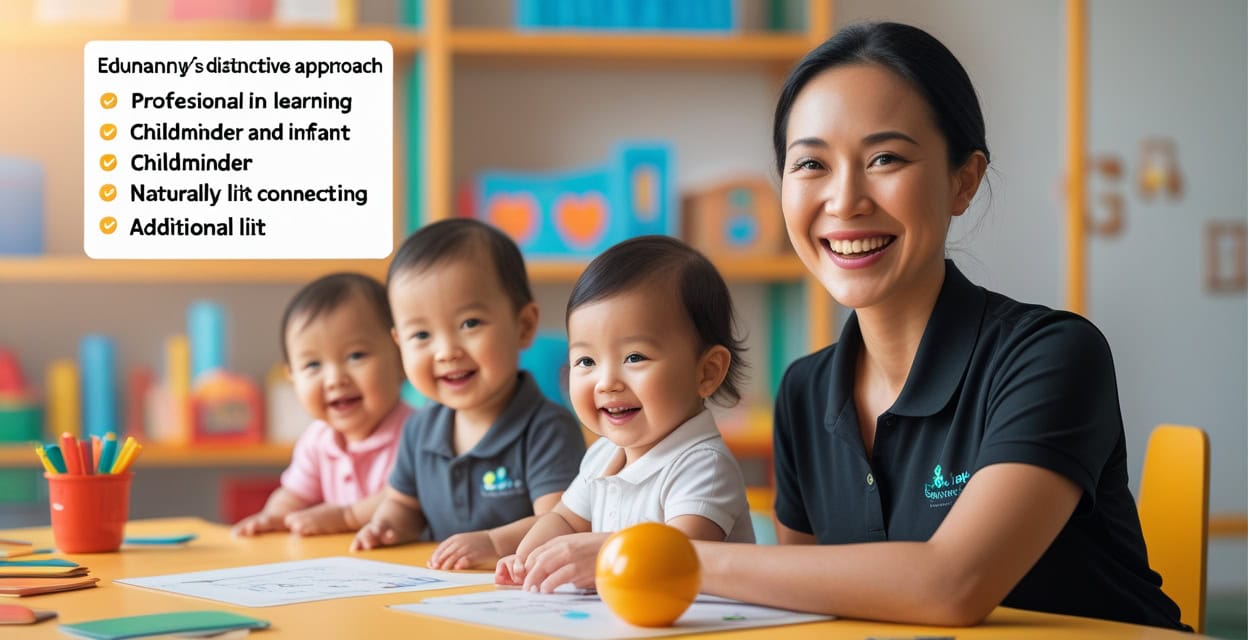
Five pillars guiding EduNanny’s distinctive approach
The following five pillars describe our distinctive approach. Each pillar is a lever for practical improvement in daily life for families, caregivers, and infants alike.
1) Pedagogy: The Four Compass Points—Ground, Gaze, Guide, Grow
- Ground: We prepare environments where the floor is the classroom—stable, clean, hazard-free—so infants roll, reach, and rise without restraint. Practical action: conduct a weekly environmental audit (floor space, transitions, toy age appropriateness) and document a “floor-time plan” for each cohort that rotates materials to invite different developmental skills.
- Gaze: We meet infants at eye level. The caregiver’s face is an instrument; the infant’s cues are the score. Practical action: 30-second attunement cycles—name feelings, mirror expressions, and respond within two to three inhalations to build secure attachment cues.
- Guide: We scaffold, not speed. A caregiver narrates, offers a finger to grasp, places a rattle just out of reach. Practical action: employ Vygotskian prompts—challenge just beyond current capability, then celebrate mastery with a verbal cue and a visible cue of progress.
- Grow: We protect unstructured curiosity. Froebel’s insight—play as learning—becomes respectful invitations: objects with real weight, textures with real stories, and songs in the languages of home. Practical action: curate “multilingual song baskets” and rotate materials that connect to family culture to support bilingual or multilingual development.
2) Safety: Choreography over Policing
- People: A 1:3 ratio, trained childminders, steady assignments for continuity of attachment. Practical action: implement caregiver pairings that reflect shifts in infant needs; document attachment continuity metrics weekly.
- Place: Modern, open layouts with low shelves; safe sleep (firm, flat, on the back), temperature control, and pediatric-grade hygiene routines. Practical action: conduct monthly safety walkthroughs with snapshots of hazards and corrective actions; keep a visible “safety board” in each room.
- Process: Bottle prep protocols, allergy flags, diapering standards, illness exclusion with clear return-to-care guidance, and incident drills that actually rehearse, not just record. Practical action: create a one-page care plan per infant that updates with milestones and medical alerts, shared with families at a fixed cadence.
- Proof: Innovation with CCTV—angles that show proximity and response, and logs that capture what matters: feeds, naps, mood, milestones. Practical action: provide families with a summarized, privacy-respecting daily log that highlights moments of need and moments of joy, not every frame.
- Partnership: Transparent communication with families—daily summaries, micro-videos of “firsts,” and two-way feedback loops so parents’ insights shape the day. Practical action: establish a weekly 15-minute “eye-level briefing” with parents to discuss progress and concerns.
- Preparedness: CPR/First Aid certified staff, crisis escalation maps, and unblocked exits. Practical action: quarterly drills, with debriefs and improvements recorded for accountability.
3) Development: The One-Minute Windows
The first thousand days are built from one-minute windows of attention. We turn routine into curriculum. Practical action:
- In the minute before a nap: we coo, we label feelings, we practice stillness. Create a consistent pre-nap routine: dim lights, soft talk, gentle handholding, and a cue for sleep readiness.
- In the minute after a feed: we burp, then stretch and reach—core work disguised as joy. Integrate micro-medley activities that promote diaphragmatic breathing and post-feeding movement.
- On the floor: we arrange objects to invite cross-body reaching and early bilateral coordination. Rotate textures and weights to cultivate tactile discrimination and grip strength.
- In language time: we name, pause, listen, and wait—responsive interaction that doubles vocabulary growth. Keep a “language bundle” of purposeful phrases from multiple languages heard at home.
- In daily logs: we note micro-m milestones and patterns—sleep cycles, self-soothing attempts, grip strength, social smiles—and we use that data to plan tomorrow’s invitations. Action: implement a simple data template to help teachers flag developmental inflection points quickly.
4) Happiness and Belonging: The Joy Index
- Predictability: A steady rhythm from 7 a.m. to 7 p.m.—not rigid, but reliable—reduces cortisol and increases curiosity. Practical action: publish a family-friendly daily rhythm poster in each room and share adjustments in a weekly summary when needed.
- Proximity: Care close to home shortens commutes, preserves sleep, and strengthens family rituals. Practical action: map parent-nearest-educator pairings to minimize travel time and maximize consistency.
- Culture: Lullabies in grandma’s tongue, familiar foods when developmentally appropriate, and family stories woven into circle time so infants recognize themselves in the room. Practical action: collect short cultural stories from families and feature them in weekly “culture moments.”
- Signals: We track smiles, coos, relaxed limbs, and shared attention. Our Joy Index is qualitative and humane—less a score than a conversation about thriving. Practical action: implement a monthly culture of joy review, highlighting moments of social engagement and comfort signals observed by caregivers.
5) The Purpose of Childminders: Civic Weavers
- Childminders knit attachment where parents are at work, preserving the parent-child bond rather than replacing it. Practical action: provide ongoing training on sensitive communication with families dealing with separation anxiety or major life changes.
- They unlock workforce participation—especially for mothers—by extending a reliable social infrastructure of care. Practical action: partner with employers to offer flexible scheduling guidance and shared-care models that support mothers returning to work.
- They carry culture forward—songs, sayings, and stories from every neighborhood—from Jurong to Tampines, from Punggol to Queenstown. Practical action: implement a rotating “community culture calendar” where families contribute songs, crafts, or stories from their heritage.
- They are professionals: trained, supervised, mentored, and given a career ladder. Practical action: document a clear professional development path with milestones, stipends for training, and supervisory feedback cycles.
- The Maximum Employment Mandate works only if it also becomes the Maximum Dignity Mandate. Practical action: evaluate caregiver well-being quarterly and adjust workloads to sustain satisfaction and retention.

How EduNanny delivers—practically, islandwide
EduNanny delivers on its promise through accessible models, clear standards, and ongoing support that helps families and caregivers thrive together.
- Three doors of access:
- Centre-Based Childminding: Modern, open-plan rooms with clear sightlines and well-zoned play.
- Home-Based Childminding: Licensed, curated homes in your neighborhood for infants who thrive in smaller circles.
- Distance Support: When a child is recovering at home or a parent is WFH, our educators guide routines, share micro-activities, and help keep the day on track.
- Hours that match the city’s heartbeat: Monday to Friday, 7 a.m. to 7 p.m. Practical action: align staffing to peak traffic and local school schedules to minimize disruption for families.
- Islandwide reach: In community and home premises, always within realistic commute times. Practical action: maintain a regional map of centers and home-based partners to optimize accessibility.
- Affordability and access: From $33/day, with fees payable by CDA/Baby Bonus where applicable. Practical action: provide a transparent, easy-to-understand fee schedule and a family subsidy calculator to help families plan.
- Transparency and trust: Privacy-respectful CCTV, concise daily reports, and open communication channels. Practical action: develop a standard daily log template that highlights growth points and concerns, shared digitally with parents.
- Stability by design: The 1:3 ratio is not an aspiration—it is a standard. Practical action: implement a “ratio compliance” dashboard and quarterly audits to ensure staffing remains within target.

A brief walk through a day
Visualize a typical EduNanny day as a rhythm that honors both structure and curiosity. The following sequence illustrates how theory becomes practice and how families can participate in the daily journey.
- Arrival: Eye-level greeting; a two-minute parent handover ritual; a quick health check; a promise: “We see you. We’ve got you.” Practical action: establish a quick “health and mood note” that travels with the infant through the day.
- Morning: Floor time with intentional invitations—textures, sounds, cause-and-effect play; caregivers narrate, infants direct. Practical action: rotate a weekly set of sensory toys tied to developmental goals.
- Midday: Safe sleep per guidelines; careful wake-ups with gentle light and soft voice. Practical action: implement a consistent nap routine with environmental cues (light, sound, temperature) that help infants settle more easily.
- Afternoon: Outdoor air where feasible; stroller walks or shaded courtyards; language play; family-culture song. Practical action: schedule daily outdoor time and document the range of sensory experiences offered outside the room.
- Close of day: A summary that names growth, not just activities. “Today she rolled twice to reach the bell. He soothed with humming for twenty seconds longer than yesterday.” Practical action: share a brief growth note with families highlighting specific micro-milestones and social signals observed.
What makes this work in Singapore now
- The ECDA Childminding Pilot positions childminding as a national social initiative with clear standards and real oversight. Practical action: parents can request documentation of pilot adherence and see how centers align with national benchmarks.
- The Maximum Employment Mandate recognizes that reliable caregiving creates jobs, keeps families secure, and keeps the economy inclusive. Practical action: centers publish workforce data showing how many local training opportunities, apprenticeships, and career ladders are available to caregivers.
- Design and data combine with heart: modern layouts, evidence-based routines, and humane documentation that illuminates—not overwhelms. Practical action: families should expect succinct, meaningful data that helps them participate in their child’s learning journey.
Conclusion: Who, what, when, where, how—and why childminding matters
Infants are the early architects of a nation. The people who care for them at eye level—childminders, parents, and educators—are the nation’s quiet governors. EduNanny’s promise is simple, practical, and scalable: care that is safe, humane, and accessible; a pedagogy that respects attachment and development; and a system of accountability that invites families to participate as partners. The first rooms are tiny republics; when governed with love, wisdom, and dignity, they plant the seeds of confident, empathetic citizens who will lead with clarity and courage.
To every parent choosing care, we offer steadiness. To every childminder choosing this calling, we offer dignity, training, and community. To Singapore, we offer a practical, affordable, and human blueprint for beginnings worthy of potential.
If you are ready to visit a room where safety feels like calm and learning looks like joy, we welcome you. You can explore more about EduNanny and our childminding options by noting the following:
Learn more or register: EduNanny.com
Explore childminding options: Childminding.EduNanny.com
Thank you for trusting us with the nation’s first rooms. In those rooms, hour by hour, we make courage ordinary, joy everyday, and growth inevitable.
[#EduNanny, #InfantCareSingapore, #1to3Ratio, #ChildmindingPilot, #EarlyChildhoodDevelopment]Ready to Experience Excellence?
Transform Your Family’s Journey
Discover Singapore’s leading infant care and childminding services. Expert guidance for your little one’s first thousand days.