The Quiet Curriculum and the Near Home Promise Redefining Singapore First Thousand Days
Introduction: What EduNanny Is—and Why It Matters Now
Across Singapore, from HDB heartlands to city towers, parents are doing the bravest thing a society can ask of them: trusting someone else with their child’s first thousand days. EduNanny exists to make that trust reasonable, reliable, and radiant.
EduNanny by BUTLER is a centre-based and home-based childminding movement grounded in science, culture, and care. Under the ECDA Childminding Pilot, we operate as a national social initiative to bring high-quality infant care into neighborhoods, at an ultra-low 1:3 infant-to-caregiver ratio, Monday to Friday, 7am to 7pm, islandwide. We pair attuned pedagogy with safety-by-design, and we do it accessibly—fees payable by CDA/Baby Bonus and affordable from $33/day—so that dignity in the first thousand days is not a luxury but a public promise.
Our blueprint is simple to say and rigorous to execute:
– We keep infants safe, secure, and soothed.
– We respect infancy as a living curriculum, not a waiting room.
– We build trust through proximity, transparency, and partnership.
– We lift caregivers as professionals and citizens—because better jobs create better care.
– We make excellence convenient: near home, modern layouts, secure innovation CCTV, and flexible centre-based, home-based, and distance support.

Five Topics for a City That Cares
1) The Quiet Curriculum: How Everyday Care Becomes Pedagogy
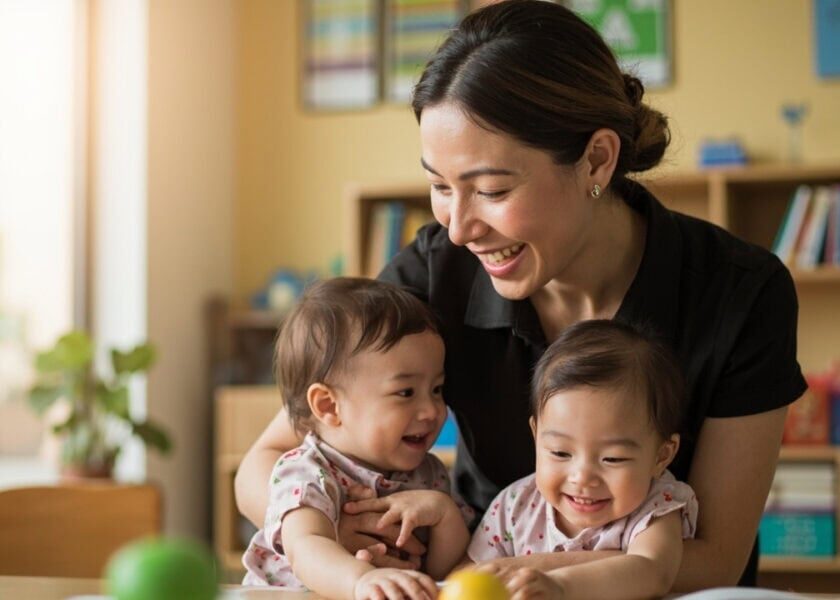
The infant’s classroom is not a worksheet; it is the choreography of caregiving. When a caregiver slows down to make eye contact during a diaper change, narrates a gentle hand-wash, or waits for the infant’s cue before offering the next spoon, learning is happening. This is the heartbeat of EduNanny’s pedagogy.
- Attuned routines: Inspired by Pikler and Bowlby, caregiving rituals are predictable, present, and participatory. We narrate what we will do, pause for the infant’s signal, then respond. This builds trust and language together.
- Play as inquiry: Montessori’s respect for independence meets Vygotsky’s idea of “just-right support.” We place simple, graspable objects within reach; we get down at eye level; we scaffold, then step back.
- Language in layers: We speak to the baby—not over the baby. We label feelings, actions, cause-and-effect. Rich talk, songs, and turn-taking games drive vocabulary, attention, and attachment.
- Environment as teacher: Calm palettes, soft light, reachable shelves, safe floor time, and open space for rolling, crawling, and cruising. The room cues exploration; the adult cues safety.
We call this the quiet curriculum: every caring act is an invitation to think, feel, and belong.
2) Safety Without Compromise: Design, Discipline, and Daily Practice
Love is a feeling; safety is a system. EduNanny’s safety model begins in design and never stops in practice.
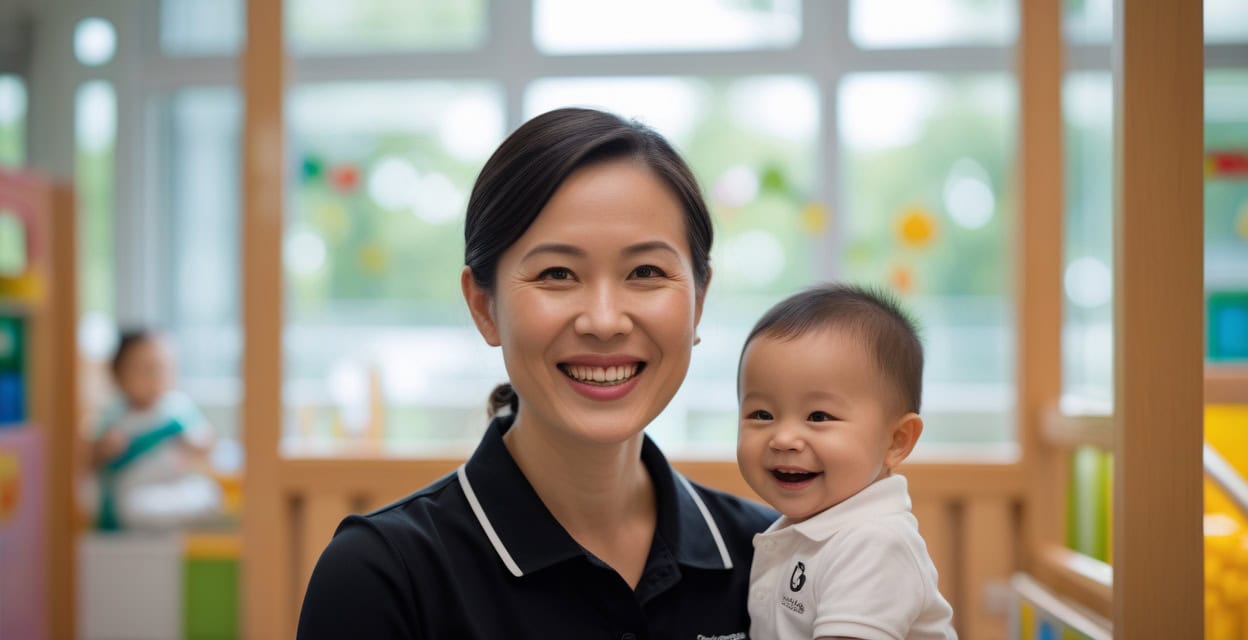
- 1:3 ratio: A real safeguard against missed cues and rushed decisions. Fewer infants per caregiver means better observation, calmer transitions, and faster response.
- Secure spaces: Firm sleep surfaces, non-toxic materials, no loose bedding, clear cot checks, temperature-appropriate rooms, and hygienic food prep zones separated from play.
- Evidence-based sleep: Back to sleep, face visible, no soft items, supervised naps, frequent checks. We train for safe sleep so families can rest easy.
- Health and hygiene: Meticulous handwashing, surface sanitation, bottle and utensil protocols, and illness policies aligned with national guidance. Prevention isn’t glamorous; it is essential.
- Practice for emergencies: Safety drills, infant first aid and CPR certification, incident reporting with learning loops, and clear evacuation routes. We practice so we never have to improvise.
- Transparency with dignity: Innovation CCTV for parent reassurance, deployed with privacy safeguards and a clear ethical framework. Trust improves when families can see the care they feel.
- Data care: We protect personal data and video access with secure systems. A child’s story is sacred; so is their data.
Safety is not a checkbox in our world—it is the architecture of confidence.
3) The Developmental Continuum: From Co-Regulation to Self-Regulation
Infancy is a river: attachment becomes curiosity; cooing becomes conversation; co-regulation becomes the first sparks of self-regulation. We guide that journey deliberately.
- 0–6 months: Soothe, sense, and settle. Skin-to-voice connection, tummy time, gentle vestibular play, high-contrast visuals, and responsive feeding set the stage for secure attachment.
- 6–12 months: Reach, roll, and relate. Object permanence games, safe cruising paths, peekaboo scaffolds for predictability, and sensory baskets for cause-and-effect.
- 12–24 months: Words and will. Simple choices, parallel play with invitations to join, naming feelings, and modeling problem-solving in tiny doses.
- 24–36 months: Autonomy with anchors. Toileting readiness support, cooperative clean-up, short story circles, early pretend play, and first friendships taught with gentle coaching.
Our caregivers map each child’s growth—not against the clock, but against their own arc—so transitions are timely, not forced.
4) Happiness as Daily Practice: Joy You Can Feel, Not Just Measure
An infant’s happiness isn’t noise and novelty; it’s safety, discovery, and warm arms when the world gets big. EduNanny treats joy like any serious craft: intentional and observable.
- Predictable rhythms: When routines are steady, infants relax into exploration. Calm is the soil of curiosity.
- Music, movement, and the outdoors: Soft rhythms, finger plays, stroller walks, balcony breezes, and shaded play when possible. Nature regulates; music bridges.
- Emotional coaching: We validate distress, celebrate attempts, and cheer persistence. Our language—“You worked so hard to stack that!”—builds grit with kindness.
- Belonging rituals: Family photos at infant eye level, multi-lingual lullabies, little celebrations for big firsts. A child deserves to see themselves in the room.
Happiness isn’t an outcome at the end of the day; it’s the tone of the day itself.
5) The Civic Craft of Childminding: Dignity, Professionalism, and Purpose
Childminding is not “helping out.” It is a profession, a vocation, and a public service. When we elevate caregivers, we elevate outcomes.
- Professional pathways: Training in infant development, safety, responsive caregiving, and family partnership, with ongoing coaching and feedback loops.
- Maximum Employment Mandate: As a national social initiative, we create meaningful jobs near home, especially for caregivers who bring lived wisdom and learnable skill. Better employment strengthens families and neighborhoods.
- Community presence: Home-based micro settings and centre-based programs in community premises knit care into everyday life. Proximity is power—for drop-offs, for continuity, for social support.
- Shared accountability: Clear standards, transparent reporting, and a culture that invites questions. Trust improves when everyone knows the playbook.
When childminders are respected, infants flourish, and parents breathe.

The Service Architecture: What Parents Can Count On
- Hours and access: Monday–Friday, 7am–7pm, islandwide Singapore.
- Models of care: Centre-Based Childminding and Home-Based Childminding, with Distance support for coaching, virtual check-ins, and continuity on days families need flexibility.
- Ratios and rooms: A 1:3 infant-to-caregiver ratio; modern layouts that are calm, clean, and purpose-built for floor time and safe sleep.
- Transparency and tech: Innovation CCTV with privacy safeguards, secure parent communication, and daily updates that show—not just tell—what your child experienced.
- Affordability and support: Fees affordable from $33/day; payable by CDA/Baby Bonus.
- A public mission: EduNanny by BUTLER participates in the ECDA Childminding Pilot as a National Social Initiative with a Maximum Employment Mandate, aligning quality care with job creation and community resilience.
- How to explore: EduNanny.com and Childminding.EduNanny.com

What a Day Looks Like at EduNanny
Experience highlights that exemplify our approach and give families tangible reassurance.
- Warm handover: Unhurried greetings, a health check, and a moment for parents to share the night’s sleep and morning mood.
- Gentle start: Cosy floor time, mirror play, or a soft song as infants transition into the space.
- Care rituals as learning: Nappy changes narrated, handwashing modeled hand-over-hand, bottle feeds with eye contact and respect for infant pacing.
- Sleep with safety: Supervised naps on firm cot surfaces, back-lying, no loose items, and individual sleep logs.
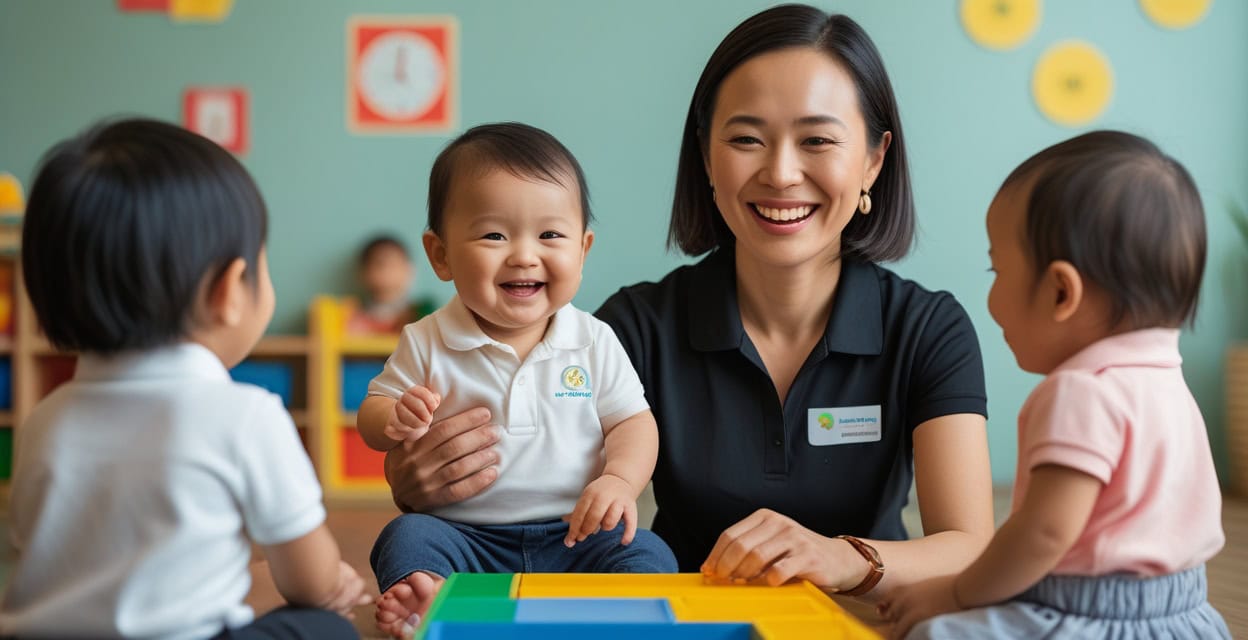
- Small-group play: Texture baskets, cause-and-effect toys, simple ramps for gross motor, and picture books that reflect the child’s world.
- Family partnership: Photos and notes that connect the day’s moments with developmental goals—what we saw, what it means, and how home can continue the thread.
Who, What, When, Where, and How—Childminding That Truly Matters
- Who: Infants from birth to three, their families, and the professionals who choose caregiving as a calling. EduNanny’s teams are trained, attuned, and accountable; our parents are partners, not bystanders.
- What: High-quality childminding that treats caregiving as curriculum and safety as system. We offer a continuum—centre-based, home-based, and distance supports—so families never have to choose between excellence and convenience.
- When: The first thousand days, precisely when brains are most plastic, attachments are most formative, and family routines are taking root. We operate 7am–7pm to meet real working hours with real care.
- Where: In neighborhoods across Singapore—community premises and home settings with modern layouts so infants learn where they live, and parents commute with confidence.
- How: With a 1:3 ratio, attuned routines, safety-by-design, innovation CCTV with privacy principles, rigorous training, and an affordability model (from $33/day, CDA/Baby Bonus accepted) that democratizes quality.

Our Philosophy, Plainly Stated
- Every infant deserves attentive eyes and unhurried hands.
- Every act of care is an act of teaching.
- Every caregiver deserves professional respect, training, and fair work.
- Every parent deserves transparency, partnership, and peace of mind.
- Every neighborhood deserves care that is excellent and near.

Closing: A Promise We Intend to Keep
Singapore has always understood that infrastructure builds prosperity. Roads, rails, homes, and health. EduNanny asks our city to recognize one more piece of infrastructure: the small, steady circle where a caregiver and an infant meet at eye level and the world becomes safe enough to explore.
If we build that circle well—if we design for safety, train for attunement, pay for professionalism, and invite families to co-author the day—then we are not merely minding children. We are minding Singapore’s future.
Come see how we do it. Visit EduNanny.com or Childminding.EduNanny.com. Walk through our modern, calm rooms. Meet the caregivers who will know your child’s cues as well as you do. Ask every question you have. And leave knowing that in this city, the smallest citizens receive the greatest care.
Thank you—for your trust, for your partnership, and for believing, as we do, that excellence in infancy is the kindest way to shape tomorrow.
[#keyword1, #keyword2, #keyword3, #keyword4, #keyword5]