
Cradling the First Thousand Days A Near Home Vision for Safe, Joyful Infants in Singapore with EduNanny

Introduction: EduNanny’s Promise for Singapore’s Families
Good evening, families, caregivers, neighbors, and every Singaporean who believes the future begins in the quiet cradle of today. EduNanny by BUTLER emerges as a new standard for infant care and childminding, designed for Singapore’s neighborhoods and working rhythms. We blend developmental science with everyday reliability, safety, and excellence. Our promise is simple: when attuned care becomes accessible to every family, we strengthen a child’s first thousand days and a nation’s next thousand months.

Introduction: What is EduNanny
EduNanny by BUTLER is a comprehensive infant care and childminding service crafted for Singapore’s diverse households. We integrate the best of developmental science—Montessori’s respect for the child, Vygotsky’s scaffolding, Bowlby’s attachment, Pikler’s clarity of caregiving, and Erikson’s early trust—with Singapore’s demand for safety, reliability, and excellence. Operating Monday to Friday, 7am–7pm, islandwide, we offer both home-based and centre-based options with an ultra-low 1:3 infant ratio. Our spaces are designed for safety and flow, and we use innovation-forward CCTV to maintain transparency and partnership with families. This is quality you can see, convenience you can feel, and affordability designed to include—fees payable by CDA/Baby Bonus, with options from $33/day. EduNanny is also participating in Singapore’s ECDA Childminding Pilot as part of a National Social Initiative that advances a Maximum Employment Mandate and elevates the standard of care.

Five Fresh Lenses on Infant Care That Matter Now
1) The Microsymphony of Care: Turning Small Moments into Lifelong Signals
- Infancy unfolds in micro-moments—tiny cues and responses that teach the brain that the world is safe and reliable. Our 1:3 ratio is not a luxury; it’s the instrument that lets caregivers notice and respond within the 60–90 second window where learning and trust consolidate.
- Practice at home: Create a 5–10 minute “micro-moment” routine after each feeding or diaper change. Sit at the child’s level, narrate facial expressions, and mirror mouth movements to support early language.
- Actionable steps for parents:
- Observe a cue (glance, breath change, fidget).
- Respond with attunement (calm voice, eye contact, gentle touch).
- Release with respect (allow self-directed play, pause to let the child lead).
- Impact: Gradual accumulation of secure attachment, curiosity, and self-regulation through consistent, respectful interactions.
2) Safety as Architecture, Not Afterthought
- Safety is a system designed into people, places, and practice. EduNanny shapes six interlocking lines of defense:
- People: Carefully selected, trained childminders practicing reflective caregiving, scenario-based drills, CPR/First Aid, ongoing development.
- Place: Light-filled layouts, clear sightlines, safe sleep zones, zone-based play, secure entries, and infant-safe exploration materials.
- Protocols: Evidence-based routines for sleep, feeding, hygiene, and medication with clear pathways for incidents and contingencies.
- Practice: Daily supervision, peer mentoring, rehearsed emergency responses, and calm coordination.
- Partnership: Consent-based CCTV for transparency, daily briefs, shared logs of feeds, naps, diapering, and milestones; bilingual communication aligned to family preferences.
- Proof: Regular audits and data reviews aligned to ECDA standards and international best practice.
Practical takeaway for parents: ask for your caregiver’s safety training records, observe the environment for clear sightlines, and request routine updates that show how safety is integrated into daily care.
3) The Living Continuum of Development: Observe, Respond, Release
- Development is a living continuum that respects each child’s pace and cultural world. Our daily practice follows a clear loop:
- Observe: Track motor, language, cognition, and socio-emotional milestones; note preferences, sensory thresholds, and emerging strengths.
- Respond: Offer right-sized challenges—side-lying play for posture, object permanence games for memory, gentle bilingual songs for rhythm, textured play for sensory integration.
- Release: Step back when the child is ready to own progress; avoid over- prompting. This mirrors Pikler’s philosophy of minimal intervention to empower self-directed growth.
Practical guidance for families: maintain a simple home observation log (what the child attempts, what prompts engagement, how they respond to new activities). Share insights with your EduNanny team to tailor daily routines to your child’s temperament and language needs.
4) The Joy Index: Measuring What Truly Matters
- Joy in infancy is quiet and profound. We track secure-base signals and attunement rather than noise alone:
- Measures include: glad-to-sad ratio, frequency of shared smiles, serve-and-return exchanges, willingness to explore with safe reassurance, smooth transitions into sleep and feeding, and self-soothing with support.
- Practical application: Use a simple daily scorecard to note moments of security (e.g., settled after a play break, consistent eye contact during feeding) and use this to adjust activities and caregiver pairing.
- Impact: A Joy Index rooted in attunement guides caregivers to create a more predictable, emotionally available environment that nurtures motivation and curiosity.
5) The Civic Purpose of Childminding: A Profession that Holds a Nation’s Hopes
- Childminding is more than a service; it is civic work. EduNanny advances a Triad Compact—Parent, Childminder, and Child—bound by daily communication and shared goals.
- As a National Social Initiative, EduNanny expands opportunities: training and employing more Singaporeans in meaningful, near-home roles, strengthening families and neighborhoods, and aligning with the Maximum Employment Mandate.
- Practical takeaways for families: view childminding as a professional career path, ask about ongoing training, and engage in regular feedback sessions to ensure the caregiver’s development aligns with your family’s values.
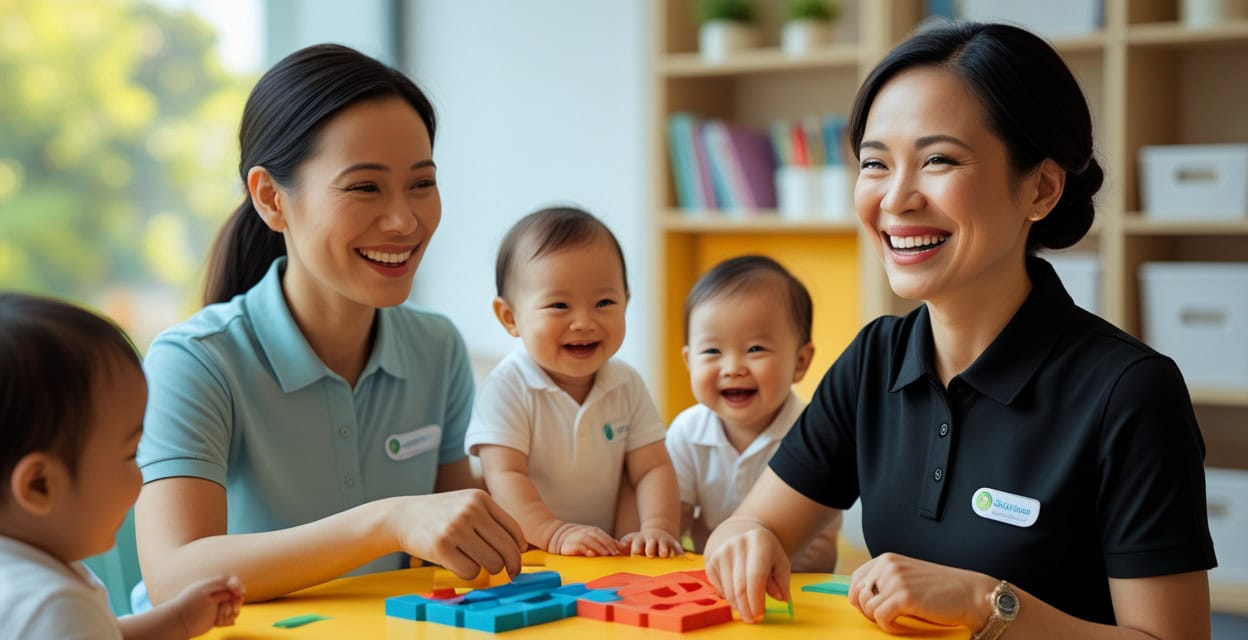
How EduNanny Makes It Work—Practically
These practical choices ensure high-quality care is accessible and sustainable for modern Singaporean families.
- Proximity and choice: Centre-based and home-based childminding located within communities, offering options that fit daily commutes and family routines.
- Time that fits work: Monday to Friday, 7am–7pm, designed around typical work hours and flexible scheduling needs.
- Right ratio, right care: Ultra-low 1:3 infant ratio to enable true attunement, safety, and responsive caregiving.
- Thoughtful spaces: Modern layouts with clear zones for sleep, feeding, sensory exploration, and quiet cuddle corners to support calm transitions.
- Transparent partnership: Innovation-forward CCTV with consent-based sharing and privacy safeguards; daily briefings; shared logs of feeds, naps, diapering, and milestones; bilingual communication as preferred.
- Access and affordability: Fee options from $33/day; CDA/Baby Bonus eligibility passed through to families; transparent pricing structures with clear value in care quality.
- Flex for modern families: Near-home placements, backup care coordination, and tele-coaching for grandparents or transitioning parents returning to work.
- A living curriculum: Daily arcs including arrival rituals, sensory play, songs and stories, outdoor pram walks where appropriate, unhurried feeds, respectful routines, sleep hygiene, and reflective pickup.
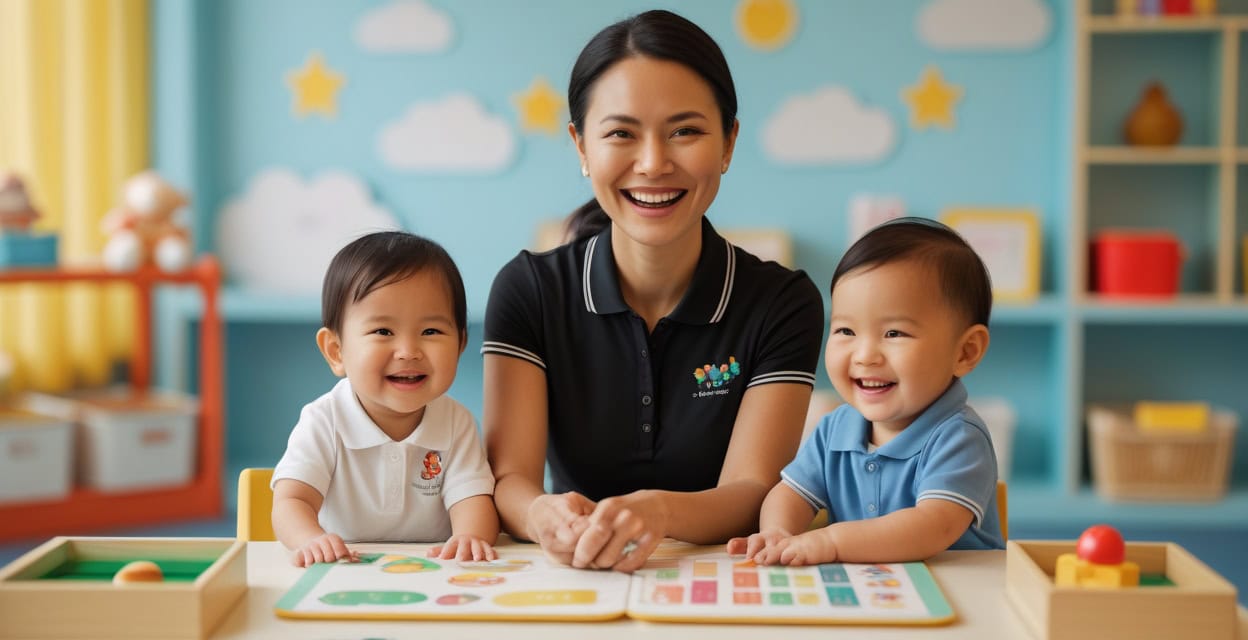
A Day in the Life, Close to Home
Imagine an ordinary morning made extraordinary by attunement. At 7:02am in Ang Mo Kio, a mother hands her son to an EduNanny caregiver who kneels to his eye level and says, “Good morning, Kai. I’m happy to see you.” A familiar lullaby hums softly in the background. They begin with floor time; Kai reaches for a soft ring, testing his grip and turning his wrist—tiny steps in motor control. Later, two infants share a mirror while a caregiver narrates facial expressions, planting seeds of empathy and language. Before nap, a warm wash, a quiet story, and a gentle pat help sleep arrive easily because trust has arrived first. At 6:30pm, the handover to mom includes concrete updates: “Two good feeds, one long nap, new sound play with ‘ba-ba’; shoulder stability improving.” Information becomes insight; insight becomes continuity at home. This is daily life when care is close, careful, and quietly transformative.

Singapore-Specific Strengths
- Islandwide coverage: Arrangements that fit commuting patterns and multigenerational living, empowering families across Singapore.
- Cultural fluency: Respect for family feeding practices, mother-tongue songs, and festival rhythms integrated into daily routines.
- ECDA alignment: Participation in ECDA’s Childminding Pilot as part of a broader civic infrastructure for early childhood care.
- Maximum Employment Mandate: Professionalizing near-home care to uplift meaningful work within communities.

A Simple Philosophy, Stated Plainly
- Safety is designed, practiced, and verified.
- Development is relational, not rushed.
- Joy is quiet, frequent, and intentional.
- Partnership is transparent, respectful, and two-way.
- Proximity is power: near home, near heart, near daily life.
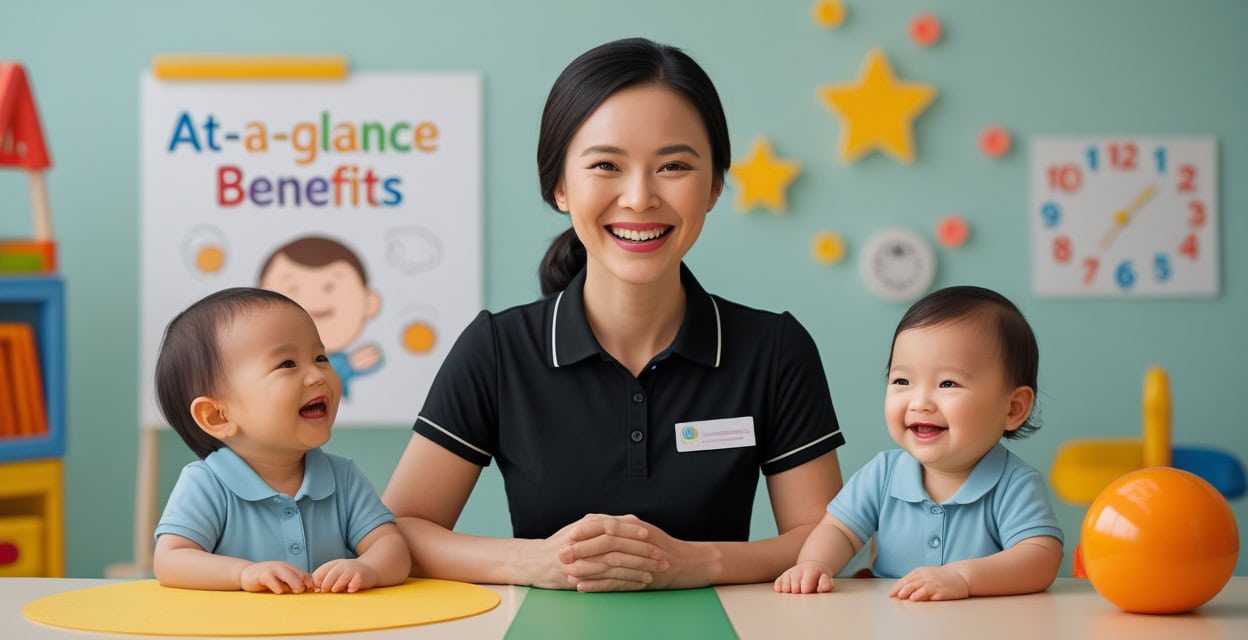
At-a-Glance Benefits
- Excellence and quality in care and pedagogy.
- Centre-based, home-based, and distance support options.
- Monday–Friday, 7am–7pm, islandwide Singapore.
- Affordable from $33/day; fees payable by CDA/Baby Bonus.
- ECDA Childminding Pilot; National Social Initiative; Maximum Employment Mandate.
- Ultra-low 1:3 infant ratio; innovation CCTV; modern layouts.
- EduNanny by BUTLER; details at EduNanny.com and Childminding.EduNanny.com.

Closing: Why Childminding Matters—Who, What, When, Where, and How
- Who: Infants who need steady hands and soft eyes; parents who deserve trustworthy partners; childminders who are professionals in the deepest human craft.
- What: Safe, joyful, developmental care that dignifies daily routines and turns them into learning and attachment.
- When: The first thousand days—the critical period for architecture of trust, language, self-regulation, and curiosity.
- Where: Near home, in EduNanny centers and community/home premises across Singapore—accessible and reliable.
- How: With an ultra-low 1:3 ratio; safety designed into people, place, protocol, and proof; a living curriculum rooted in Observe–Respond–Release; transparency through CCTV; affordability via CDA/Baby Bonus; and hours aligned with real work and commutes.

Conclusion: A Civic Promise in Tiny Moments
EduNanny is more than a service; it is a civic promise that every family deserves professional, loving, science-led infant care. When caregivers are trained, when environments are safe and enriching, and when families are part of a transparent partnership, children grow with confidence, curiosity, and resilience. The first thousand days lay the architecture for a lifetime of learning—and in Singapore, they lay the foundation for a confident, connected nation.
If you believe the future begins in these early exchanges of trust, walk with us. Consider EduNanny for your family: explore EduNanny.com or Childminding.EduNanny.com, tour a modern space, meet a childminder, ask hard questions, and feel the difference when care is close, careful, and quietly transformative. The future doesn’t arrive suddenly; it’s cradled, minute by minute. Let’s give every child a neighborhood that says, “You are safe. You are seen. You can grow.” And let’s give every parent the peace of mind they deserve.
SEO keywords: [#earlychildhood, #infantcare, #SingaporeECE, #EduNanny, #parentalpeace]