
EduNanny Singapore The Near Home Movement for Safe Joyful Infancy

EduNanny by BUTLER: Close care. Clear trust. Big futures.
Good evening, friends, parents, carers, and partners in the hopeful work of raising Singapore’s youngest citizens. EduNanny is more than a service—it is a movement grounded in science, culture, and practical humanity. We exist to make infant care closer, more consistent, and deeply attuned to the rhythms of a child’s life and a family’s routines. EduNanny serves families in centre-based settings, home-based arrangements, and distance-supported care—Monday to Friday, 7am to 7pm, islandwide—so the rhythms of infant life align with the rhythms of Singaporean work and community life. We maintain an ultra-low infant-to-carer ratio of 1:3, design modern calm environments, offer transparency through CCTV, and deliver excellence at an affordable price point, from $33/day, with fees payable by CDA/Baby Bonus. As part of the ECDA Childminding Pilot and a National Social Initiative, EduNanny grows quality care and maximum employment hand in hand, so families and the broader economy prosper together.

How EduNanny makes infant care and childminding better for Singapore
Proximity
Infants thrive when care is near home and within familiar neighbourhood ecosystems. Proximity reduces commute stress for caregivers and preserves infants’ routines. It also strengthens language, foodways, and sensory experiences tied to local places—from HDB courtyards to hawker centres—helping children feel a sense of belonging from day one.
- Practical steps for families: Seek near-home options first, whether in community-based centres or trusted home-based settings. Ask carers to map a child’s daily routines to the family’s schedule (meal times, nap windows, play times) and request sample day plans that align with your home routines.
- What to observe in a near-home setting: Consistent daily rhythms, familiar foods or age-appropriate substitutions, and spaces designed to minimize long commutes for the infant’s energy, with clearly defined zones for sleep, play, and meals.
- EduNanny practice insight: We publish transparent care logs and maintain a shared cadence with parents so you can see, in real time, how your child’s day unfolds—nurturing trust and continuity across environments.
Predictability
Predictable scheduling is a cornerstone of security for infants and peace of mind for parents. Our service windows—from 7am to 7pm, Monday to Friday, islandwide—create reliable, dignified coverage that respects caregiving work and reduces the need to negotiate between quality and logistics.
- Implementation tip for families: Request a written daily rhythm (wake, feed, play, nap, and return) and a weekly overview that shows how caregiver-led activities align with family routines.
- What to expect in practice: Routine-based transitions, consistent sleep setups for safe naps, and standardized feeding and diaper-change protocols across settings.
- EduNanny advantage: Uniform standards across Centre Based, Home Based, and Distance support ensure that, regardless of setting, your infant experiences the same quality of care and communication.
Parity
Parity means quality, safety, and communication are equal across all EduNanny settings. We uphold the same high bar—1:3 ratio, clean and modern layouts, safety-by-design principles, transparent communication, and pedagogy anchored in attachment science and purposeful play.
- What you can demand: A consistent ratio, a uniform safety checklist, and an accessible care log that records feeding, sleep, and development notes.
- Practical example: If you switch from a centre to a home-based EduNanny arrangement, you should receive a comparable daily plan, caregiver training records, and a home-like environment that mirrors the centre’s safety and cleanliness standards.
- EduNanny insight: We view parity as a continuous improvement process—regular audits, caregiver development sessions, and feedback loops with families to calibrate practices to each child’s unique trajectory.

Five topics for the future of infant care in Singapore
1) Pedagogy in practice: “Observe, Invite, Name, Release”
Great pedagogy is quiet, deliberate, and deeply human. Grounded in Pikler, Bowlby, Montessori, and Vygotsky, EduNanny trains carers to apply a four-beat rhythm all day long:
- Observe: Notice cues before crying—eye gaze, hand-to-mouth actions, arching back. We teach a 90-second attentional window so infants feel seen without shouting.
- Invite: Offer participation rather than performing care “to” the infant. Example: “Would you like to roll to me?”
- Name: Use simple language to label feelings and experiences. Example: “You’re frustrated; the block is stuck.”
- Release: Step back slightly once engagement is established—give the infant space to explore and build courage.
Practical applications:
- During feeding, narrate the process: “We’re going to have a bite now; what would you like to try first?”
- During play, reflect the child’s interest back: “You’re exploring how to roll—shall we try again with your toy?”
- Daily routines become micro-lessons in motor control, problem-solving, and social reciprocity.
2) Safety that you can see, hear, and verify: the Four Rings
Safety isn’t a poster; it’s a set of habits. EduNanny aligns with ECDA expectations and global best practice through four rings:
- Ring 1: Person—Rigorous caregiver vetting, CPR/first aid training, safe sleep, milk handling, allergy protocols, and scenario rehearsals until reflexive.
- Ring 2: Space—Low-clutter, toxin-conscious environments; sleep spaces designed for safe sleep ABCs (Alone, on Back, in Cot).
- Ring 3: Process—Five ritual checks: Entry (health and hand hygiene), Feeding (time/log), Sleep (safe setup and interval checks), Movement (supervised floor time, no unsafe devices), Exit (transfer notes).
- Ring 4: Proof—Innovation CCTV and digital care logs with transparent incident reporting for trust and continuous learning.
Practical tips for families during visits:
- Ask to see caregiver certifications and an on-site safety checklist.
- Review the play and sleep areas for cleanability, toxin-free materials, and safety gate controls.
- Request a sample day log and the process for reporting concerns or incidents.
3) Development as five daily “nutriments”
In the first thousand days, development is a steady layering of capacities, not a sprint to milestones. EduNanny structures days around five nutriments:
- Touch: Warm, predictable caregiving touch during routines builds body maps and security.
- Talk: Rich, turn-taking talk—singing, labeling actions, bilingual lullabies—supports language and attachment.
- Time: Unhurried floor-based exploration strengthens core stability, hand skills, and curiosity.
- Try: Just-right challenges—grasping, rolling, cruising—with safe scaffolding nurture persistence and joy in mastery.
- Tranquility: Protected sleep windows and quiet recovery moments prevent over-stimulation and support calm nervous systems.
Implementation ideas:
- Design play sequences that alternate active exploration with quiet moments to balance arousal levels.
- Coordinate with parents to mirror language exposure and routines at home for continuity.
- Use simple, universal cues to teach self-regulation, such as “pause, breathe, try again.”
4) Happiness architecture: designing for small joys
Infancy happiness is about coherence and security, not entertainment alone. EduNanny builds a “Joy Budget” into every hour:
- One song, one sunlight moment, one quiet moment of stillness in each hour.
- Predictable micro-rituals—hello windows, goodbye waves, clean-hands rhymes—that bring transitions into comfort.
- Sensory gentleness—natural light, soft textures, human voices over electronics—to keep arousal in the green learning zone.
- A bilingual cuddle culture reflecting Singapore’s diversity, with infants hearing love in both English and family languages.
Measurement approach:
- Track settling times, engagement cues, appetite, and sleep quality to assess happiness trends.
- Share patterns with parents through simple visuals and monthly check-ins.
5) The purpose of childminders: a civic craft
A childminder is a professional and a public good, not a temporary solution. EduNanny defines the role through a Care Triad:
- Parent: Your values lead the cadence; we co-create routines and decisions that align with your family’s priorities.
- Childminder: A secure base in everyday life—present, predictable, proud of the craft.
- Community: Care offered in centres or homes, backed by a National Social Initiative and a Maximum Employment Mandate that uplifts families and the workforce.
Impact in practice: When this triad is strong, parents can work with confidence, infants grow with attachment and exploration, and communities retain their social fabric and resilience.

What EduNanny offers—clearly and simply
- Excellence across settings: Centre Based Childminding, Home Base Childminding, and Distance support—each designed to maintain the same care standard.
- Real convenience: Monday–Friday, 7am–7pm, islandwide, including near-home premises for community-based care and home premises for comfort and ease.
- Ultra-low ratio: 1:3 infant ratio to protect attunement and safety.
- Safety and transparency: Modern layouts and innovation CCTV that enable peace of mind and open communication.
- Affordability and access: From $33/day, with fees payable by CDA/Baby Bonus.
- National alignment: A pilot within ECDA’s Childminding Pilot framework, part of a broader National Social Initiative and Maximum Employment Mandate to uplift families and the workforce.
- Easy onboarding: Simple pathways to start—EduNanny.com and Childminding.EduNanny.com.

Implementing EduNanny in your family: practical guidance
- Start with a needs assessment: Map your family’s work hours, caregiver availability, languages spoken at home, and any dietary or health considerations for your child.
- Choose the right setting: Centre-based, home-based, or distance-supported options can be blended to fit your child’s temperament and your logistical needs.
- Prepare for onboarding: Gather medical records, vaccination history, emergency contact details, and any special care instructions. Schedule a trial day.
- Establish a communication cadence: Agree on daily updates, weekly summaries, and a monthly review to discuss development milestones and any concerns.
- Partner with carers on pedagogy: Share language preferences, play interests, nap routines, and feeding cues so the caregiver’s approach mirrors your home environment.
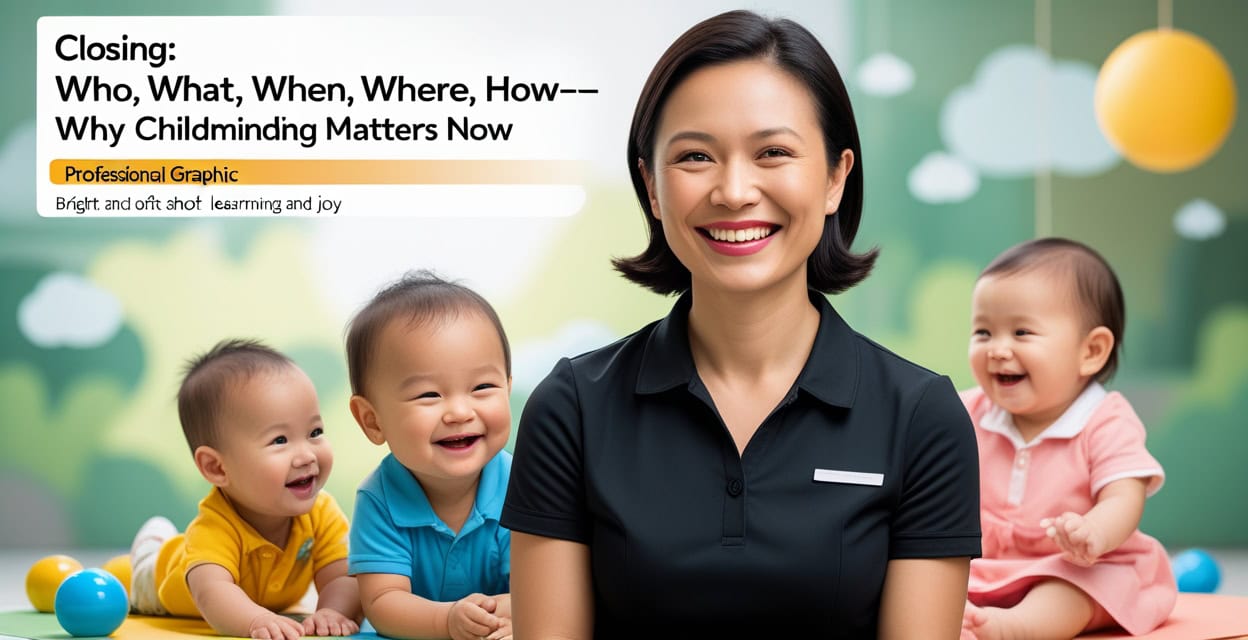
Closing: Who, what, when, where, how—why childminding matters now
- Who: Working families, single parents, caregivers between shifts, grandparents seeking support, and infants who deserve steady eyes and warm hands.
- What: Professional childminding that treats daily care as a living curriculum—attachment, safety, language, movement, and rest woven into ordinary moments.
- When: The vital first thousand days, when the brain writes its most durable code and when parents need reliable care the most.
- Where: Near home—in community and home premises, and in thoughtfully designed centres—calm, clean, transparent environments.
- How: Ultra-low 1:3 ratio; trained, proud childminders; safety by design; transparent technology; and a partnership that centers the parent’s voice.
The philosophy and purpose of EduNanny are simple and profound: to make care small enough to feel like family and strong enough to serve a nation. We exist so parents can work with confidence, infants can grow with joy, and Singapore can keep faith with its future—one quiet feed, one safe nap, one brave first step at a time.
If this is the care you want near your home, we invite you to begin today:
- EduNanny.com
- Childminding.EduNanny.com
EduNanny by BUTLER. Close care. Clear trust. Big futures. Thank you.

Conclusion
EduNanny represents a practical, evidence-based approach to infant care that honours proximity, predictability, and parity across settings. By embedding a thoughtful pedagogy, rigorous safety practices, and a developmental framework—rooted in the first thousand days—we empower families, caregivers, and communities. The Path to better infant care is collaborative: parents share values, childminders uphold professional standards, and the nation benefits from a resilient, capable future generation. Start today by exploring EduNanny options near you, and join a movement that treats care as a civic craft and everyday life as a learning horizon.
[#EduNannySingapore, #InfantCareSingapore, #EarlyChildhoodDevelopment, #ChildmindingPilot, #ECDA]