Cradling the First Thousand Days in Singapore Through Near Home Infant Pods

Our Smallest Citizens, Our Largest Promise: EduNanny Singapore
Good evening, parents, caregivers, neighbors, and partners in the future of Singapore. In a city that moves with precision and pace, there is a quieter clock that sets our true national rhythm: the breath of a sleeping infant, the gaze that finds a trusted face, the tiny hand that reaches for a world worth believing in. Tonight, EduNanny—by BUTLER—introduces a civic promise to cradle those moments with excellence, dignity, and joy. This article expands that promise into practical guidance for families, caregivers, and communities who want to see early childhood care that is near, trustworthy, and transformative.

EduNanny: A New Standard in Singapore
EduNanny by BUTLER is a new standard in infant care and childminding for Singapore. We bring high-quality care near home and near heart, with center-based and home-based options, and even distance support when families need guidance remotely. We operate Monday through Friday, 7am to 7pm, islandwide across community and home premises. We keep an ultra-low, research-informed 1:3 infant ratio. We design modern, light-filled environments. We practice complete transparency with innovative CCTV for live and recorded visibility. And we honor affordability—plans from $33/day—with fees payable by CDA/Baby Bonus. This is part of the ECDA Childminding Pilot and a national social initiative that carries a maximum employment mandate: a model that builds family security while creating dignified jobs in care.
How can families translate this promise into daily decisions? Start by mapping your needs, then aligning with EduNanny’s practices. Here are actionable steps to evaluate and select care that fits your family:
- Define your priorities: safety, flexibility, proximity, language exposure, and a predictable daily rhythm. Create a one-page checklist for visits to compare centers and home settings.
- Ask about the Attunement Loop in practice: how do caregivers observe, acknowledge, respond, and reflect? Request examples of daily notes that show micro-moments of learning and trust.
- Clarify safety commitments: verify staff CPR/First Aid certification, sleep safety protocols, hygiene standards, and how CCTV is used—privacy policies, consent processes, and who can review footage.
- Assess accessibility and affordability: confirm hours, holiday policies, and whether distance support can prevent caregiver burnout during school holidays or illness.

Pedagogy in Motion: Care as Curriculum
At EduNanny, care is not a prelude to learning; it is learning. We treat caregiving routines—feeding, diapering, bathing, settling—as co-regulated dialogues that build a child’s brain and trust. Below are practical ways families and educators can implement this philosophy at home and in care settings.
Attunement Loop: How to Use It Daily
- Observe: Spend 2–3 minutes at the start of a routine watching the child’s cues. Is eye contact preferred? Do they turn away when overstimulated? Record one cue you noticed today.
- Acknowledge: Name the child’s feelings in a simple, age-appropriate way: “You’re curious about the light,” or “You look tired; let’s rest.”
- Respond: Adjust pace, tone, and environment to support autonomy. If a child hesitates, slow down and offer choices (texture, tempo, space).
- Reflect: End with a quick note for tomorrow: how did the child settle, what helped, what to adjust?
Practical home application: create a 20-minute “care as curriculum” block twice daily—once in the morning and once after nap—where you narrate actions, name feelings, and provide safe, low-risk challenges (e.g., stacking cups, finding a hidden toy) that align with the child’s stage.
Environment matters: design spaces that invite safe exploration—low mirrors, textured mats, open baskets with natural materials, soft light, breathable sleep zones, and movement arcs for tummy time and rolling practice. Establish threshold rituals at handovers—eye contact, name, touch, and consent—so transitions feel relational rather than abrupt.
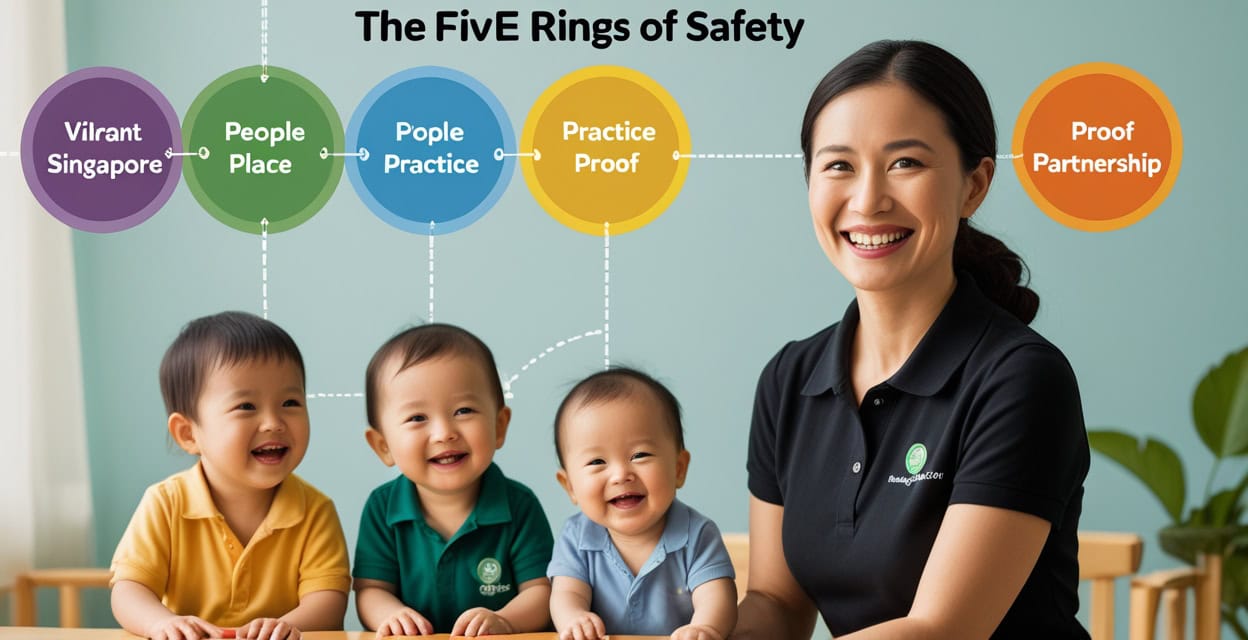
The Five Rings of Safety: People, Place, Practice, Proof, Partnership
Safety must be both felt and verified. Our model is engineered around five rings, each with concrete practices you can inspect or request documentation for during a tour or home visit.
People
- Rigorous selection: background checks, references, and verification of qualifications.
- Infant-first-aid and CPR, ongoing training in safe sleep, hygiene, feeding, and child protection.
- 1:3 ratio to allow vigilant attention without rushing care.
Place
- Modern layouts with defined zones for sleep, feeding, and exploration to minimize risk.
- Non-toxic, wipeable surfaces; secured gates; anchored furniture; good airflow.
- Home-based and center-based environments that meet consistent safety standards.
Practice
- Evidence-based safety protocols (sleep on back, firm cot, no soft bedding).
- Proper bottle preparation and storage; allergy introductions with parent guidance.
- Infection control with enhanced cleaning cycles and hand hygiene practices.
Proof
- Innovative CCTV for transparency, coupled with real-time and recorded logs of care moments.
- Daily session logs: sleep checks, diapering, feeding, and notable milestones.
- Supervisory coaching and feedback using logged data to improve practices.
Partnership
- Daily handover checklists and clear emergency contacts.
- Joint risk assessments for outings and activities.
- Open communication channels so parents know what educators know, when they know it.
Environmental vigilance is also part of safety—for example, monitoring heat and hydration during outdoor time, and adjusting routines for haze or air quality changes. Safety is a culture, not a checkbox.
Development You Can See: Six Threads of the First Thousand Days
Infant development is braided, not linear. EduNanny tracks six threads that weave into sustained growth and form a robust foundation for later learning. Here are practical, parent-friendly insights and tips to support each thread at home and with EduNanny caregivers.
Attachment Security
- Definition: A child’s sense of a reliable, comforting base that invites exploration.
- What to look for: ease of settling after separation, seeking comfort from a familiar caregiver, and returning to a caregiver after social interaction.
- Home tips: establish brief, predictable departures (3–5 minutes) and warm reunions; practice nap transitions with a comforting routine.
Sensory Regulation
- Definition: The child’s ability to manage textures, light, sound, and movement without becoming overwhelmed.
- What to look for: tolerance to new textures, gradual exposure to new environments, calm responses to sensory input.
- Home tips: provide gentle, repeated exposure to varied textures; use slow, rhythmic activities like brushing hands or soft music during routine tasks.
Gross and Fine Motor
- Definition: Development of large movements (crawling, walking) and small movements (grasp, pincer grip).
- What to look for: progression through tummy time, rolling, reaching, transferring objects, finger isolation.
- Home tips: create safe movement spaces; offer age-appropriate toys that promote grasping, transferring, and manipulating objects.
Early Language
- Definition: Warm, contingent, and meaningful verbal interactions; bilingual exposure when appropriate.
- What to look for: responsive vocalizations, babbling in two languages, storytelling during daily routines.
- Home tips: narrate routines, label objects in multiple languages, sing lullabies and rhymes; read daily at child’s eye level.
Social Engagement
- Definition: Beginning cooperation, shared attention, and proto-conversation.
- What to look for: reciprocal smiles, shared play, simple turn-taking gestures.
- Home tips: model social games like peekaboo, idea of “your turn/my turn,” and gentle shared activities with family members.
Emerging Executive Function
- Definition: Foundational skills like focus, waiting, and flexible thinking.
- What to look for: ability to wait briefly, follow simple routines, show curiosity with problem-solving during play.
- Home tips: use short activity blocks with predictable endings; practice “one more” games to build patience; provide safe choices to foster autonomy.
A sample morning might include a gentle hello ritual, a five-minute sensory exploration tray, a short outdoor window when weather permits, floor-based gross motor practice, and a story-singing circle before an unhurried settling routine. We practice “follow the child, frame the day”—right-sized stimulation within stable rhythms.

Happiness as a Safety Signal: Joy, Belonging, and Family Partnership
In infancy, happiness is measurable: a relaxed body, bright eyes, rhythmic breathing, and curiosity that returns after comfort. We treat joy like a vital sign, and we use family partnership to amplify well-being.
Wellbeing Index
- Definition: A simple, ongoing assessment of affect, appetite, engagement, and sleep quality.
- How to use it: note patterns across several days; if stress signs persist, consult the caregiver to adapt routines or activities.
Family Partnership
- Three-minute reunions: slow, attuned handovers that honor the child’s need to reconnect with family first.
- Narrative updates: share small stories from the day to highlight milestones and preferences.
- Culture in care: invite family traditions, lullabies, and heritage rituals to be part of daily routines.
Joy is not an extra; it is evidence of nervous system safety and a predictor of learning. When families feel confident about the care environment, children flourish with fewer stress responses and longer attention spans during play and exploration.

The Purpose and Profession of Childminding: A Singapore Care Corps
Childminding is a profession, a vocation, and a public good. EduNanny’s model elevates childminders with fair pay, structured training, and a clear career ladder—from trainee to lead childminder to mentor and center supervisor. Through the maximum employment mandate, we are building a Singapore Care Corps—creating dignified jobs, upskilling neighbors to serve neighbors, and strengthening the social fabric that surrounds each child.
Near-home care saves families time, reduces commute emissions, and returns precious minutes to the morning hello and the bedtime story. It is city planning in miniature: human-centered, community-rooted, and economically sensible. Use these prompts to discuss career growth with EduNanny tutors or recruiters during visits or online:
- What pathways exist for professional development within EduNanny?
- What qualifications are required for lead caregiver roles, and how are they supported financially?
- How does EduNanny support ongoing coaching and mentorship in homes and centers?
How EduNanny Makes Infant Care and Childminding Great in Singapore
We meet families where they live. With center-based and home-based options, islandwide coverage, and a commitment to compatibility with family schedules, EduNanny aims to be as accessible as it is excellent.
Practical guidance for families evaluating EduNanny options:
- Visit both a center-based and a home-based setting to compare environments and routines.
- Ask to observe a handover and a sample day to see the Attunement Loop in action.
- Request a sample daily log and a recent Wellbeing Index snapshot to understand how care is tracked.
- Discuss privacy and consent for CCTV usage and data storage; ask about who has access to footage.
Practical Tips for Families Visiting EduNanny
- Prepare a family care book with your child’s routines, dietary needs, and comfort items; share it during the first visit.
- Bring a photo or a small keepsake to help your child feel secure during transitions.
- Ask for a trial week: agree to a 2–3 day trial in which you can observe how routines are conducted and how your child responds.
- Request a bilingual language plan if your home uses more than one language; ensure caregivers are prepared to support multilingual development.
A Day in the Life: A Brief Vignette Extended
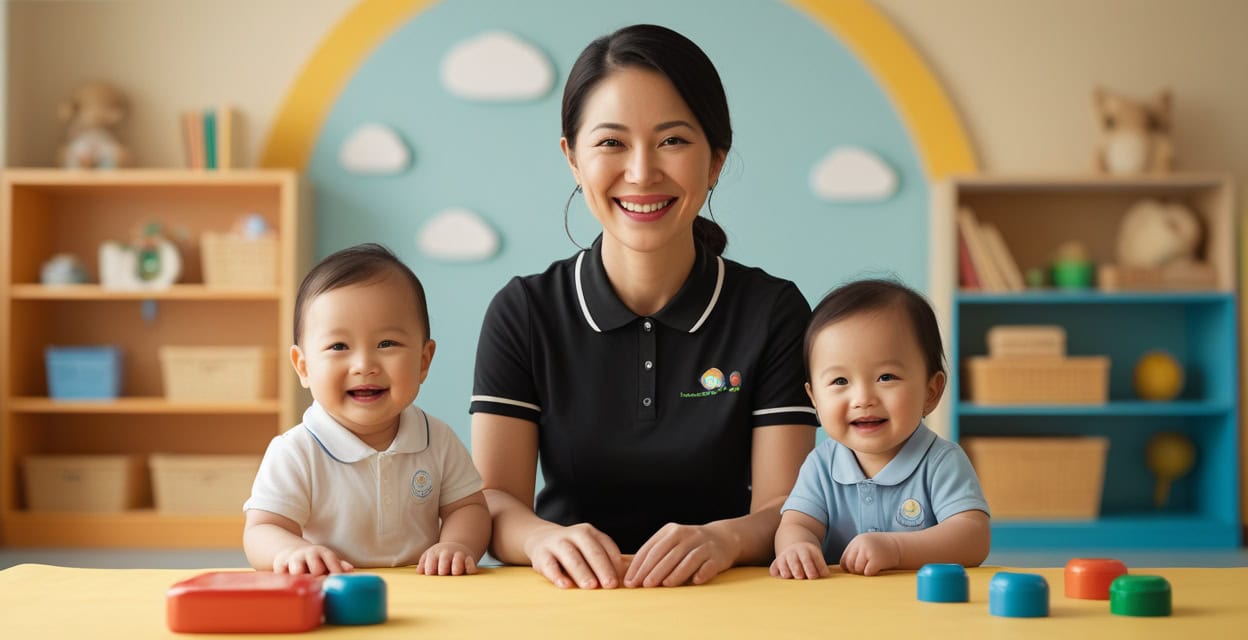
At 7:42am, a parent kneels to their baby’s eye level at the doorway. The childminder says the child’s name softly, waits for eye contact, and opens her hands. A smile, a lean forward, a gentle transfer—no rush. The morning unfolds: tummy time with a textured cloth, a tune sung in two languages, a moment of frustration acknowledged and supported, a nap on a firm, clear cot with regular checks logged on CCTV time stamps. At 5:18pm, reunion. The child beams; the childminder steps back. Three minutes of parent-child reattachment before a concise handover: “He explored the bell twice, enjoyed the cool breeze at 10am, settled easily after a story.” Ordinary magic. Science made tender.
Expanded practical example for families to emulate at home:
- Morning drop-off ritual (3 minutes): greet by name, offer a comforting touch, and release with a brief, positive signal (e.g., “See you after lunch!”).
- Mid-morning play: a short, safe exploration path with a sensory tray; document a micro-moment like “looked at the bell, reached for it, smiled.”
- Lullaby and nap routine: 5–7 minutes of quiet routine with consistent cues to reinforce secure sleep associations.
- Evening reunion: a two-minute reconnect before sharing highlights from the day, then a transition to bedtime routines at home.

Why This Matters—Now
We live in an era where parents strive to do right by their children while sustaining careers and caring for elders. The distance between home and quality care cannot be a gulf crossed by stress; it must be a short, dependable bridge. When care is close, consistent, and transparent, parents breathe easier, infants thrive sooner, and communities grow stronger.
Key takeaways for families considering EduNanny:
- Care is a partner to parenting, not a substitute for it. Seek settings that support your family’s routines and values.
- Proximity matters: near-home care reduces commute time, stress, and missed mornings or stories at bedtime.
- Transparency builds trust: understand how care is logged, who can review footage, and how privacy is protected.
- You are part of a national initiative: EduNanny’s model contributes to workforce development and social cohesion by elevating care as a public good.

Practical Details You Can Count On

Closing: Who, What, When, Where, How—Because Childminding Matters
Who: Singapore’s infants and toddlers—and their parents who deserve trust, time, and peace of mind. Childminders who deserve respect, training, and a profession with purpose.
What: High-quality, near-home infant care and childminding with a 1:3 ratio, transparent safety, and a living curriculum grounded in attachment, play, and development.
When: The hours that matter to working families—Monday to Friday, 7am to 7pm—so mornings begin smoothly and evenings reunite joyfully.
Where: In your neighborhood—center-based environments and carefully prepared home settings—so care is not a commute but a community.
How: Through excellence you can see—modern layouts, vigilant protocols, innovative CCTV, trained professionals—and affordability that welcomes every family, supported by CDA/Baby Bonus.
And why? Because the first thousand days are not just a chapter in a child’s life; they are the table of contents for everything that follows. If we get these days right—if we make care close, safe, joyful, and attuned—we do more than support parents. We seed resilience, empathy, curiosity, and confidence in a new generation of Singaporeans.
Tonight, I invite you to hold this promise with us. Visit EduNanny.com or Childminding.EduNanny.com. Walk through a space. Meet a childminder. Watch a handover ritual. Feel the difference that care-as-curriculum makes. Choose center-based, home-based, or distance support—whatever your family needs this season. And know that with EduNanny by BUTLER, your child’s ordinary day is treated like Singapore’s most important work.
Our smallest citizens are waiting. Let’s build, with steady hands and open hearts, the future they deserve.

Conclusion
EduNanny’s model tethered to research-based care, transparent safety, and family partnership offers practical pathways for families to navigate early childhood care with confidence. By focusing on the first thousand days as a living curriculum, we empower infants to grow with attachment, curiosity, and resilience. For parents, the message is clear: seek care that is near, respectful, and responsive; demand documentation that demonstrates safety and progress; and engage in the daily rituals that reinforce trust between home and care. For communities, EduNanny represents a scalable approach to building dignified jobs and a stronger social fabric around every child. If you are evaluating options for your family, begin with a tour, ask the right questions, and imagine how close care can be to home—and to your heart.
Take the first step today: visit EduNanny.com or Childminding.EduNanny.com, walk through a space, meet a caregiver, and observe a handover ritual. Choose the model that fits your child and your schedule, and join us in shaping a future where every infant has a secure base and every family has the support they need to thrive.
[#keyword1, #keyword2, #keyword3, #keyword4, #keyword5]