
EduNanny Singapore A Pedagogy of Attachment, Play, and Public Purpose

EduNanny Singapore: A Pedagogy of Attachment, Play, and Public Purpose
Good evening, families, caregivers, partners, and champions of Singapore’s youngest citizens. This article expands the vision you heard in the speech, translating pedagogy into practical action for parents and caregivers, and outlining how EduNanny translates timeless child development principles into a modern, Singapore-ready service. Built on Montessori respect for the child, Pikler’s trust in free movement, Vygotsky’s social learning, Bowlby’s secure attachment, Piaget’s discovery through play, Erikson’s stages of trust and autonomy, Froebel’s reverence for play, Spock’s humane common sense, and Malaguzzi’s concept of a hundred languages, EduNanny makes these traditions actionable, transparent, and accessible to every family.

What is EduNanny?
EduNanny is a national standard for dignified childminding—center-based, home-based, and distance-guided—designed for Singapore’s rhythms and realities. It represents a continuum of care that is:
- Mon-Fri support, 7am–7pm across islands, in community and home premises.
- 1:3 infant ratio with a primary caregiver system to build secure attachment.
- Transparent by design with opt-in CCTV for peace of mind and coaching data for teams.
- Modern, calm environments designed to be cognitively rich and physically safe.
- Affordable care from $33/day, with CDA/Baby Bonus payments where eligible.
- EduNanny by BUTLER—an integrated service accessible at EduNanny.com and Childminding.EduNanny.com, aligned to ECDA pilots and Singapore’s family-work resilience goals.
This is not only a care model; it is a holistic ecosystem that supports families, commercially viable care networks, and a workforce of trained childminders. It bridges the best of international child development science with Singapore’s unique family and work realities.

First theme: Attachment is architecture, not sentiment
In the first year of life, the brain architects its own security system. Drawing on Bowlby, EduNanny builds reliable relationships through a primary caregiver model within a 1:3 infant ratio. The result is secure attachment, smoother sleep, calmer feeding, and a child who learns that the world is predictable and safe. Here are practical actions you can apply at home or in a EduNanny setting:
- Consistency matters: assign a primary caregiver for a baby’s daily routine. Even in group settings, ensure a familiar caregiver handles the baby’s key moments—feeding, soothing, and diapering.
- Structured transitions: pre-enrolment home calls, day-one familiar scents (a cloth, a blanket), and brief, scaffolded separations during the first week for gentle adjustment.
- Reading micro-cues: train caregivers to observe lip smacks (hunger), gaze aversion (overstimulation), and clenched fists (fatigue), enabling proactive regulation.
- Consistent soothing voice and touch: use the same calm tone and attuned hand placement to establish a reliable safety signal for the infant.
- Home-family collaboration: daily exchanges of a small “watch-this” note or photo to reinforce a familiar caregiving rhythm at home.
Actionable takeaway for parents: ask potential care providers how they manage primary caregiving, looping videos or photos of the day-to-day quiet, consistent routines, and whether staff turnover is minimized in the first year.

Second theme: Tiny discoveries, serious pedagogy
Even a six-month-old is learning through exploration and social interaction. EduNanny translates Piaget’s discovery and Vygotsky’s social learning into micro-doses of developmentally appropriate experiences:
- Floor time over containers: prioritize child-led, floor-based play to strengthen posture, motor control, and gaze-following.
- Treasure baskets rotating with texture: metal, wood, fabric, and natural objects invite inquiry into weight, temperature, texture, and sound.
- Rich language narration: narrate daily activities—“I’m warming your milk now; you hear the hum?”—to embed vocabulary in routine care.
- Bilingual songs in natural contexts: songs layered with meanings build rhythm and early language in both Mandarin and English (or other local languages) through everyday moments.
- Documenting learning through observation: prefer ongoing notes over rigid schedules; spontaneity is a key curriculum element for infancy.
- Safe, purposeful materials: when a baby bangs or mouths objects, replace with a safe chewable or drum to channel exploration responsibly.
Actionable takeaway for parents: create a home “discovery basket” with everyday items (wooden spoon, fabric square, smooth seed pods) and set a daily 10-minute window for guided exploration, with caregiver narration about the infant’s choices and reactions.

Third theme: Safety is a system you can see
Parents want proof, not promises. EduNanny’s safety framework is highly visible and auditable, designed to protect babies and give families confidence:
- Sightlines and distinct zones: layout spaces so staff can supervise at all times, with separate sleep, feed, and play zones to minimize cross-contamination and confusion.
- Safe sleep rigor: firm cot, fitted sheet, supine position, no loose items, temperature checks, and documented monitoring.
- Feeding safety protocols: correct bottle preparation, milk tracking, allergen handling, and paced feeding to prevent choking.
- Airway safety and first aid: hands-on CPR and first aid for all childminders, with regular refreshers.
- Hygiene cycles: handwashing choreography, cleaned surfaces, toy rotation, and clear clean/dirty pathways inside spaces.
- Emergency readiness: daily safety checklists and periodic evacuation drills that practice calm exits with babies secured in arms.
- Opt-in CCTV transparency: privacy-respecting video updates that support coaching and family peace of mind.
Actionable takeaway for parents: ask about the safety drills performed, the cadence of safety audits, and how spaces are redesigned if a child has heightened needs or a new caregiver joins the team.
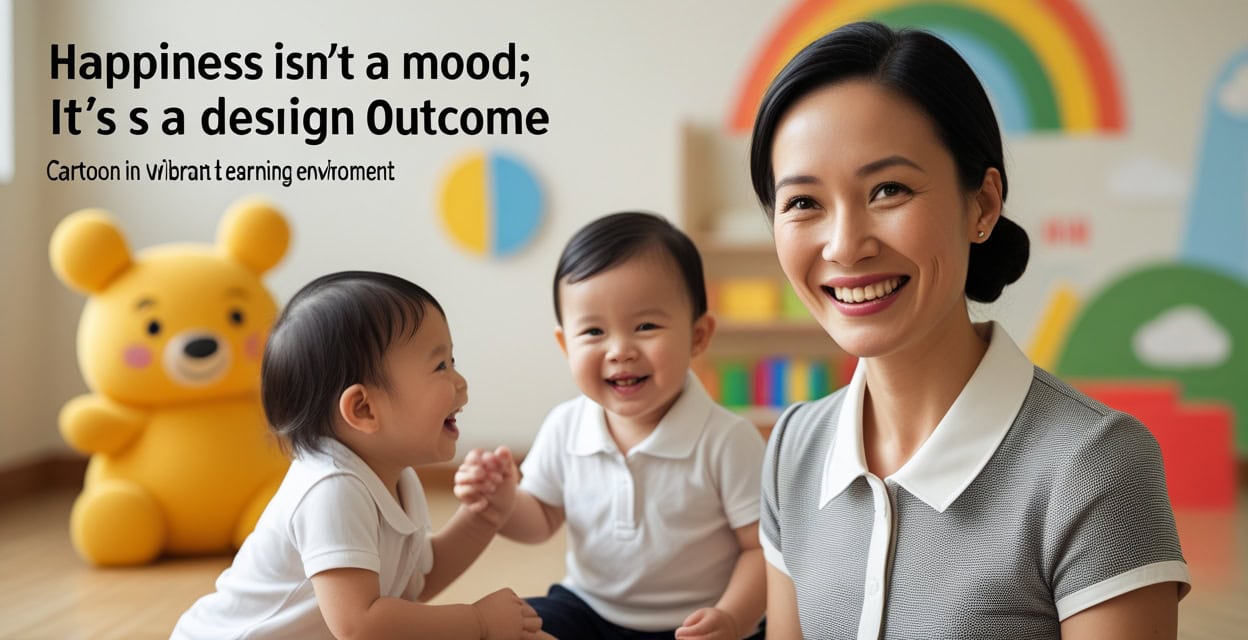
Fourth theme: Happiness isn’t a mood; it’s a design outcome
EduNanny links happiness to structured design that supports trust and autonomy. Erikson’s early tasks translate into daily routines that feel secure and respectful:
- Unhurried mornings: calm greetings, no rushed handovers, and a predictable wake-time ritual.
- One-on-one diaper change as time-in: narration and gentle touch turn diapering into intimate caregiving rather than a task.
- Unrestrained movement: safe space for baby-led exploration and self-initiated movement, with rotation that respects fatigue and recovery times.
- Balanced sensory diet: ample natural light, soft soundscapes, and controlled quiet moments to hear one’s own coos.
- Well-being indicators: daily affect range, engagement time, distress recovery, feeding ease, sleep quality, and caregiver-child synchrony.
- Family partnership: daily logs, photos, reflective notes, live check-ins, and weekly “tiny triumphs” debriefs to sustain collaboration.
Actionable takeaway for parents: foster a predictable, gentle routine at home that mirrors the care setting—this reduces transitions, supports bonding, and creates a shared language of wellbeing between family and caregiver.

Fifth theme: The social purpose of childminding in Singapore
High-quality childminding is a public good—training a dignified workforce, supporting families, and strengthening community cohesion. EduNanny anchors this as a National Social Initiative:
- Professionalizing the workforce: dignified employment with training and ongoing coaching, ensuring care standards rise with expertise.
- Local access and reduced commute: services near homes and workplaces to ease caregiver burden and increase community bonds.
- Affordability and policy alignment: fees from $33/day, with CDA/Baby Bonus support where eligible.
- SME and network enablement: a care network that supports small and medium enterprises while maintaining high standards.
Actionable takeaway for policymakers and employers: recognize childminding as essential infrastructure—like transit and housing—so policies encourage stable employment, affordable access, and robust safety standards that empower families to participate in the workforce.

How EduNanny makes infant care great—operationally and accessibly
- Excellence and quality across center-based, home-based, and distance-guided models
- Islandwide availability, Monday–Friday, 7am–7pm for true convenience
- A protective 1:3 infant ratio and a primary-caregiver approach for secure attachment
- Modern layouts, calm environments, and opt-in innovation CCTV for transparency
- Affordable options from $33/day; fees payable by CDA/Baby Bonus where eligible
- EduNanny by BUTLER platform with easy scheduling at EduNanny.com and Childminding.EduNanny.com
- A childminding pilot spirit aligned with ECDA guidelines and national goals for inclusion, safety, and employment
Practical guidance for parents selecting EduNanny services:
- Ask for a guided tour of the space—observe sightlines, sleep areas, and how transitions are managed.
- Request a demonstration of the primary caregiver handover process, including the use of daily logs and photos.
- Inquire about safety drills, first-aid certification expiry dates, and child-specific safety plans (allergies, medical needs).
- Discuss language exposure and how bilingual or multilingual routines are embedded into daily care.
- Clarify fee structures, subsidies, and how CDA/Baby Bonus credits are applied to your account.

Let me paint a day in the life
A mother in Punggol begins her shift confident that her 9-month-old has the same caregiver who settled him yesterday. Drop-off is slow and warm—she lingers, hears a familiar song, and receives a short reassurance: “He slept long last night? We’ll watch his wake window for a slightly later nap.” A message an hour later shows tummy time with a posting activity; a note celebrates his first two-finger pincer grasp on a soft ring. Midday, the team logs a paced feed and a 45-minute nap in a dim, cool room. In the afternoon, a nature basket appears: smooth seed pods, cool spoons, soft cloth—supervised exploration. Before pick-up, the caregiver shares a micro-observation: “He turned away when it got loud, so we created a quiet nook—he quickly returned to play.” That is the pedagogy of presence—the daily praxis that lets parents exhale at work.
Every detail matters: the environment is calm, the caregiver speaks with intention, and the baby’s world feels safe enough to explore. The day is not a checklist; it is a choreography of care where relationships lead curiosity and safety enables discovery.

Training matters
EduNanny training is practical and ongoing. Childminders are coached to:
- Notice rather than rush; invite rather than direct.
- Prepare environments so spaces “teach” without taking attention away from the child.
- Document learning without interrupting the child’s focus.
- Plan for safety, practice for emergencies, and build trust with small, consistent actions.
- Balance innovation with human connection; technology serves relationships, not replaces them.
Practical guidance for caregivers: engage in regular reflective practice, review incident logs, and participate in coaching sessions that model responsive, developmentally appropriate caregiving strategies.

The heart of the matter: Who, what, when, where, and how childminding truly matters
Who does childminding serve?
- The infant—the citizen in formation, whose brain and heart are shaping a lifelong trajectory
- The parent—whose confidence at work and peace at home depend on reliable, respectful care
- The caregiver—whose skilled labor deserves dignity, training, and fair employment
- The community—whose cohesion grows when care is local, safe, and seen
What is childminding at its best?
- Attachment made visible, pedagogy made gentle, safety made routine, joy made daily
- Spaces and moments structured to support development at the child’s pace
When does it matter?
- Now—the first thousand days when neural connections are most plastic and protective relationships leave lifelong footprints
Where should it happen?
- Center hubs modeling excellence
- Home settings that keep care familiar and accessible
- Islandwide options to ensure real choice for families
How is it done well?
- Clear standards, continuous training, low ratios, and high transparency
- Thoughtful design, reliable hours, accessible fees
- Humility: observe first, then act; read the child’s body before imposing adult plans
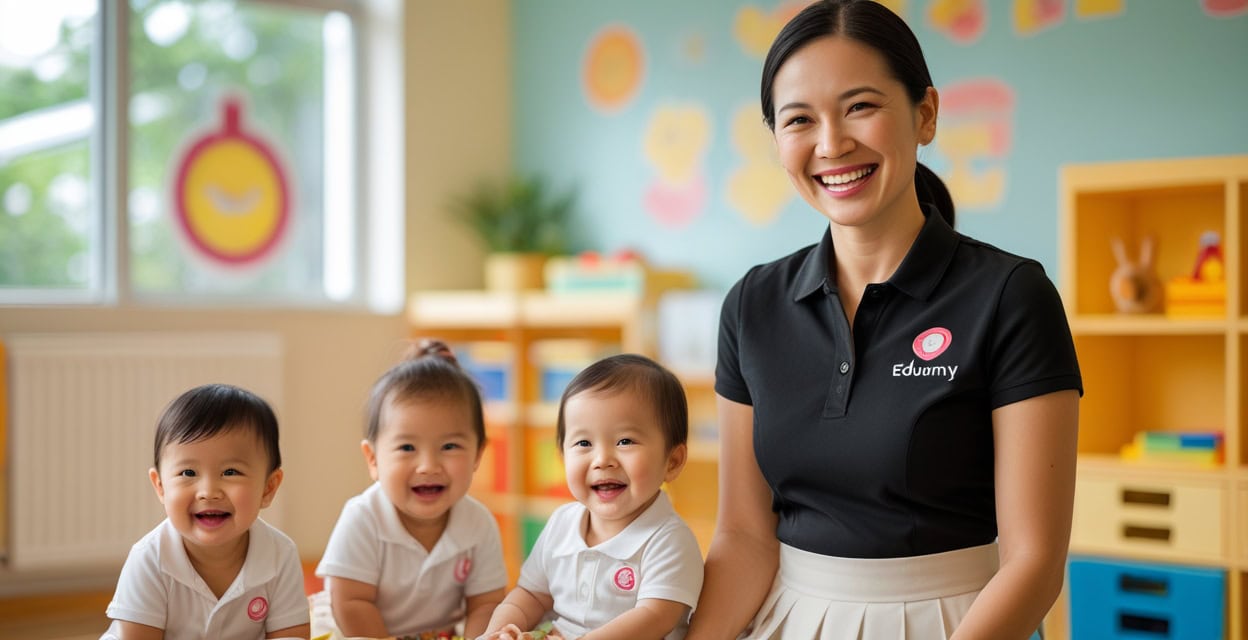
EduNanny’s philosophy and purpose
EduNanny is built on a simple but powerful premise: protect the bond, prepare the environment, practice safety as culture, and partner with families so that every infant’s day is held with dignity and delight. Our promise is presence, not perfection; our advantage is competence, not only cost; our innovation is the choreography of care—refined daily through data-informed coaching and a deep commitment to human connection.

Conclusion
EduNanny is more than a care model; it’s a national statement about how Singapore can nurture its youngest citizens while supporting families and empowering caregivers. By centering attachment, curious learning, safety, happiness, and social purpose, EduNanny translates timeless child development wisdom into practical infrastructure for modern life. If you’re a parent, consider a daily life for your baby that is slow enough for discovery and strong enough for safety. If you’re a caregiver, embrace a profession where attentiveness is expertise and steadiness is science. If you’re an employer or policymaker, view childminding as essential infrastructure—integral to a resilient workforce and a cohesive society.
Singapore’s infants will not remember our speeches. They will remember, through the steadiness of our care, the sense that the world is safe enough to explore. That is the quiet power of EduNanny: a daily habit of presence that makes every feed a conversation, every nap a sanctuary, every play a lesson, and every handover a handshake of trust. To learn more or to enroll, visit EduNanny.com or Childminding.EduNanny.com. To work with us, to host a home-based site, or to start a community hub, speak to our team. Together, we can make excellent care commonplace—center-based, home-based, and distance-supported—Monday through Friday, 7am to 7pm, islandwide, affordable, and dignified.
A final thought, from infant to nation: when we attune to the smallest signals, we build the largest possibilities. Let’s build them—safely, joyfully, and with purpose—one attentive moment at a time.
SEO keywords: [#EduNannySingapore, #earlychildhooddevelopment, #infantcare, #attachmenttheory, #childmindingpolicy]